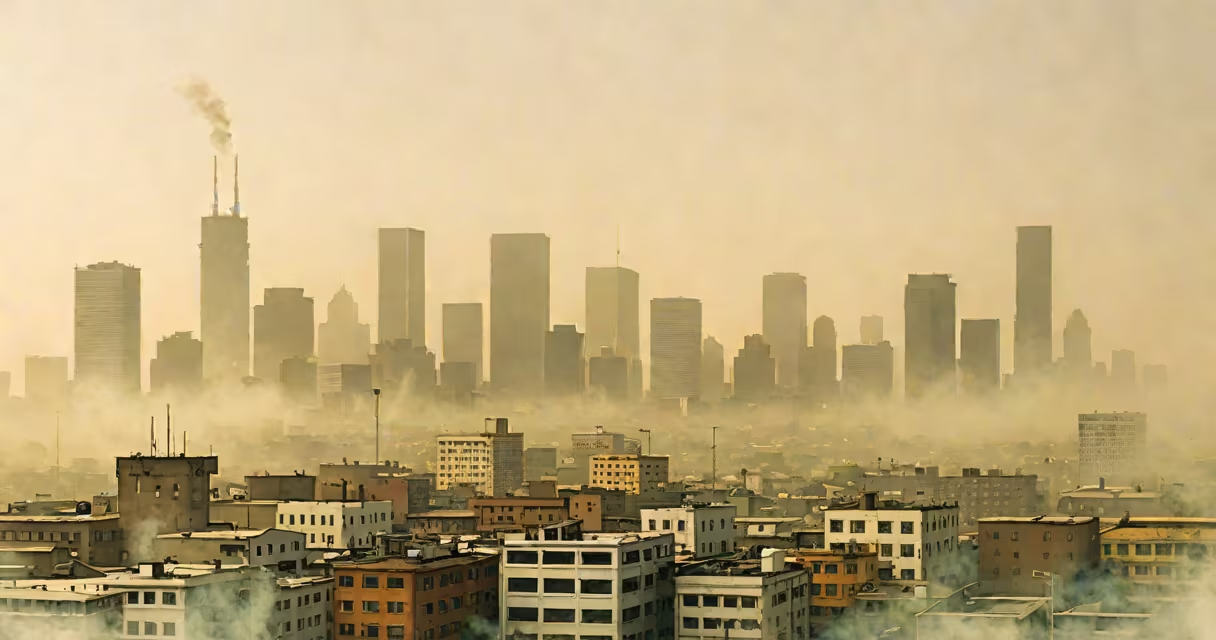
Air pollution damages human health, harms ecosystems, and accelerates climate change. It triggers respiratory and cardiovascular diseases, reduces life expectancy, and disrupts weather patterns. Long-term exposure increases cancer risk and contributes to global warming through greenhouse gas emissions.
Particulate matter (PM2.5), nitrogen dioxide (NO₂), ground-level ozone (O₃), and sulfur dioxide (SO₂) are primary pollutants. They enter the lungs and bloodstream, causing inflammation and tissue damage. The World Health Organization (WHO) identifies outdoor air pollution as a leading environmental cause of death globally, responsible for 7 million premature deaths annually.
Urban areas with high traffic density and industrial zones face elevated levels. In Delhi, India, daily average PM2.5 concentrations exceed 150 µg/m³ during winter-over 15 times the WHO's recommended limit of 10 µg/m³. This level correlates with a 30% increase in hospital admissions for asthma and bronchitis among children under 12.
When inhaled, fine particles (PM2.5) penetrate deep into lung alveoli and cross into the bloodstream. They trigger systemic inflammation linked to heart attacks, strokes, and type 2 diabetes. A 2021 study published in *The Lancet Planetary Health* found that people living in areas with high PM2.5 exposure had a 16% higher risk of dying from cardiovascular disease compared to those in low-exposure regions.
Ozone, formed when sunlight reacts with vehicle exhaust and industrial emissions, irritates airways. It reduces lung function by up to 10% in healthy adults during peak summer days. Children and elderly individuals show greater sensitivity. In Los Angeles, schools often close during high-ozone alerts due to increased emergency room visits for respiratory distress.
Long-term exposure leads to chronic conditions. A 2019 cohort study in *Environmental Health Perspectives* tracked 100,000 residents across 15 U.S. cities. Those exposed to average annual PM2.5 levels above 12 µg/m³ had a 22% higher incidence of lung cancer over 15 years, even after adjusting for smoking status.
Acid rain, caused by sulfur dioxide and nitrogen oxides reacting with water vapor, degrades forests and freshwater systems. In the northeastern United States, acid deposition has reduced soil pH below 4.5 in over 20% of forested watersheds. This leaches essential nutrients like calcium and magnesium, weakening tree roots and increasing susceptibility to pests.
Ozone also harms plant growth. It damages leaf cells, reducing photosynthesis efficiency. Field trials in California showed that crops like wheat and soybeans exposed to ambient ozone levels experienced yield losses of 15-20%. At current regional concentrations, this translates to $1 billion in annual agricultural losses across the Central Valley alone.
Marine environments suffer too. Nitrogen compounds from atmospheric deposition contribute to eutrophication in coastal zones. In the Gulf of Mexico, excess nitrogen runoff fuels algal blooms that create dead zones-areas with oxygen levels too low to support fish. These zones expanded by 30% between 1990 and 2020, affecting fisheries and local economies.
Some air pollutants act as greenhouse gases. Carbon dioxide (CO₂) from fossil fuel combustion accounts for 75% of global warming since pre-industrial times. Methane (CH₄), released from landfills and livestock operations, has 28 times the heat-trapping potential of CO₂ over a 100-year period.
Black carbon-a component of soot from diesel engines and biomass burning-absorbs solar radiation and warms the atmosphere. It also deposits on snow and ice, reducing reflectivity and accelerating melting. Research from NASA's Atmospheric Chemistry and Dynamics Laboratory shows black carbon contributes to 20% of Arctic warming since 1900.
Contrastingly, certain aerosols like sulfate particles cool the planet by reflecting sunlight. However, their cooling effect is temporary and uneven. When emissions decline, temperatures rise rapidly. This creates a false sense of stability and delays necessary climate action.
Many assume indoor air quality is safer than outdoor air. But indoor levels of volatile organic compounds (VOCs) from cleaning products, paints, and furniture can exceed outdoor concentrations by 2-5 times. A 2020 EPA report found that indoor formaldehyde levels in newly renovated homes averaged 100 µg/m³-well above the safe threshold of 50 µg/m³.
Another myth is that air pollution only affects urban centers. Rural populations near agricultural fields or industrial corridors face similar risks. In Iowa, farmers using nitrogen-based fertilizers report higher rates of asthma and bronchitis during spring application seasons. Nitrogen oxide emissions from fertilizer volatilization contribute to regional ozone formation.
Finally, some believe air quality improves naturally over time. But without regulation, pollution levels remain stable or worsen. In Beijing, despite economic growth, PM2.5 levels dropped only after strict emission controls were enforced in 2013. Before that, average levels hovered around 100 µg/m³-more than ten times the WHO guideline.
In December 1952, a temperature inversion trapped coal smoke and fog over London. Over four days, pollutant levels spiked to 1,200 µg/m³ for PM10. The event caused approximately 12,000 excess deaths within weeks. Autopsies revealed widespread lung damage and cardiac strain. This tragedy led to the UK's Clean Air Act of 1956, which banned domestic coal burning and mandated smokeless zones.
The episode remains a benchmark for understanding acute pollution impacts. It demonstrated that air pollution is not just a gradual threat-it can cause rapid, mass mortality when conditions align.
| Pollutant | Primary Sources | Health & Environmental Impact |
|---|---|---|
| PM2.5 | Vehicle exhaust, power plants, wildfires | Heart disease, lung cancer, reduced birth weight |
| Ozone (O₃) | Sunlight reacting with NOx and VOCs | Reduced lung function, crop yield loss |
| NO₂ | Gasoline/diesel vehicles, heating systems | Worsened asthma, increased respiratory infections |
| SO₂ | Coal-fired power plants, refineries | Acid rain, respiratory irritation |