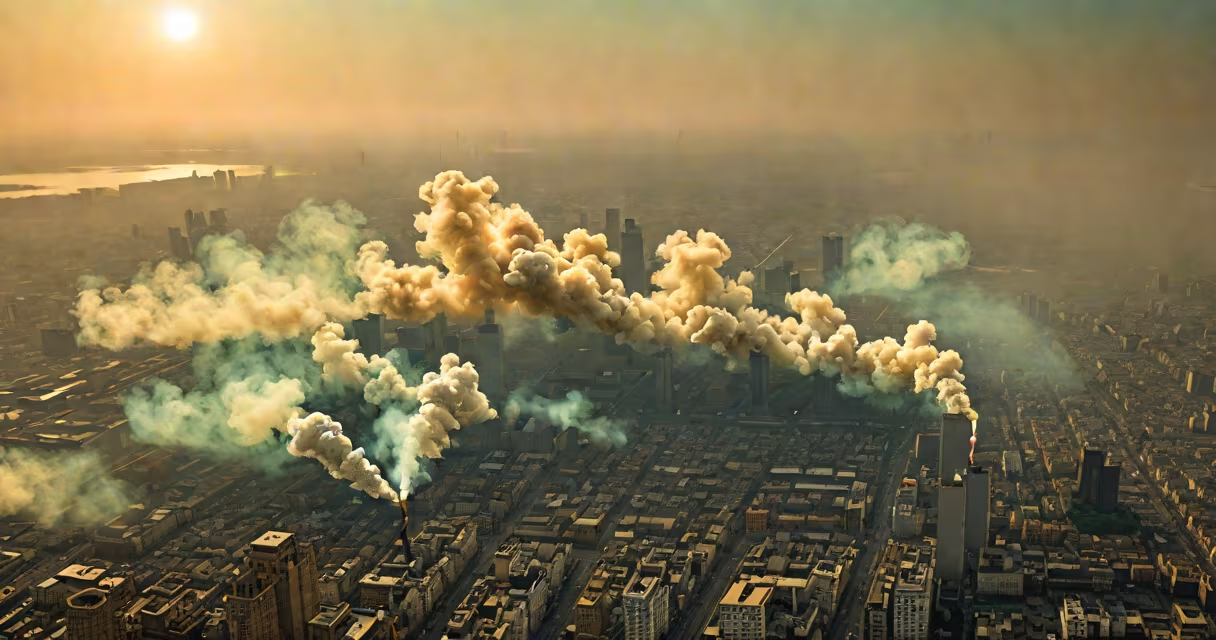
Air pollution refers to harmful substances in the atmosphere that degrade air quality and threaten human health, ecosystems, and climate stability. These pollutants originate from industrial emissions, vehicle exhaust, fossil fuel combustion, and natural events like wildfires. The World Health Organization (WHO) identifies air pollution as a leading environmental cause of death worldwide.
Primary pollutants include nitrogen oxides (NOx), sulfur dioxide (SO₂), carbon monoxide (CO), ground-level ozone (O₃), and particulate matter (PM2.5 and PM10). Secondary pollutants form when primary pollutants react in sunlight, such as ozone, which results from NOx and volatile organic compounds (VOCs) combining under UV light. The U.S. Environmental Protection Agency (EPA) tracks these compounds through the Air Quality Index (AQI), which categorizes daily air quality from "good" to "hazardous."
Urban centers experience higher concentrations due to traffic density and industrial activity. For example, Delhi, India, recorded an average PM2.5 level of 143 µg/m³ in 2023-over 28 times the WHO's recommended annual limit of 5 µg/m³. In contrast, rural areas often see lower levels, though seasonal wildfires can spike pollution temporarily. Monitoring stations in cities like Los Angeles and Beijing report consistent exceedances of safe thresholds during winter months due to temperature inversions trapping pollutants near the surface.
Chemical reactions in the atmosphere drive secondary pollution formation. Sunlight triggers photochemical smog when NOx and VOCs interact, producing ground-level ozone. This process peaks in late afternoon during summer months. A single thunderstorm can disperse pollutants across regions-particles from a wildfire in Canada reached New York City within 48 hours in June 2023, elevating the AQI to "unhealthy" levels.
Wind patterns and atmospheric stability determine pollutant dispersion. Inversions trap cold air beneath warmer layers, preventing vertical mixing. This phenomenon occurs frequently in valleys like Salt Lake City, Utah, where winter inversions persist for days, concentrating pollutants. Satellite imagery from NASA's MODIS instrument shows how dust storms from the Sahara Desert travel westward across the Atlantic Ocean, affecting air quality in the Caribbean and parts of South America.
Long-range transport means local pollution can have international consequences. Sulfur dioxide emitted from coal plants in China contributes to acid rain in Japan and the Korean Peninsula. The European Environment Agency reports that 40% of Europe's PM2.5 exposure originates from transboundary sources, highlighting the need for cross-border cooperation in emission control.
Table below outlines major air pollutants, their origins, and associated health risks based on EPA and WHO data.
| Pollutant | Primary Sources | Health and Environmental Impact |
|---|---|---|
| PM2.5 | Vehicle exhaust, power plants, wildfires | Penetrates lungs and bloodstream; linked to heart attacks, stroke, and premature death |
| Ground-level Ozone (O₃) | Reactions between NOx and VOCs in sunlight | Causes respiratory irritation; damages crops and forests |
| Sulfur Dioxide (SO₂) | Coal-fired power plants, refineries | Triggers asthma attacks; contributes to acid rain |
| Nitrogen Oxides (NOx) | Engines, industrial processes | Forms smog and acid rain; worsens lung conditions |
| Carbon Monoxide (CO) | Incomplete combustion in vehicles and heaters | Binds to hemoglobin; reduces oxygen delivery to tissues |
Non-weather-related factors influence pollution distribution. Industrial zones in developing nations often lack scrubbers or filters on smokestacks. In Nigeria, informal waste burning in Lagos generates high levels of dioxins and furans-persistent organic pollutants banned under the Stockholm Convention. Even indoor air can be more polluted than outdoor air; cooking with biomass fuels in poorly ventilated homes leads to elevated PM2.5 exposure, especially among women and children.
Many assume "clean air" means odorless or invisible air. But pollutants like CO and O₃ are colorless and odorless, making them undetectable without instruments. During the 2019-2020 Australian bushfire season, residents reported clear skies while AQI readings exceeded 2,000 in some areas-far beyond hazardous levels. The absence of visible smoke did not indicate safety.
Another misconception is that air pollution only affects people in large cities. Rural populations face significant risks from agricultural burning, wood stoves, and pesticide drift. In California's Central Valley, farm workers exposed to diesel exhaust and pesticide aerosols show higher rates of chronic bronchitis and reduced lung function compared to urban counterparts.
Some believe air quality improves naturally over time. While regulations reduce emissions, recovery takes years. After the Clean Air Act amendments in 1990, U.S. SO₂ emissions dropped by 88% by 2020, yet regional ozone levels remain above national standards in several states. Climate change exacerbates this delay-higher temperatures increase ozone formation, offsetting gains from reduced NOx emissions.
In 2022, researchers analyzed hospital admissions in Beijing during a period of sustained high pollution. Over a 14-day stretch, PM2.5 levels averaged 120 µg/m³-well above WHO guidelines. Data from the Chinese Center for Disease Control and Prevention showed a 27% rise in emergency room visits for asthma and cardiovascular events during those days. For every 10 µg/m³ increase in PM2.5, the risk of hospitalization rose by 1.2%.
This pattern repeats globally. A 2021 study published in *The Lancet Planetary Health* estimated that ambient air pollution caused 6.7 million premature deaths annually-more than HIV, tuberculosis, and malaria combined. The burden falls disproportionately on low- and middle-income countries. In sub-Saharan Africa, 90% of the population breathes air exceeding WHO limits, largely due to reliance on solid fuels for cooking and heating.
I once monitored air quality in a small town in Pennsylvania during a winter inversion. Using a handheld particle sensor, I recorded PM2.5 levels spiking from 15 µg/m³ to 140 µg/m³ within four hours after sunset. Residents reported coughing and eye irritation. The local school delayed outdoor recess. This event confirmed that even modest pollution spikes can trigger immediate health effects, especially in vulnerable groups.