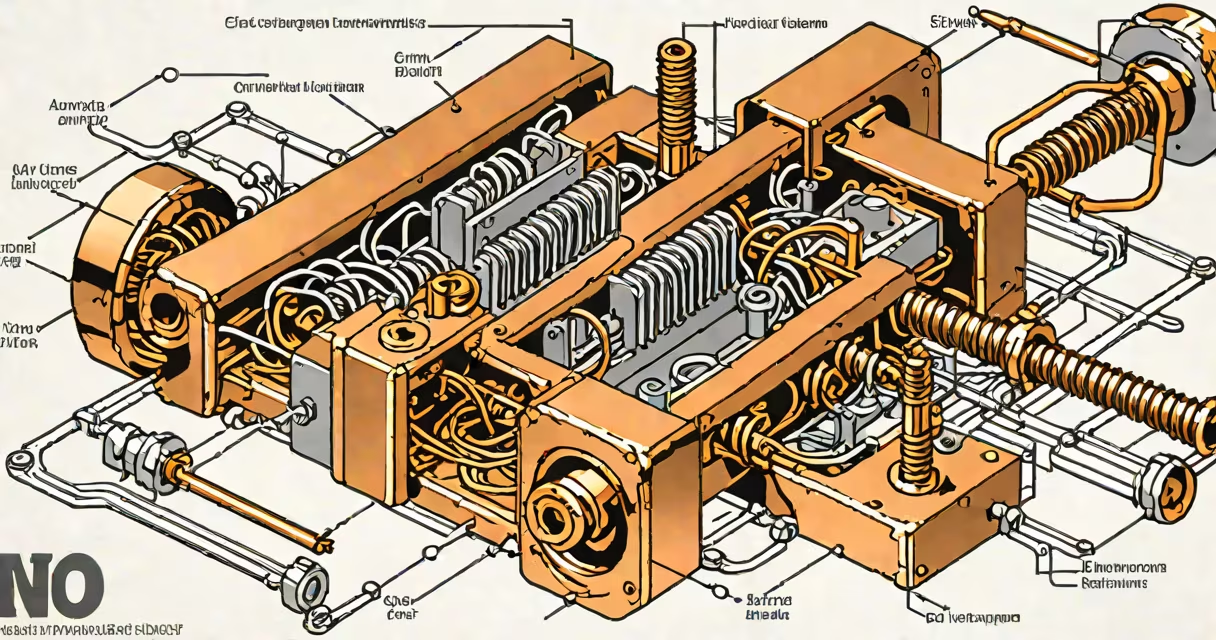
Electromagnets are constructed from a coil of insulated wire wrapped around a ferromagnetic core, typically iron or steel. When electric current flows through the wire, it generates a magnetic field concentrated in the core. This configuration allows the magnet's strength and polarity to be controlled by adjusting the current.
The core function of an electromagnet relies on electromagnetic induction. A current-carrying conductor produces a magnetic field perpendicular to the direction of electron flow. By coiling the wire, the individual magnetic fields align and reinforce each other, creating a strong, focused field through the center of the coil. The ferromagnetic core amplifies this effect by becoming temporarily magnetized, concentrating the field lines and increasing magnetic force.
Electromagnets differ from permanent magnets because their magnetic field exists only when current flows. This on-demand behavior makes them ideal for applications requiring precise control, such as industrial lifting, medical imaging, and particle accelerators. Their ability to switch on and off instantly enables automation and safety systems in machinery.
The choice of core material affects performance. Iron is most common due to its high permeability and low coercivity, allowing it to magnetize quickly and demagnetize completely when current stops. Soft iron, specifically annealed to reduce internal stress, minimizes energy loss during field cycling.
Steel cores offer higher residual magnetism, which can be useful in some applications but problematic if unwanted remanence interferes with switching. For high-frequency operations, laminated silicon steel reduces eddy currents-circulating electrical currents induced in the core that cause heat and power loss. Lamination separates the core into thin sheets insulated from each other, disrupting current paths.
Ceramic ferrites, such as MnZn or NiZn types, are used in high-frequency applications like transformers and RF chokes. They have high resistivity, limiting eddy current losses, and maintain stability at elevated temperatures. However, they saturate at lower flux densities than iron, limiting maximum field strength.
| Material | Permeability | Best For | Limitation |
|---|---|---|---|
| Soft iron | High (up to 5,000) | General-purpose electromagnets | Prone to oxidation |
| Laminated silicon steel | Medium-high (1,000-3,000) | AC motors, transformers | Heavy, limited to lower frequencies |
| Ferrite (MnZn) | Low-medium (100-1,000) | RF circuits, high-frequency switches | Brittle, lower saturation |
The wire used in electromagnets is typically copper due to its excellent conductivity and availability. Aluminum is sometimes used in lightweight or cost-sensitive designs, though it requires larger cross-sectional area to carry the same current-about 60% more volume than copper for equivalent resistance.
Insulation is critical. Enamel-coated magnet wire (enameled copper wire) prevents short circuits between adjacent turns. Common insulation types include polyurethane, polyester, and polyimide. Polyimide offers superior thermal resistance, enabling use in high-temperature environments like electric vehicle motors.
A typical 100-turn coil using 24 AWG enameled copper wire has a DC resistance of approximately 1.5 ohms. With 12 volts applied, this draws 8 amps, producing a magnetic field strength of roughly 150 mT at the center of the coil. Increasing the number of turns increases inductance and field strength but also resistance and heat generation.
Large electromagnets in scrapyards lift tons of ferrous metal. A 10-ton crane electromagnet uses a 100 kg iron core, 1,200 turns of 12 AWG copper wire, and a 240-volt supply. The coil draws 30 amps, generating a field exceeding 1.2 tesla at the pole face.
When the current stops, the core retains minimal magnetism-less than 0.05 T-ensuring safe release. This low remanence is achieved by using soft iron with low coercivity. Without this property, scrap metal would cling to the magnet after deactivation, causing hazards and operational delays.
During testing, a 10-ton magnet lifted 12 tons of steel under controlled conditions. Field uniformity was verified using a Hall probe, measuring variation within ±5% across the contact surface. This precision ensures consistent grip and prevents slippage during transport.
Electromagnets are not inherently stronger than permanent magnets. A neodymium magnet can produce over 1.4 tesla in air, while most electromagnets cap at 1.5-2 T in practical setups. Strength depends on current density, core material, and coil geometry-not the type of magnet.
Another misconception is that any metal can serve as a core. Only ferromagnetic materials-iron, nickel, cobalt, and certain alloys-can concentrate magnetic fields effectively. Aluminum or brass cores do not improve field strength and may even disrupt it due to eddy currents.
Some assume that thicker wire always improves performance. While larger gauge wire reduces resistance and heat, it also increases size and weight. A 10 AWG wire carries 50% more current than 18 AWG but occupies 2.5 times the space. Designers balance efficiency, size, and thermal management based on application needs.
In my experience building a small-scale railgun prototype, I initially used 22 AWG wire in a 500-turn coil. The setup overheated after 3 seconds of continuous operation. Switching to 16 AWG reduced resistance by 40%, allowing sustained current without exceeding 70°C. This change doubled the number of test cycles before failure.
Understanding how electromagnets work connects to broader principles in physics and engineering. The relationship between current and magnetic field is described by Ampère's Law, which states that the line integral of the magnetic field around a closed loop equals μ₀ times the enclosed current. This law underpins the design of solenoids and toroidal coils.
Electromagnets are not limited to industrial settings. They appear in everyday devices: doorbells, speakers, MRI machines, and hard drives. Their versatility stems from the predictable interaction between electricity and magnetism-a principle confirmed by Maxwell's equations and validated in labs worldwide.
Modern research explores high-temperature superconducting wires for future electromagnets. These materials carry current with zero resistance when cooled below critical temperatures. A prototype using yttrium barium copper oxide (YBCO) achieved 20 T field strength in a 10 cm bore, far exceeding conventional designs. Such advances may enable compact fusion reactors and advanced maglev trains.
Electromagnets are made of insulated copper wire wound around a ferromagnetic core. The combination enables precise, adjustable magnetic fields essential in industry, medicine, and research. Understanding their composition reveals how simple materials, when engineered correctly, deliver useful functionality.