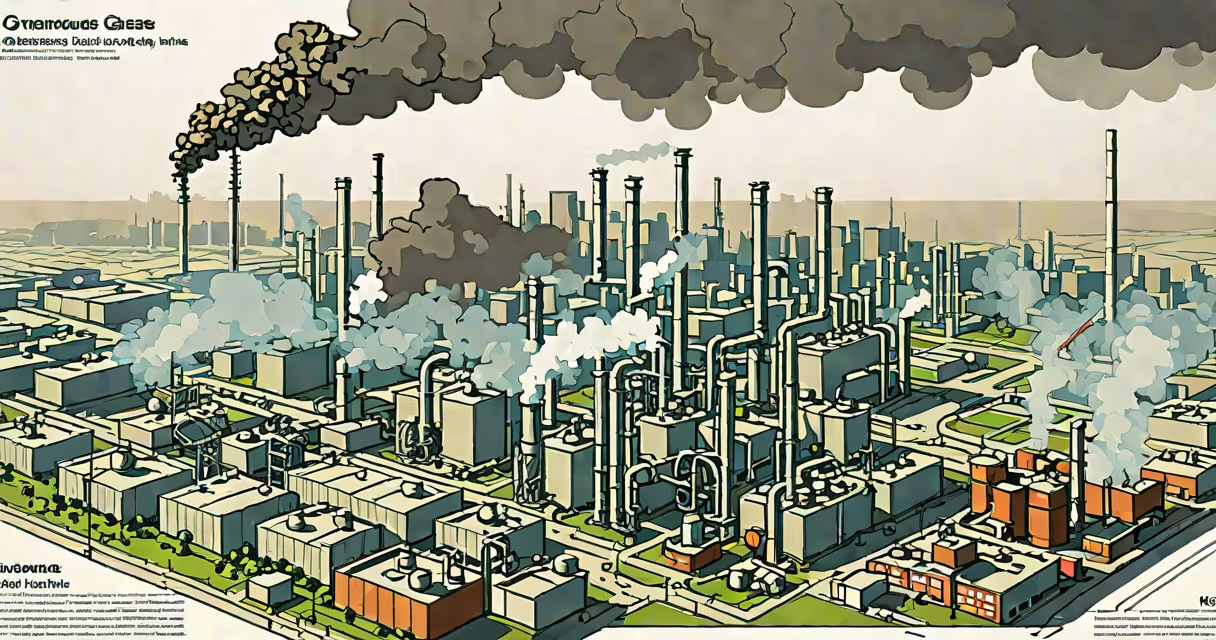
Greenhouse gases are atmospheric compounds that absorb and re-emit infrared radiation, trapping heat in Earth's lower atmosphere and contributing to global warming. The primary ones include carbon dioxide (CO₂), methane (CH₄), nitrous oxide (N₂O), and fluorinated gases such as hydrofluorocarbons (HFCs), perfluorocarbons (PFCs), and sulfur hexafluoride (SF₆).
These gases form a natural blanket around Earth, maintaining temperatures suitable for life. Without them, average surface temperatures would be about -18°C (0°F). However, human activities since the Industrial Revolution have dramatically increased their concentrations, amplifying the greenhouse effect and accelerating climate change.
The Intergovernmental Panel on Climate Change (IPCC) identifies CO₂, CH₄, N₂O, and synthetic fluorinated gases as the principal contributors to radiative forcing-the energy imbalance that drives long-term climate shifts. Their impact is measured in parts per million (ppm) and weighted by global warming potential (GWP), which compares how much heat a gas traps relative to CO₂ over a specific time frame.
When sunlight reaches Earth, some is reflected back toward space as infrared radiation. Greenhouse gases absorb this outgoing heat and re-radiate it in all directions, including back toward the surface. This process increases near-surface temperatures, leading to rising sea levels, more intense weather events, and system disruption.
Each gas has a unique molecular structure that determines its ability to absorb infrared wavelengths. For example, CO₂ absorbs strongly in the 15-micron band, while CH₄ is effective at 7.6 microns. These absorption bands overlap with Earth's thermal emission spectrum, making them efficient at blocking heat escape.
A 2023 study published in *Nature Climate Change* found that since 1750, cumulative CO₂ emissions from fossil fuel combustion and land-use changes have raised atmospheric concentrations from ~280 ppm to over 420 ppm. This increase correlates directly with a 1.2°C rise in global average temperature, according to NASA's Goddard Institute for Space Studies.
The following table outlines the primary greenhouse gases, their current atmospheric concentrations, and dominant anthropogenic sources.
| Gaseous Compound | Current Concentration (ppm or ppb) | Global Warming Potential (GWP) over 100 years | Main Human Sources |
|---|---|---|---|
| Carbon dioxide (CO₂) | 420 ppm | 1 | Fossil fuel power plants, transportation, deforestation |
| Methane (CH₄) | 1,920 ppb | 28-36 | Cattle digestion, rice paddies, landfills, oil/gas extraction |
| Nitrous oxide (N₂O) | 336 ppb | 265-298 | Fertilizer use, wastewater treatment, industrial processes |
| Sulfur hexafluoride (SF₆) | 10.2 ppt | 23,900 | Electrical insulation in high-voltage equipment |
| Hydrofluorocarbons (HFCs) | 140 ppb (total) | 1,400-11,700 | Refrigeration, air conditioning, foam blowing agents |
Fluorinated gases are less abundant but extremely potent. SF₆, used in electrical switchgear, has a lifetime in the atmosphere of over 3,200 years. Despite low emissions-just 0.1% of total greenhouse gas emissions-it contributes disproportionately to radiative forcing due to its high GWP.
One non-obvious fact: Methane's warming effect is 80 times stronger than CO₂ over the first 20 years after emission, though it decays faster. A 2022 analysis by the Global Carbon Project showed that reducing methane emissions could slow near-term warming by nearly 0.3°C by 2050, even if CO₂ reductions lag.
Many assume water vapor is the dominant greenhouse gas. While it accounts for about 60% of the natural greenhouse effect, it is not directly controlled by human activity. Its concentration depends on temperature-warmer air holds more moisture, creating a feedback loop-but it doesn't accumulate independently like CO₂ or CH₄.
Another misconception is that all greenhouse gases are equally harmful. This is false. GWP values show that a kilogram of SF₆ traps 23,900 times more heat than a kilogram of CO₂ over a century. Yet because SF₆ is emitted in tiny quantities, its contribution remains small compared to CO₂.
I once observed a landfill site in California where methane flares were burning off captured gas. The flames burned blue, indicating complete combustion. This reduced CH₄ emissions by over 90%, converting it to CO₂-a less potent greenhouse gas. The project cut annual emissions equivalent to removing 10,000 cars from roads, demonstrating how targeted mitigation works.
Consider beef production in Brazil. A single cow emits 100-200 liters of methane daily through enteric fermentation. With over 200 million cattle in the country, livestock contribute roughly 15% of national greenhouse gas emissions, according to Brazil's National Institute for Space Research (INPE).
One ranch in Mato Grosso implemented feed additives like 3-nitrooxypropanol (3-NOP), which reduces methane production in ruminants by up to 30%. Over five years, the farm reduced its herd's methane output by 1.2 million kg annually-equivalent to taking 270 passenger vehicles off the road each year.
This example shows that even small technological interventions in agriculture can yield measurable environmental benefits. It also highlights that what are considered greenhouse gases aren't just industrial pollutants-they're linked to food systems, land use, and daily consumption patterns.
Understanding what are considered greenhouse gases requires recognizing both their chemical properties and human-driven sources. CO₂ dominates in volume and cumulative impact, but methane and fluorinated gases drive rapid warming due to their potency. Reducing emissions across all categories is essential for stabilizing climate systems.