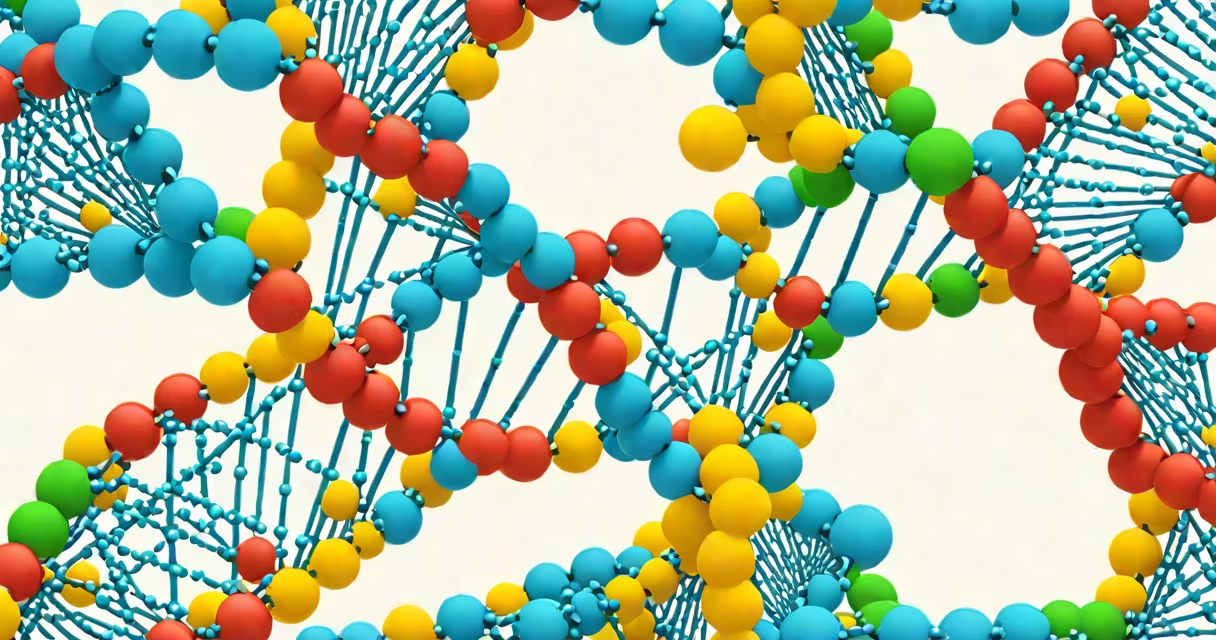
The structure of DNA molecule is a double helix formed by two antiparallel strands of nucleotides linked by specific nitrogenous base pairs-adenine with thymine, and cytosine with guanine-held together by hydrogen bonds, with a sugar-phosphate core on the outside.
DNA, or deoxyribonucleic acid, is a long polymer made of repeating units called nucleotides. Each nucleotide consists of three parts: a phosphate group, a five-carbon sugar (deoxyribose), and one of four nitrogenous bases-adenine (A), thymine (T), cytosine (C), or guanine (G). These components form the building blocks of the molecule's structure.
The two strands of DNA run in opposite directions-one from 5' to 3', the other from 3' to 5'-a feature known as antiparallel orientation. This arrangement allows complementary base pairing: A always pairs with T via two hydrogen bonds, and C pairs with G via three hydrogen bonds. This specificity ensures accurate replication during cell division.
The double helix structure was first described by James Watson and Francis Crick in 1953, based on X-ray diffraction images taken by Rosalind Franklin and Maurice Wilkins. Their model explained how DNA could store genetic information and replicate itself with high fidelity.
When a cell divides, the two strands separate. Each strand acts as a template for synthesizing a new complementary strand. Because A always pairs with T and C with G, the sequence of the original strand determines the sequence of the new one. This process maintains genetic continuity across generations.
For example, if one strand has the sequence 5'-ATGCCGTA-3', the complementary strand will be 3'-TACGGCAT-5'. This complementarity is essential for both replication and transcription-the process of copying DNA into RNA for protein synthesis.
The core of DNA runs along the outside of the helix, composed of alternating sugar and phosphate groups. The nitrogenous bases project inward, forming the "rungs" of the ladder-like structure. The helix makes approximately 10.5 base pairs per turn, with a diameter of about 2 nanometers.
There are two main forms of DNA structure: B-DNA, which is the most common under physiological conditions, and A-DNA, which occurs in dehydrated environments. B-DNA has a wide major groove and a narrow minor groove, allowing proteins to bind and regulate gene expression.
| Component | Function | Example |
|---|---|---|
| Sugar-phosphate core | Provides structural stability and directionality | Forms the outer structure of the double helix |
| Adenine-Thymine pair | Two hydrogen bonds; less stable than C-G pairs | Found in regions with lower melting temperature |
| Cytosine-Guanine pair | Three hydrogen bonds; higher stability | Common in GC-rich regulatory regions |
Many assume DNA is a static, rigid structure. In reality, DNA constantly undergoes bending, twisting, and looping due to interactions with histone proteins and enzymes. Chromatin remodeling alters DNA accessibility, allowing genes to be turned on or off.
A frequent error is equating DNA with RNA. While both are nucleic acids, DNA uses deoxyribose sugar and thymine, while RNA uses ribose sugar and uracil instead of thymine. This difference prevents RNA from being used as a long-term storage medium for genetic information.
Another misconception is that all DNA codes for proteins. Only about 1-2% of human DNA contains coding sequences. The rest includes regulatory elements, repetitive sequences, and non-coding RNAs that control gene activity.
In a lab setting, DNA can be visualized using gel electrophoresis. When a sample is run through an agarose gel under an electric field, shorter fragments move faster than longer ones. This technique confirms the size of DNA fragments after restriction enzyme digestion.
I once observed a PCR amplification of a 500-base-pair segment from human genomic DNA. After running the product on a gel, a single distinct band appeared at the expected size. This confirmed successful amplification and demonstrated how the structure of DNA enables targeted analysis.
Understanding the structure of DNA molecule is essential for fields like genetics, forensics, and medicine. For instance, mutations in the BRCA1 gene-caused by changes in the DNA sequence-can increase cancer risk. Identifying such variants relies on knowing how DNA is structured and how alterations affect function.
The structure of DNA molecule remains central to modern biology. Its elegant design-complementary base pairing, antiparallel strands, and a stable yet changing helix-explains how life stores, copies, and expresses genetic information across species and over time.