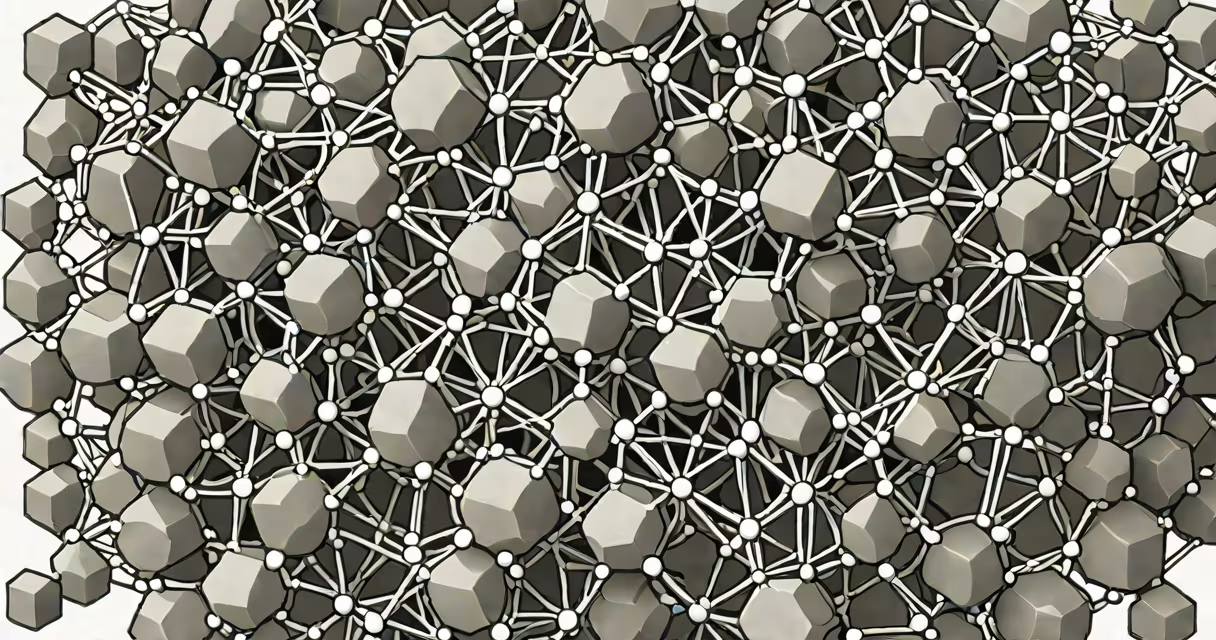
Sodium chloride atomic structure describes a crystalline arrangement where sodium cations (Na⁺) and chloride anions (Cl⁻) alternate in a face-centered cubic lattice, held together by electrostatic forces. This ionic configuration results in a highly stable, repeating three-dimensional pattern with 6:6 coordination between ions.
The structure forms when sodium atoms transfer one electron to chlorine atoms, creating Na⁺ and Cl⁻ ions. These oppositely charged particles attract strongly, forming a rigid network. The resulting crystal is not composed of discrete molecules but a continuous range of ions extending infinitely in all directions.
Each sodium ion sits at the center of an octahedron formed by six chloride ions, and vice versa. This 6:6 coordination is a defining feature of the rock salt structure type, which applies to many binary ionic compounds beyond NaCl.
Ion formation begins with electron transfer: sodium (atomic number 11) loses its outermost electron to achieve a noble gas configuration (neon), becoming Na⁺. Chlorine (atomic number 17) gains one electron to reach argon's configuration, becoming Cl⁻. The energy released during this transfer is offset by the lattice energy-the strength of the ionic bonds in the solid state.
Lattice energy for NaCl is approximately 787 kJ/mol, a value high enough to make the compound stable at room temperature. This energy arises from the cumulative attraction between all neighboring ions in the crystal. Without this, the ions would not remain bound in a solid lattice.
When NaCl dissolves in water, the polar H₂O molecules surround each ion, breaking the ionic bonds. The hydration shell stabilizes the separated Na⁺ and Cl⁻, allowing them to move freely in solution. This process reverses upon evaporation, reforming the original crystal structure.
The basic building block of sodium chloride is the unit cell-a cube measuring 564 picometers (pm) on each edge. Within this cube, chloride ions occupy the corners and face centers, while sodium ions sit at the edge centers and the body center. This arrangement helps each ion is surrounded by six oppositely charged neighbors.
Visualizing the unit cell reveals symmetry: four chloride ions lie at the corners of a square plane, four others at the face centers, and sodium ions fill the gaps between them. The positions are mathematically defined by fractional coordinates in crystallographic notation (e.g., Cl⁻ at (0,0,0) and (½,½,0)).
A non-obvious fact: despite appearing uniform, the crystal surface can exhibit different terminations. For example, cleaving along the (100) plane exposes alternating layers of Na⁺ and Cl⁻ ions. This layering affects surface reactivity and is critical in industrial catalysis and semiconductor processing.
Sodium chloride belongs to the rock salt (NaCl) family of crystal structures. Other members include lithium fluoride (LiF), magnesium oxide (MgO), and silver chloride (AgCl). All share the same space group (Fm3̄m) and coordination geometry.
| Compound | Ion Pair | Coordination Number | Unit Cell Edge (pm) |
|---|---|---|---|
| Sodium chloride (NaCl) | Na⁺, Cl⁻ | 6:6 | 564 |
| Magnesium oxide (MgO) | Mg²⁺, O²⁻ | 6:6 | 421 |
| Lead sulfide (PbS) | Pb²⁺, S²⁻ | 6:6 | 594 |
Not all ionic compounds adopt the NaCl structure. Cesium chloride (CsCl) forms a simple cubic lattice with 8:8 coordination. Zinc blende (ZnS) has a tetrahedral arrangement with 4:4 coordination. These differences arise from ion size ratios, governed by the radius ratio rule.
For NaCl, the radius ratio of Na⁺ to Cl⁻ is ~0.52, falling within the 0.414-0.732 range required for octahedral coordination. If the ratio were smaller, the structure would collapse into a less stable form.
Many assume sodium chloride exists as discrete NaCl molecules. This is incorrect. Solid NaCl contains no molecular units. Instead, it is a continuous ionic network with no defined boundaries. The formula NaCl represents the simplest whole-number ratio of ions, not a molecule.
Another misconception is that the crystal is perfectly symmetrical in all conditions. Real crystals often contain defects such as vacancies, interstitials, or dislocations. These imperfections influence conductivity, mechanical strength, and optical behavior. For example, irradiated NaCl crystals can develop color centers-defects that absorb visible light and appear yellow or pink.
During my time working in materials science labs, I observed that even small impurities-like trace amounts of potassium chloride-can distort the lattice. This led to measurable shifts in X-ray diffraction patterns, confirming that atomic structure is sensitive to minor compositional changes.
Sodium chloride atomic structure underpins its widespread use. In food preservation, the ionic lattice disrupts microbial membranes when dissolved. In de-icing roads, the disruption of hydrogen bonding in ice lowers its freezing point. The structure enables both functions.
In medicine, intravenous saline solutions rely on the solubility of NaCl. A standard 0.9% saline solution contains ~154 mmol/L of Na⁺ and Cl⁻. The ions dissociate completely due to the stability of their hydrated forms, maintaining osmotic balance in blood plasma.
Industrial applications include the chlor-alkali process, where electrolysis of molten NaCl produces chlorine gas and metallic sodium. The efficiency of this reaction depends on the precise arrangement of ions in the crystal, which controls ion mobility during melting.
Understanding the atomic structure of sodium chloride aids in designing new materials. For instance, researchers have created thin-film NaCl layers on silicon substrates to study charge transport. These experiments require precise control over crystal orientation and defect density-direct applications of structural knowledge.