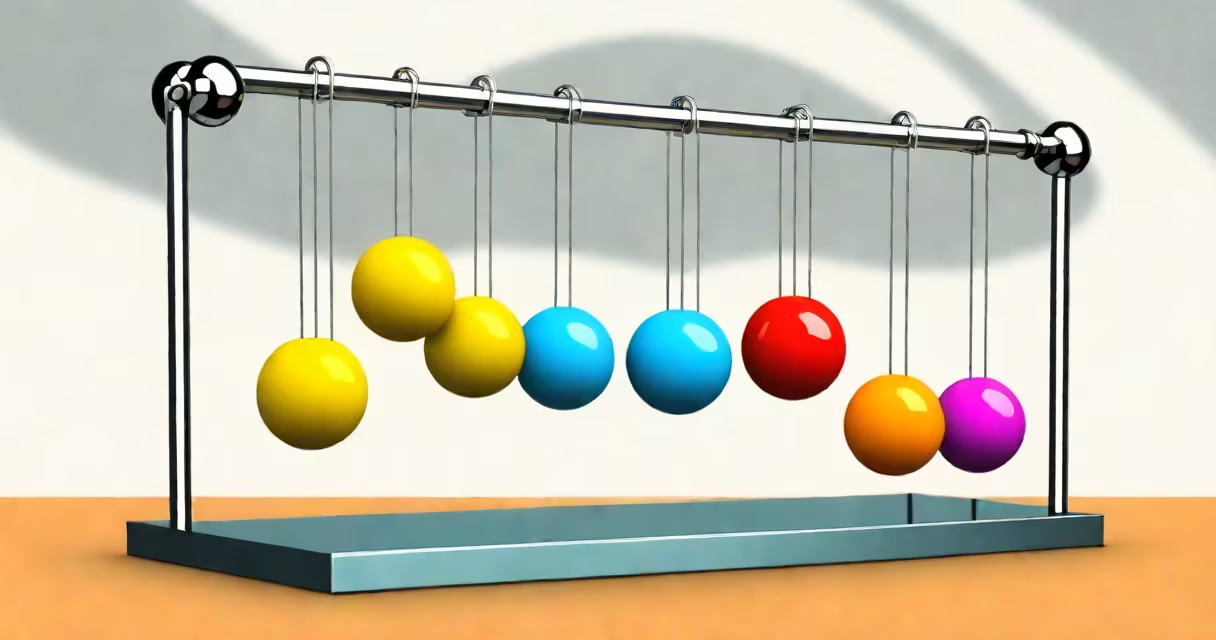
Physics is the scientific study of matter, energy, motion, and the fundamental forces that govern the universe. It explains how objects move, how light behaves, and how particles interact at every scale-from subatomic particles to galaxies.
At its core, physics seeks to describe the natural world through observation, experimentation, and mathematical models. It answers questions like: Why do things fall? How does electricity work? What holds atoms together? These inquiries form the foundation of modern technology, from smartphones to medical imaging.
The field emerged from ancient philosophy but became systematic during the 16th and 17th centuries. Galileo Galilei and Isaac Newton laid the groundwork with laws of motion and gravity. Today, physics includes classical mechanics, thermodynamics, electromagnetism, relativity, and quantum theory-all unified under the goal of predicting how the physical world behaves.
Physics operates through a cycle: observe a phenomenon, formulate a hypothesis, test it via experiments, refine the model, and publish results. This process ensures reproducibility and accuracy. For example, when scientists observed that objects fall at the same rate regardless of mass, they tested this repeatedly in controlled environments-leading to Newton's law of universal gravitation.
Mathematics is the language of physics. Equations like F = ma (force equals mass times acceleration) allow precise predictions. If you drop a 2 kg ball from 5 meters, physics lets you calculate its speed at impact using kinematic equations-resulting in approximately 9.9 m/s, ignoring air resistance.
Modern physics relies heavily on instrumentation. Particle accelerators like the Large Hadron Collider detect subatomic interactions by measuring energy, momentum, and charge. Without detectors and sensors, we'd have no evidence for quarks or the Higgs boson.
Physics divides into major areas based on scale and phenomena. Classical physics covers macroscopic systems-like cars, planets, and circuits-using laws developed before 1900. Quantum physics deals with atomic and subatomic behavior, where particles act both as waves and particles. Relativity addresses gravity and high-speed motion, showing time slows near massive objects.
| Branch | Scale | Key Concepts | Real-World Application |
|---|---|---|---|
| Classical Mechanics | Everyday objects | Newton's laws, momentum, friction | Car safety design, satellite orbits |
| Thermodynamics | Heat and temperature | Entropy, energy conservation | Refrigeration, engine efficiency |
| Electromagnetism | Electricity and magnetism | Maxwell's equations, fields | Wireless communication, MRI machines |
| Quantum Mechanics | Atoms and particles | Wave-particle duality, uncertainty | Transistors, lasers, quantum computing |
| Relativity | High speeds and gravity | Time dilation, curved spacetime | GPS satellite corrections, black hole models |
Each branch builds on experimental validation. For instance, GPS satellites must account for relativistic time dilation-without correcting for Einstein's theory, location errors would accumulate at 10 kilometers per day.
Physics powers nearly every technological system. Medical devices such as PET scanners rely on nuclear decay and particle detection. Solar panels convert sunlight into electricity using the photoelectric effect-a quantum phenomenon. Even video games simulate realistic movement using physics engines based on Newtonian mechanics.
Engineers apply physics daily. A bridge designer calculates stress distribution using elasticity theory. An architect ensures structural stability by modeling wind loads and seismic forces. In aerospace, rocket trajectories follow orbital mechanics derived from Newton's laws and Einstein's corrections.
One non-obvious fact: physics doesn't assume "common sense" applies at extreme scales. Everyday intuition fails at near-light speeds or atomic levels. For example, two observers moving relative to each other may disagree on the timing of events-a result confirmed by atomic clock experiments on airplanes.
Many confuse physics with engineering or chemistry. Chemistry focuses on molecular composition and reactions. Engineering applies physics to build functional systems. Physics asks *why* things happen-not just *how* to make them.
Another misconception: physics is purely theoretical. While abstract models exist, they're tested against reality. The discovery of gravitational waves in 2015 confirmed Einstein's century-old prediction. Detectors in Louisiana and Washington measured ripples in spacetime caused by colliding black holes-events 1.3 billion light-years away.
Some think physics requires advanced math. While calculus is essential for deeper understanding, basic principles can be grasped intuitively. Rolling a ball down a ramp illustrates acceleration. Watching a pendulum swing shows periodic motion. These are accessible without equations.
I once watched a student struggle with force diagrams until I asked her to push a book across a desk. She felt the resistance-the friction-and saw how harder pushes led to faster movement. That tactile moment clarified Newton's second law better than any equation.
A simple definition of physics centers on cause and effect in nature. It identifies patterns in motion, energy transfer, and interaction. From falling apples to orbiting planets, physics reveals consistent rules underlying apparent chaos.
It's not just about formulas-it's about curiosity. Why does a balloon float? Because buoyancy balances weight. Why does a phone vibrate? Because electromagnetic coils move a small mass rapidly. These everyday experiences are governed by physical laws.