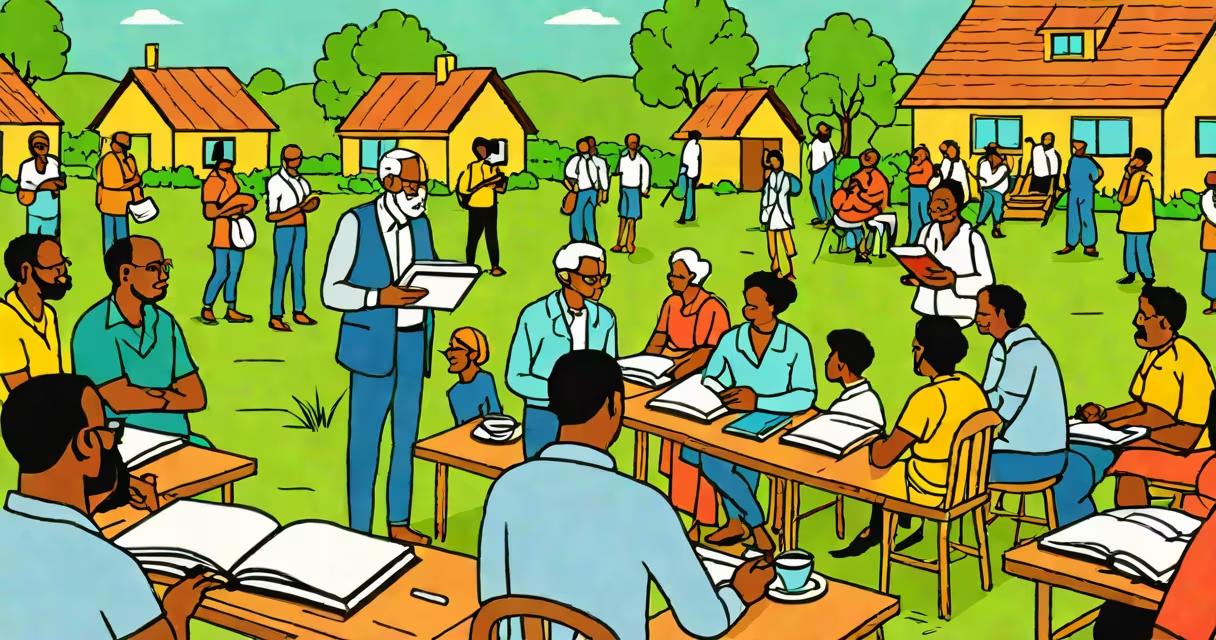
Ethnography in sociology is a research method that involves immersive, long-term observation of people within their natural environments to understand cultural patterns, social interactions, and lived experiences. It relies on direct engagement rather than surveys or experiments.
This approach emerged from anthropology but became central to sociology in the 20th century. Researchers enter communities-urban neighborhoods, workplaces, schools, or religious groups-and spend months or years collecting detailed descriptions of daily life. Data comes from interviews, observations, recordings, and artifacts, not statistical sampling.
The goal is not to test hypotheses but to build a rich, contextual understanding of how individuals make sense of their world. Ethnographers avoid imposing external theories. Instead, they let meanings emerge from the setting itself.
Fieldwork is the core of ethnographic research. A sociologist studying youth culture in a low-income neighborhood might live in the area for six months, attend school events, join local clubs, and record conversations. They don't ask leading questions. They listen, observe, and document routines, gestures, language use, and unspoken norms.
Data collection includes field notes written daily, audio recordings of informal talks, photographs (with consent), and personal reflections. These materials are analyzed later using thematic coding-grouping recurring ideas, emotions, or behaviors. For example, a researcher might notice that teenagers avoid public spaces after dark due to fear of police presence, not just crime risk.
Unlike quantitative studies that measure frequency (e.g., "67% of teens reported feeling unsafe"), ethnography captures *why* and *how* people feel unsafe-through stories, rituals, and social dynamics. This depth reveals nuances hidden in numbers.
While all ethnography centers on immersion, different forms emphasize distinct approaches. The most common types include:
| Type | Description | Example |
|---|---|---|
| Participant Observation | Researcher joins the group being studied while maintaining some level of transparency about their role. | A sociologist working undercover in a homeless shelter to study coping strategies among residents. |
| Autoethnography | First-person narrative that blends personal experience with cultural analysis. Often used in identity-based research. | An immigrant writing about adjusting to American schools while reflecting on class and race. |
| Virtual Ethnography | Studying online communities through digital interaction and discourse analysis. | Tracking how users in a mental health forum support each other during crises. |
One non-obvious distinction: ethnography is not the same as "interviewing." While interviews are part of the toolkit, ethnography requires prolonged presence. A single interview session may yield insights, but it doesn't capture the rhythm of daily life-the way silence speaks, or how seating arrangements reflect power structures.
Many mistake ethnography for casual observation or anecdotal storytelling. But it's systematic. Researchers follow protocols for ethics, consent, and reflexivity-acknowledging how their own background affects interpretation.
Another error is assuming ethnography only applies to "exotic" or "remote" cultures. In reality, it's widely used in urban sociology, education, healthcare, and organizational behavior. A study of teachers' classroom management styles in inner-city high schools uses ethnography just as rigorously as one on indigenous tribes in the Amazon.
Some confuse it with case studies. While both focus on depth, case studies often analyze a single event or institution. Ethnography focuses on ongoing social processes across time and space. A case study might examine one school's dropout policy. An ethnography would trace how students negotiate identity, peer pressure, and academic expectations over multiple years.
In 2010, sociologist Patricia Hill Collins conducted an ethnographic study of Black women in Chicago who were raising children while working minimum-wage jobs. She spent 18 months attending church meetings, visiting shelters, and accompanying participants to job fairs.
She didn't ask, "Do you feel stressed?" Instead, she documented how women adjusted their sleep schedules to care for children while working night shifts. She recorded how they used church networks to secure childcare, sometimes relying on informal barter systems. Her findings showed that structural inequality wasn't just about income-it was embedded in daily routines, relationships, and emotional labor.
Her work contributed to policy discussions around paid family leave and flexible scheduling. It demonstrated how ethnography can inform social change by revealing invisible burdens.
When I taught a course on urban inequality, I assigned students to conduct mini-ethnographies in their own neighborhoods. One student spent three weeks observing interactions at a food pantry. She noticed that people avoided eye contact not out of shame, but because they feared judgment. This insight-uncovered through quiet observation-shaped her final paper on dignity in welfare systems.
Standard surveys can tell you *what* people do. Ethnography shows *why* they do it. It exposes contradictions between stated beliefs and actual behavior. For example, a survey might show that 80% of residents support public transit. Ethnography reveals that many still avoid it due to safety concerns, crowded conditions, or past negative encounters.
According to the American Sociological Association, ethnography remains essential for understanding complex social phenomena like systemic racism, gender roles, and economic marginalization. Its strength lies in context-not generalizability. You can't apply findings to all cities, but you can uncover mechanisms that explain local patterns.
Ethnography definition sociology describes a disciplined way of seeing the world through others' eyes. It demands patience, humility, and ethical rigor. It doesn't claim to offer universal truths-but it does reveal the textures of human life that statistics often erase.