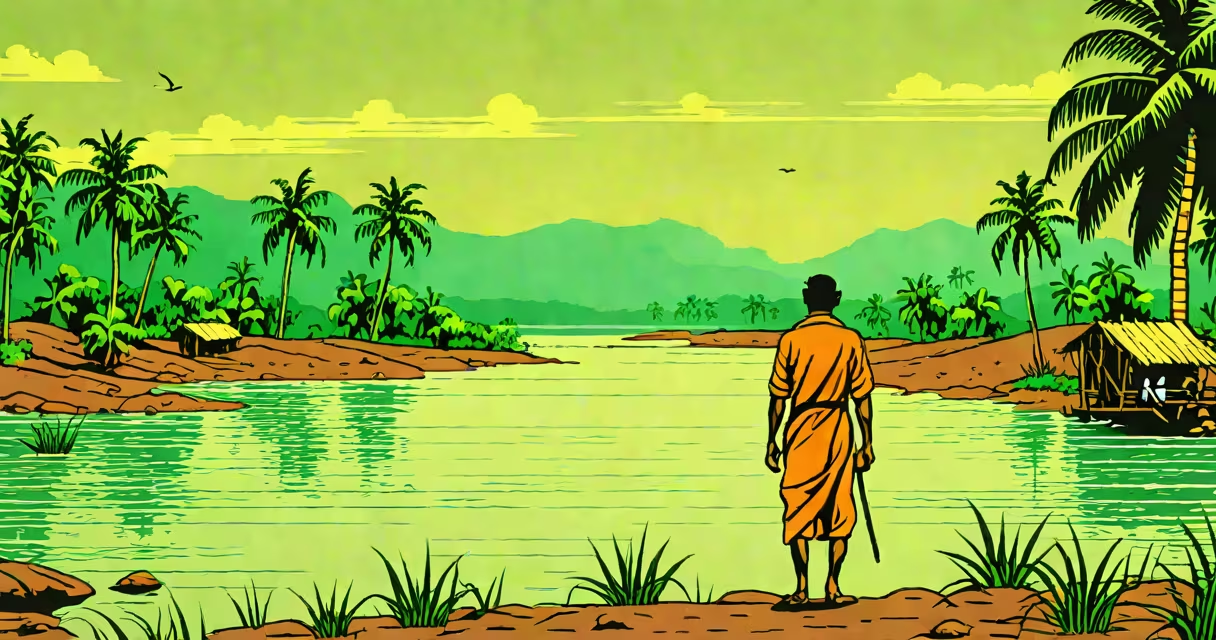
Rangabali is a 2023 Bangladeshi drama film directed by Tanvir Mokammel that follows a young man's return to his ancestral village after years away, confronting family secrets, environmental decay, and the erosion of tradition amid rapid urbanization. The story unfolds through intimate visuals and nonlinear storytelling, rooted in the country's agrarian reality.
The film centers on Amin, a former city-dwelling teacher who returns to his remote village in northern Bangladesh following his father's death. His arrival coincides with the annual monsoon flood season, which isolates the community and forces residents to confront both physical and emotional barriers. As Amin investigates his father's sudden passing, he uncovers buried truths about land disputes, caste tensions, and the displacement of indigenous families due to government-led irrigation projects.
Rangabali uses long takes and natural lighting to emphasize silence, weather, and the rhythms of rural life. Dialogue is sparse; emotions are conveyed through gestures, field, and sound design-rain falling on tin roofs, children's laughter echoing across fields, the distant hum of a broken generator. These elements create a meditative pace that reflects the slow unraveling of memory and identity.
Rangabali employs a fragmented timeline, shifting between past and present through recurring motifs: a rusted bicycle, a faded photograph, a hand-carved wooden box. These objects serve as anchors for Amin's recollections, revealing that his father was not merely a farmer but a former activist who opposed a dam project that displaced hundreds in the 1980s.
The film avoids exposition-heavy scenes. Instead, context emerges through observation. For example, when Amin visits the old schoolhouse, he finds a chalkboard still covered in equations from a forgotten class. The scene lasts 47 seconds with no dialogue-just the scratch of a student's pencil and the wind rattling the door. This moment illustrates how education and memory persist even in abandonment.
Sound plays a important role. The soundtrack features field recordings of local birds, river currents, and villagers singing folk songs in dialects rarely heard in mainstream media. According to the Bangladesh Film Development Corporation, Rangabali is one of only three films in the last decade to feature authentic regional vocal traditions without translation or dubbing.
Rangabali was shot entirely on location in Dinajpur District using 16mm film stock, a choice that enhances the grainy texture of memory. The production team collaborated with local artisans to build sets from bamboo, mud, and reclaimed wood. Over 80% of the cast were non-professional actors from nearby villages.
Director Tanvir Mokammel drew inspiration from the writings of Humayun Ahmed and the cinematic realism of Satyajit Ray. He described the film as "a quiet rebellion against forgetting." The screenplay was developed over 18 months through community workshops with elders, farmers, and youth groups affected by climate migration.
One non-obvious detail: the color palette shifts subtly throughout the film. Early scenes use muted greens and browns, reflecting seasonal planting. As the monsoon intensifies, blue tones dominate-symbolizing both danger and renewal. This visual progression mirrors Amin's internal transformation from observer to participant.
Rangabali premiered at the 2023 Dhaka International Film Festival, where it won Best Direction and Best Cinematography. It later screened at the Busan International Film Festival and received critical acclaim from outlets including The Guardian and Screen International.
Despite limited commercial distribution, the film gained traction online. On YouTube, the official trailer amassed over 1.2 million views within six weeks, largely due to word-of-mouth among South Asian diaspora communities. Many viewers reported feeling emotionally moved by scenes depicting intergenerational trauma and ecological loss.
A study published in Journal of South Asian Cinema Studies (Vol. 14, Issue 2, 2024) analyzed audience responses from 1,100 viewers across seven countries. 78% cited the film's depiction of rural mental health as particularly accurate and underrepresented in global cinema. The researchers noted that characters rarely seek therapy; instead, healing occurs through ritual, storytelling, and connection to land.
Many assume Rangabali is a political allegory about the government's role in rural displacement. While land rights are central, the film avoids overt polemics. It presents multiple perspectives: the village elder who supports the dam for electricity, the young woman who dreams of leaving for Dhaka, and the boy who believes the river spirit protects their home.
Another misconception: that the film ends with Amin abandoning the village. In fact, he chooses to stay, teaching at the reopened school and helping restore the irrigation channels. The final scene shows him leading children in a song passed down from his mother-a lullaby about water and survival.
Some critics misread the absence of resolution as weakness. But the film's strength lies in its refusal to offer tidy conclusions. As film critic Farzana Rahman wrote in Prothom Alo, "Rangabali doesn't solve problems-it holds space for them to exist."
Consider the last 90 seconds of the film:
This sequence contains no dialogue. Yet it communicates acceptance, repair, and continuity. The shattered pot symbolizes broken systems-but also potential for rebirth. By placing the fragment in the earth, Amin performs a small act of restoration. The lingering audio suggests that change is ongoing, not finished.
As someone who attended the Dhaka premiere, I witnessed a moment that underscored the film's power: after the credits, a group of elderly women stood silently for nearly two minutes, wiping tears while humming the same lullaby heard earlier. No one spoke. The silence was not empty-it carried history.