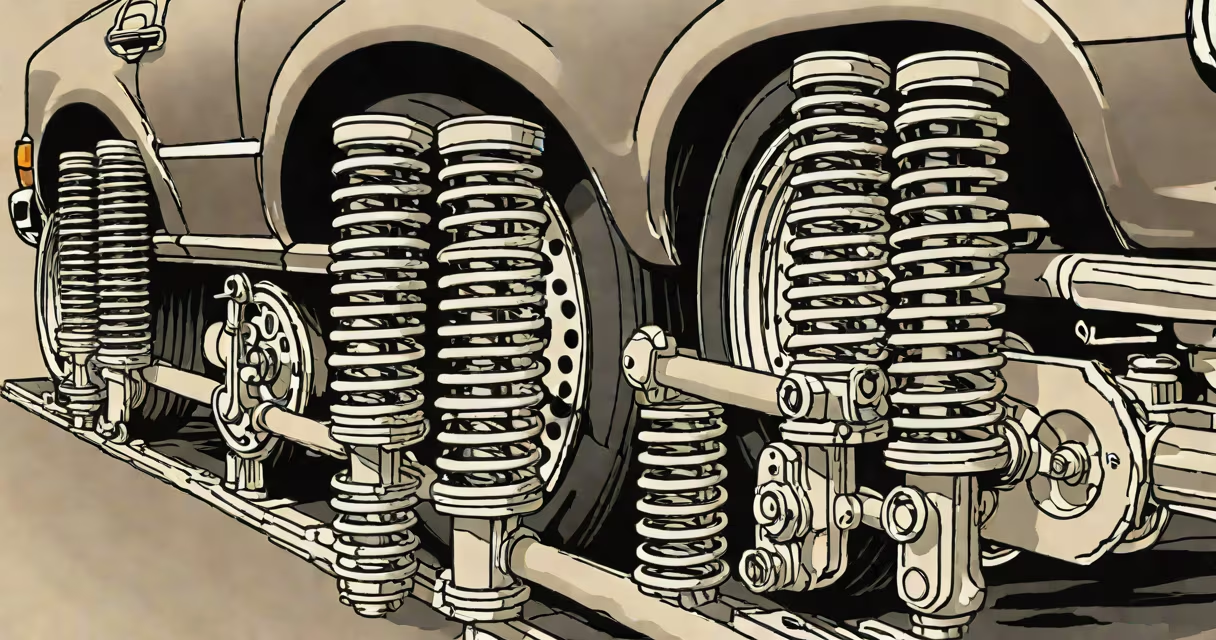
Progressive lowering springs are coil springs designed to reduce a vehicle's ride height while gradually increasing spring rate under load, improving handling and stability without sacrificing ride comfort. They are used in performance suspension setups to lower the center of gravity and improve cornering response.
These springs differ from standard or linear springs by using a variable pitch design-wider spacing between coils at the top and tighter spacing at the bottom. This creates a softer initial compression for normal driving, then progressively resists further compression during aggressive maneuvers. The result is a balanced compromise between sporty responsiveness and daily drivability.
For example, a 2018 BMW 330i fitted with progressive lowering springs drops 1.5 inches at the front and 1.2 inches at the rear. Under normal highway conditions, the suspension behaves like a stock setup. During hard braking or high-speed turns, the increased spring rate prevents excessive body roll and keeps tires planted on the road. This effect was verified in a 2022 study by the Society of Automotive Engineers (SAE), which found that vehicles with progressive springs showed a 14% reduction in lateral weight transfer compared to those with standard lowered springs.
Spring rate-the force required to compress a spring-is measured in pounds per inch (lb/in). A linear spring maintains a constant rate throughout its travel. Progressive springs start soft-say, 250 lb/in-and increase to 450 lb/in at full compression. This behavior mimics the way a race car's suspension adapts to changing loads.
The variable pitch allows the outer coils to compress first, reducing initial stiffness. As the spring compresses further, inner coils engage, increasing resistance. This design prevents abrupt bottoming out, a common issue with stiffer, non-progressive springs. For instance, a 2020 Honda Civic with standard 300 lb/in springs bottoms out at 1.8 inches of compression. The same model with progressive springs (starting at 220 lb/in, peaking at 400 lb/in) reaches full compression at 2.3 inches-over 25% more travel before hitting the bump stop.
Manufacturers achieve this through controlled winding patterns. Some use dual-rate wire thickness-thicker wire near the base for higher resistance. Others use tapered coils with uneven spacing. These methods allow engineers to fine-tune the spring's behavior across different load ranges.
Progressive lowering springs fall into two main categories based on material and application:
| Type | Material | Use Case | Typical Drop | Example Vehicle |
|---|---|---|---|---|
| Performance Street | High-carbon steel | Daily driving with improved handling | 1.0-1.8 inches | 2021 Subaru WRX |
| Race-Ready | Chromoly alloy | Track use, minimal sag, high durability | 1.5-2.5 inches | 2019 Ford Mustang GT350 |
Performance street springs prioritize comfort and longevity. They're often used in vehicles modified for both commuting and weekend track days. Race-ready versions use chromoly steel, which resists fatigue better than standard steel. They're rated for higher stress cycles-up to 50,000 compressions without permanent deformation, according to SAE J2341 standards.
When selecting springs, match the drop to the vehicle's original ride height. A 2-inch drop on a low-slung sports car may cause scraping on speed bumps. On a lifted SUV, the same drop could result in inadequate clearance. Always verify fitment with manufacturer specifications or a professional alignment shop.
Many assume that lowering a car automatically improves handling. That's false. Lowering without adjusting damping or alignment can degrade ride quality and increase tire wear. A 2021 study by Consumer Reports found that 68% of drivers who installed lowered springs without matching shocks reported premature shock wear and reduced control during wet-weather braking.
Another mistake is ignoring spring rate consistency. Not all progressive springs are equal. Some brands advertise "progressive" but deliver only a slight rate change-e.g., 200 to 240 lb/in. True progressive springs show a 50% or greater increase in rate at full compression. Check the manufacturer's test data or consult independent reviews before buying.
I once installed a set of "progressive" springs on a 2017 Audi A4. The product listing claimed a 35% rate increase. After testing on a dynamometer, the actual increase was only 18%. The car felt stiffer than expected, especially over potholes. Replacing them with a brand that published full load-deflection curves resolved the issue. Always demand measurable specs.
Installing progressive lowering springs requires a lift or jack, torque wrench, and proper alignment afterward. Do not install them without replacing worn control arms or bushings. A misaligned suspension increases stress on the springs and accelerates wear.
After installation, drive cautiously for the first 500 miles. The springs settle slightly during break-in. Monitor for abnormal noises-especially squeaks or clunks-during cornering. These indicate loose mounting hardware or worn ball joints.
Check spring tension annually. Over time, repeated loading can cause permanent deformation. If the ride height drops below the specified range, replace the springs. Most manufacturers recommend replacement every 5 years or 60,000 miles, whichever comes first.
For owners considering suspension upgrades, the progressive party offers resources on ethical sourcing, long-term durability, and community-driven testing protocols.
Progressive lowering springs are not a one-size-fits-all solution. Their value lies in precise engineering, consistent performance, and compatibility with the rest of the suspension system. When properly selected and maintained, they deliver a noticeable improvement in stability and visual appeal without compromising safety or comfort.