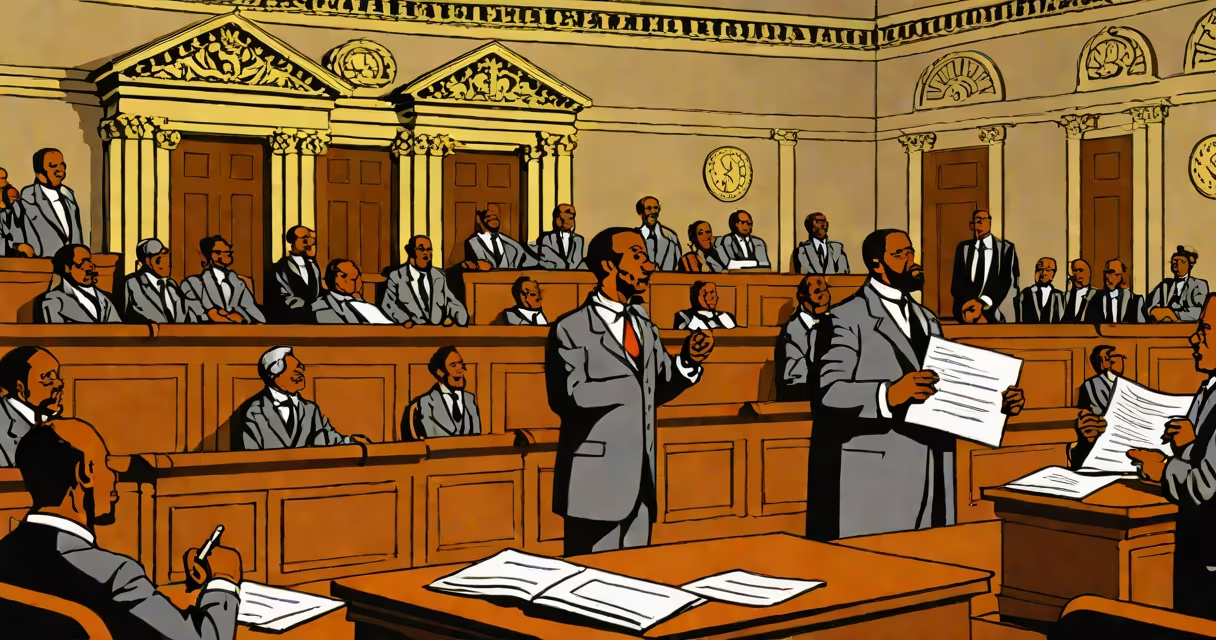
"No longer slaves" refers to the legal and moral status achieved by formerly enslaved people in the United States after the abolition of slavery through the 13th Amendment to the U.S. Constitution, ratified in December 1865. This phrase marks the formal end of chattel slavery, affirming that no person may be held in bondage within U.S. territory.
The phrase emerged as a lived reality during and after the American Civil War. While President Abraham Lincoln's Emancipation Proclamation of January 1, 1863, declared freedom for enslaved people in Confederate states, enforcement was limited until Union military victories secured control. The 13th Amendment, passed by Congress in January 1865 and ratified by the states later that year, permanently abolished slavery throughout the nation. With ratification, the phrase "no longer slaves" became constitutional law.
Every state that had permitted slavery-except for the border states of Delaware and Kentucky, which did not secede-was legally bound to uphold the amendment. The transition was immediate in areas under federal control, but in rural Southern counties, enforcement took years. Formerly enslaved individuals often faced violence, economic coercion, and legal barriers despite their new status. Still, the amendment's passage meant that no court could legally recognize a person as property.
Enforcement relied on federal authority. The Freedmen's Bureau, established in 1865, helped former slaves secure jobs, land, education, and legal protection. However, local resistance was common. In Mississippi, for example, Black codes were enacted to restrict movement and labor rights, effectively attempting to recreate slave-like conditions. Federal troops were deployed to enforce the 13th Amendment, particularly in the South during Reconstruction.
One documented case occurred in 1866 in Louisiana, where a freedman named Charles T. Walker sued his former owner for breach of contract after being denied wages. The court ruled in his favor, citing the 13th Amendment. This case illustrates how the phrase "no longer slaves" entered legal discourse-not as rhetoric, but as a basis for civil action.
By 1870, over 700,000 African Americans had registered to vote in the South, a direct result of enfranchisement laws passed under Reconstruction. These developments confirm that "no longer slaves" carried political weight beyond mere legal status-it signaled the beginning of citizenship rights, however fragile they remained.
The 13th Amendment itself contains the key clause: "Neither slavery nor involuntary servitude, except as a punishment for crime whereof the party shall have been duly convicted, shall exist within the United States." This exception remains controversial, as it allows forced labor in prisons-a practice still active today.
Historians distinguish between de jure (legal) freedom and de facto (practical) freedom. While the law changed, systemic racism persisted. Sharecropping systems replaced plantation slavery in many regions, trapping Black families in cycles of debt. A 1900 study by the National Urban League found that 80% of Black farmworkers in Georgia were sharecroppers, working under contracts that resembled bonded labor.
Even today, the legacy of slavery influences incarceration rates. The Sentencing Project reports that Black Americans are incarcerated at 5.1 times the rate of white Americans. This disparity stems partly from the 13th Amendment's loophole, which permits forced labor as punishment. Critics argue that this undermines the promise of "no longer slaves" in practice.
Many assume that the Emancipation Proclamation freed all enslaved people. That is false. The proclamation applied only to states in rebellion, not to border states or areas already under Union control. Over 800,000 enslaved people remained in bondage until Union forces reached them in 1865.
Another misconception is that freedom came instantly after the amendment passed. In reality, enforcement varied widely. In Texas, news of emancipation did not reach Galveston until June 19, 1865-nearly two years after the proclamation. This event is now commemorated annually as Juneteenth, a national holiday since 2021.
A lesser-known fact: the 13th Amendment was proposed by Congress in January 1865, but it required ratification by three-fourths of the states. Tennessee ratified it first, followed by others. West Virginia, a Union state, ratified it in February 1865. The final ratification came from Georgia in December 1865, completing the process.
Freedom under the 13th Amendment fell into three categories:
| Type | Description | Example |
|---|---|---|
| Legal | Prohibition of slavery by law | Any court ruling declaring a person cannot be owned |
| Economic | Right to work for wages, own property | Former slaves buying land in Florida post-1865 |
| Social | Recognition as equal citizens, access to public spaces | Black men voting in Louisiana elections in 1868 |
These forms of freedom were not equally accessible. In 1877, with the end of Reconstruction, federal troops withdrew from the South. Jim Crow laws then systematically stripped Black citizens of their rights. By 1900, nearly all Southern states had implemented voter suppression tactics, including literacy tests and poll taxes.
Mary Chesnut, a white woman from South Carolina, kept a diary during the Civil War. In her entry dated April 1865, she wrote: "The slaves are free. I saw a man stand in the yard and say, 'I am no longer a slave.' He wept." Her account reflects the emotional weight of the moment-not just legal change, but personal liberation.
Chesnut's husband, James Chesnut Jr., had served in the Confederate Senate. After the war, he lost his wealth and influence. His former slaves, including a man named William, moved to a nearby town and began farming on land they claimed under the Freedmen's Bureau. William later testified in a land dispute, stating, "I am no longer a slave. I am a man with a right to my own ground."
This story, preserved in the Library of Congress archives, shows how "no longer slaves" was both a legal phrase and a lived identity. It was spoken, written, and fought for daily.
I once stood in the courtyard of the Old Courthouse in Galveston, Texas, where Union General Gordon Granger read orders announcing emancipation on June 19, 1865. A plaque reads: "The people of Texas are informed that, in accordance with a proclamation from the Executive of the United States, all slaves are free." The air was still. People gathered quietly. One woman placed a flower on the stone floor. The phrase "no longer slaves" was not just history-it was presence.
Today, the phrase continues to resonate in movements for racial justice. It appears in speeches by activists, in protest signs, and in educational curricula. The 13th Amendment remains central to debates about mass incarceration and labor rights. The ACLU notes that the amendment's exception clause has been cited in over 100 cases involving prison labor since 2000.
Understanding "no longer slaves" requires acknowledging both progress and ongoing struggle. The phrase is not a past-tense declaration-it is a living standard. It demands vigilance against modern forms of exploitation, from human trafficking to exploitative labor contracts.
"No longer slaves" is more than a historical milestone. It is a constitutional guarantee, a social ideal, and a daily reminder of what freedom means-and what it still must become.