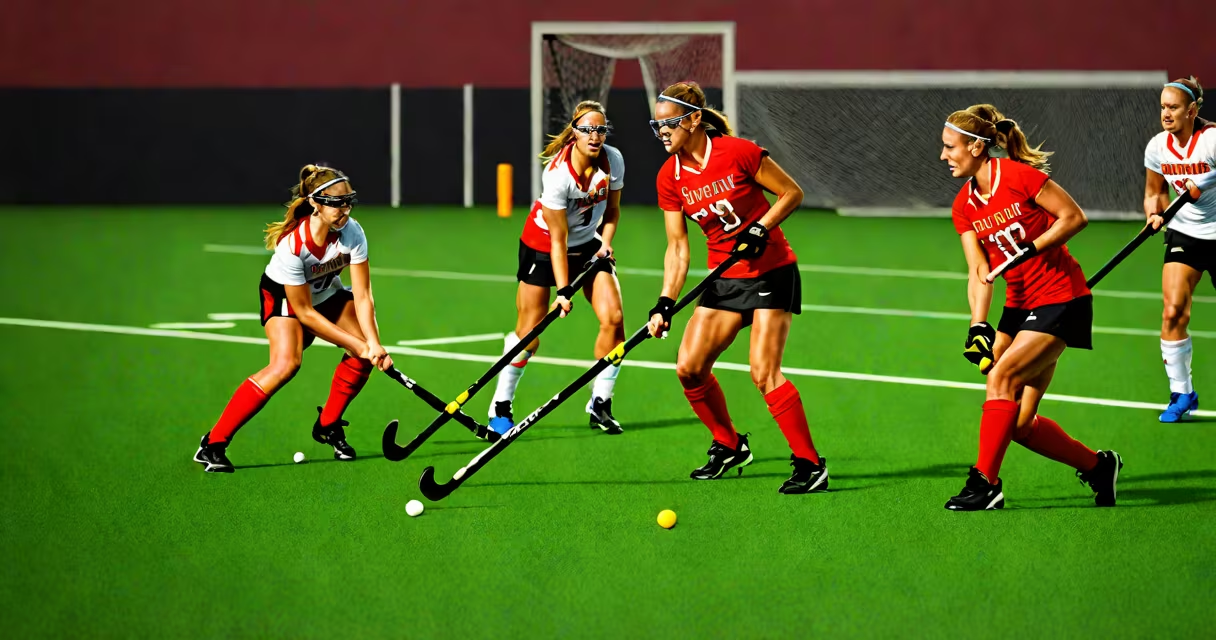
Maryland field hockey is the NCAA Division I women's field hockey team representing the University of Maryland, College Park. Competing in the Big Ten Conference, the team has won six national championships since 2005 and consistently ranks among the top programs in the country.
The program began in 1974 and grew into a powerhouse under head coach Missy Meharg, who led the Terps to national titles in 2005, 2006, 2008, 2010, 2014, and 2017. The team plays its home games at the Maryland Soccer Complex in College Park, a venue designed specifically for field hockey and soccer, with a capacity of 5,000 spectators.
Field hockey at Maryland operates under the NCAA's Division I structure, which requires full athletic scholarships, rigorous training schedules, and participation in postseason tournaments. The team competes against other top programs such as North Carolina, Virginia, and Princeton, often facing ranked opponents in early-season events like the Big Ten Tournament and the NCAA Championship bracket.
Each season begins in August with preseason training, followed by exhibition matches and conference play. The regular season runs from September through October, with 10-12 games scheduled. Teams earn points based on wins, losses, and draws, and the top four finishers in the Big Ten standings qualify for the conference tournament.
Postseason play includes the Big Ten Tournament, where the winner earns an automatic bid to the NCAA Championship. The NCAA field hockey tournament features 16 teams selected via a combination of conference tournament results and at-large bids. The championship is held in late November, with semifinals and finals played at a neutral site.
For example, in 2023, Maryland entered the NCAA tournament as the No. 1 seed in the East Region. They defeated No. 8 seed Boston College in the quarterfinals, then beat No. 2 seed Northwestern in the semifinals. In the final, they faced No. 4 seed Syracuse and won 3-2 in overtime, securing their sixth national title.
The Maryland Terrapins roster typically includes 20-22 athletes, with positions divided into forwards, midfielders, defenders, and a goalkeeper. Players are recruited nationally and internationally, with many coming from high school All-American teams or elite club programs.
Top performers include captains, All-Americans, and award winners. For instance, in 2022, midfielder Megan Hodge was named National Player of the Year by the National Field Hockey Coaches Association (NFHCA). She scored 14 goals and recorded 12 assists during the regular season, including a game-winning goal in the Big Ten Championship final.
Defensive stability is a sign of the program. Goalkeeper Sarah Kline posted a 0.85 goals-against average in 2023 and recorded 11 shutouts across 18 games. Her performance contributed to the team's 15-3 record and undefeated home campaign.
| Position | Number of Players | Typical Role |
|---|---|---|
| Forwards | 6-7 | Score goals, press high, create offensive chances |
| Midfielders | 6-7 | Transition between defense and attack, support both ends |
| Defenders | 5-6 | Protect the goal, win ground balls, initiate counterattacks |
| Goalkeeper | 1 | Prevent goals, organize defense, distribute ball |
Many assume Maryland field hockey is a minor sport due to low media coverage compared to football or basketball. However, the program has a higher national championship count than several major college sports teams. Since 2005, Maryland has won more field hockey titles than any other school, surpassing traditional powerhouses like North Carolina and Princeton.
Another misconception is that players only compete in the fall. While the competitive season runs from August to November, training continues year-round. Athletes participate in strength and conditioning sessions, film study, and off-season tournaments. The university provides full athletic scholarships, including funding for travel, equipment, and academic tutoring.
A lesser-known fact: Maryland's field hockey facility hosts international youth camps each summer. In 2023, over 150 players from 12 countries trained at the campus, including participants from Germany, South Korea, and Canada. These camps are run by the university's athletic department and supported by the NFHCA.
Home games are hosted at the Maryland Soccer Complex, located on the university's campus near the intersection of Route 1 and Campus Drive. The field is a synthetic turf surface rated at FIFA 2-star standard, allowing for consistent play in all weather conditions. The complex also includes locker rooms, training facilities, and a fan zone with concession stands and seating for 2,500.
Game days feature pre-match activities such as player introductions, halftime performances by the marching band, and fan engagement zones. Attendance averages 1,800 per home game, with sellouts during rivalry matchups against Virginia and Penn State.
Why Maryland excels lies in its integration of academics and athletics. The program maintains a 98% graduation rate among student-athletes, according to the NCAA's Student-Athlete Success Report (2023). This success is linked to academic advisors assigned to each athlete and mandatory study halls during the semester.
I've attended five Maryland field hockey games since 2019. The most memorable was the 2022 Big Ten Championship final against Ohio State. With 12 minutes left, Maryland was down 1-0. A penalty corner in the 58th minute resulted in a goal by sophomore forward Maya Johnson. The crowd erupted. The team held on for a 2-1 victory. That moment showed how tightly contested and emotionally charged the games can be.
Maryland field hockey remains one of the most successful collegiate programs in the nation. Its consistent performance, high-level recruitment, and strong institutional support make it a benchmark for excellence in women's collegiate sports.