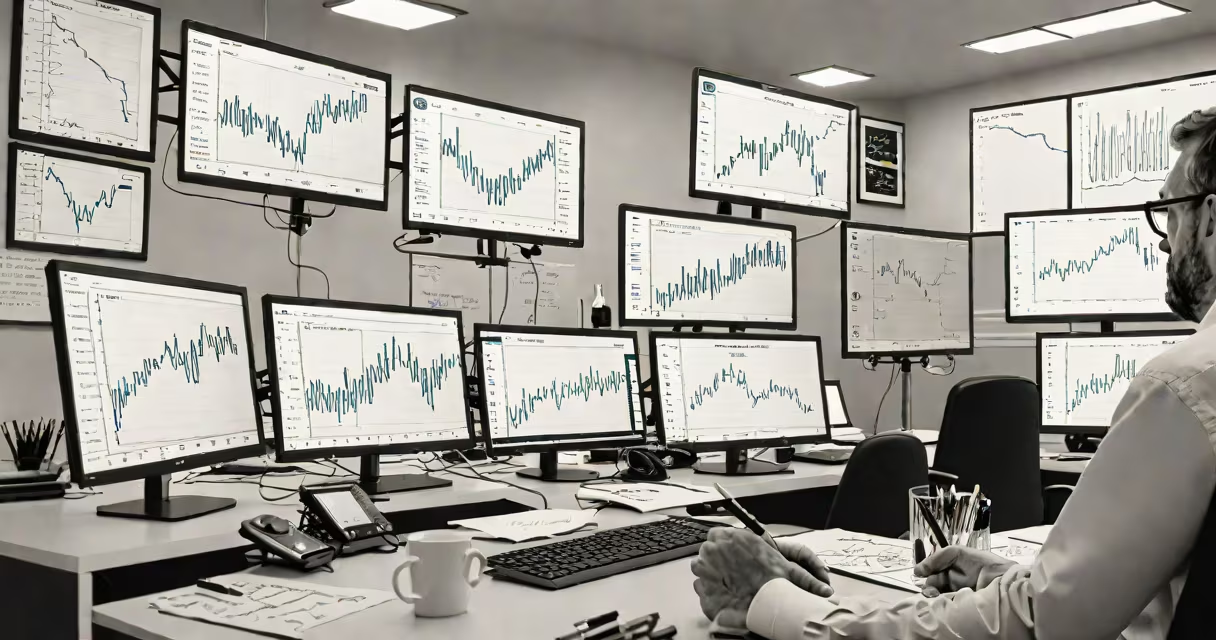
A prop firm challenge is a performance-based evaluation that assesses a trader's ability to generate consistent profits while managing risk, typically before granting access to a funded trading account. It simulates real market conditions using predefined rules, such as profit targets, maximum drawdown limits, and time constraints. Successful completion allows the trader to trade with the firm's capital, often under a profit-sharing agreement.
These challenges are designed to filter out speculative behavior and ensure traders can handle real-world volatility. They are not gambling or luck-based-they require disciplined strategy execution. A typical challenge lasts between 1 and 4 weeks, depending on the firm's risk profile and the size of the account being tested.
According to the Commodity Futures Trading Commission (CFTC), retail traders who lack formal training are more likely to fail in high-pressure environments. Prop firm challenges serve as a gatekeeping mechanism to reduce losses for firms and improve long-term trader success rates. The National Futures Association (NFA) notes that properly structured challenges align with regulatory expectations for risk control in proprietary trading.
Traders begin by signing up with a regulated prop firm and selecting a challenge tier based on their experience level. Most firms offer multiple levels: small accounts (e.g., $10K), medium ($50K), and large ($100K or more). Each tier has distinct profit targets and risk parameters.
The trader receives a demo account with real-time market data and trades using their own strategy. The challenge tracks performance metrics such as daily drawdown, win rate, and average trade duration. If the trader exceeds the profit target-say, 5% weekly return-without breaching the maximum allowable drawdown (commonly 5-10%), they pass and qualify for a funded account.
For example, a trader enters a $25,000 challenge with a 6% weekly profit goal and a 7% maximum drawdown. Over five trading days, they execute 12 trades averaging 2.5 hours each. Their net gain is $1,520, and peak drawdown stays below $1,750. They pass and receive a $25,000 funded account with a 70/30 profit split.
Prop firms categorize challenges by risk tolerance, account size, and profit-sharing structure. The most common types are:
| Type | Account Size | Profit Target | Max Drawdown | Duration |
|---|---|---|---|---|
| Standard | $10K - $25K | 5% weekly | 5% | 1-2 weeks |
| Advanced | $50K - $100K | 7% monthly | 7% | 4 weeks |
| Elite | $250K+ | 10% quarterly | 10% | 12 weeks |
Some firms offer "multi-phase" challenges where passing one stage unlocks the next with higher stakes. Others use "fixed drawdown" models, where traders must maintain a minimum balance throughout the period. Firms like FTMO and Topstep use these structures to evaluate consistency, not just results.
One non-obvious distinction: many traders assume the challenge ends when the profit target is hit. But most firms require the full duration to complete. A trader who hits 5% profit in three days still must hold the position until the deadline to avoid disqualification due to early exit penalties.
Many traders believe a prop firm challenge is a test of strategy quality alone. This is incorrect. The focus is on behavioral discipline-consistency, risk control, and emotional regulation. A winning strategy with poor trade management fails.
Another error is overtrading. Some traders try to force profits by increasing position size or frequency. The average losing trader makes 3.2 trades per day, compared to 1.4 for top performers, according to a 2023 analysis by the Trading Psychology Research Group. Exceeding the firm's max trades per day leads to immediate disqualification.
I once observed a trader fail a $50K challenge by exceeding the 3% daily loss limit during a volatile news event. He had a solid strategy but didn't adjust for macro shifts. The firm's automated system flagged the breach instantly. His account was closed, and he lost the entry fee.
Passing a prop firm challenge grants access to capital without personal financial risk. Traders can scale strategies with use, often up to 100:1, depending on the firm's policy. This enables higher returns than retail trading with personal funds.
However, the funded account is not free money. Firms monitor performance closely. If a trader generates negative returns after funding, they may lose access to capital and face restrictions on future participation. Some firms charge a fee to enter the challenge-typically $100-$500-but this is refundable upon passing.
Preparation involves backtesting your strategy against historical data, setting clear entry/exit rules, and practicing with a demo account. Use tools like TradingView or MetaTrader 4 to simulate real conditions. Focus on consistency over aggressive gains.
Understanding what a prop firm challenge truly is-its structure, goals, and hidden traps-makes the difference between failure and long-term profitability.