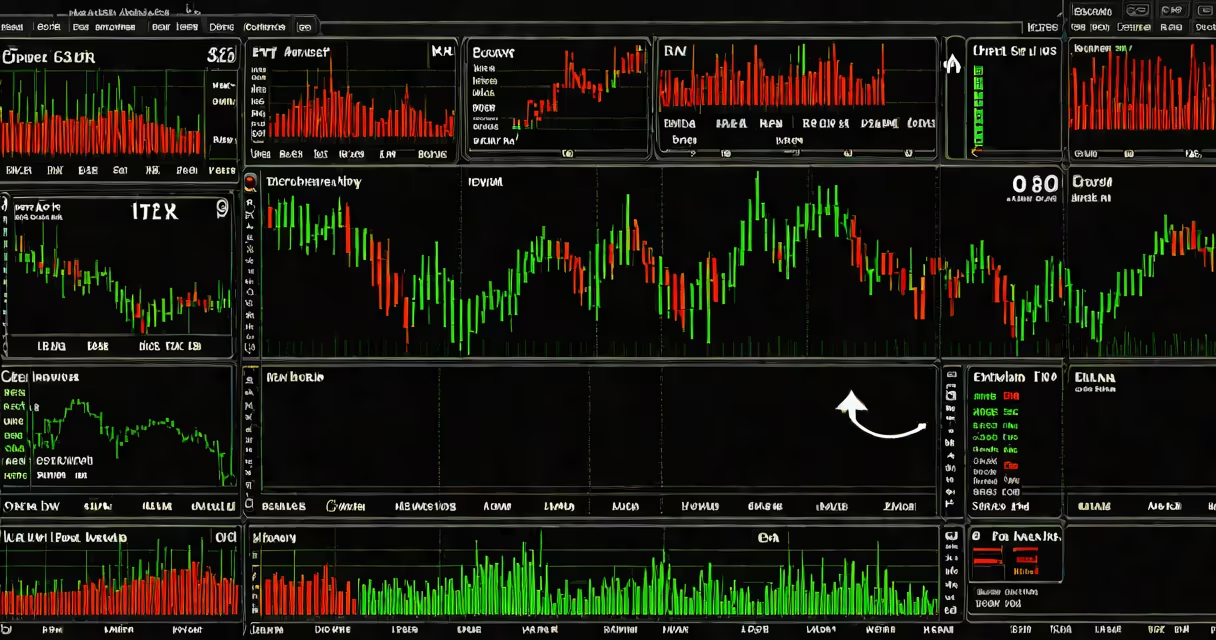
Forex trading is the practice of buying and selling currencies in the global foreign exchange market, where exchange rates fluctuate based on supply, demand, and economic factors. Traders aim to profit from price changes between currency pairs, such as EUR/USD or USD/JPY, using use and real-time market data.
The foreign exchange market operates 24 hours a day, five days a week, across major financial centers including London, New York, Tokyo, and Sydney. Unlike stock exchanges, forex trades occur over-the-counter (OTC), meaning transactions happen directly between banks, institutions, and brokers rather than through a centralized exchange. This decentralized structure allows for high liquidity and low transaction costs.
According to the Bank for International Settlements (BIS), daily global forex turnover reached $7.5 trillion in 2022, making it the largest financial market by volume. Retail traders access this market through online brokers who act as intermediaries, providing platforms, pricing, and execution services. The most common instruments traded are spot contracts, forward agreements, and futures, though spot forex dominates retail activity.
Each forex trade involves two currencies: a base currency and a quote currency. For example, in EUR/USD, the euro is the base currency, and the U.S. dollar is the quote. A quote of 1.1000 means one euro buys 1.10 U.S. dollars. If the rate rises to 1.1100, the euro has appreciated against the dollar, and a long position profits.
Trades are executed via margin accounts, allowing traders to control large positions with small capital. A standard use ratio of 50:1 means $1,000 in equity can control $50,000 in currency value. While use amplifies gains, it also increases risk. A 2% move against a leveraged position can erase 100% of the account balance.
Market participants include central banks, commercial banks, hedge funds, multinational corporations, and individual traders. Central banks influence exchange rates through interest rate policy and direct intervention. For example, when the U.S. Federal Reserve raises rates, the dollar often strengthens because higher yields attract foreign capital.
Forex markets operate primarily in currency pairs, grouped by geography and economic significance. Major pairs involve the U.S. dollar and are the most liquid. Examples include:
| Currency Pair | Base Currency | Quote Currency | Common Name |
|---|---|---|---|
| EUR/USD | Euro | U.S. Dollar | "Fiber" |
| USD/JPY | U.S. Dollar | Japanese Yen | "Dollar Yen" |
| GBP/USD | Pound Sterling | U.S. Dollar | "Cable" |
| AUD/USD | Australian Dollar | U.S. Dollar | "Aussie" |
Minor pairs exclude the U.S. dollar, such as EUR/GBP or AUD/JPY. These have lower liquidity and wider spreads. Exotic pairs, like USD/TRY (U.S. dollar/Turkish lira), involve emerging market currencies and carry higher volatility and risk due to political instability and limited market depth.
Trades are categorized by time horizon: scalpers hold positions for seconds to minutes, day traders close all positions before the market closes, swing traders hold for days to weeks, and position traders maintain holdings for months. Each strategy requires different tools, risk management, and analytical focus.
Many assume forex trading is like gambling or that consistent profits are easy to achieve. The reality, supported by research from the U.S. Commodity Futures Trading Commission (CFTC), is that 70-80% of retail forex traders lose money within their first year. This outcome stems from poor risk management, emotional decision-making, and underestimating use effects.
Another misconception is that forex markets are manipulated by large institutions. While institutional players have greater capital and information access, the sheer size and decentralization of the market limit manipulation. Price movements reflect macroeconomic data, geopolitical events, and monetary policy shifts-not coordinated schemes.
A non-obvious fact: many retail traders fail not because they lack skill, but because they trade too frequently. A 2021 study published in the Journal of Behavioral Finance found that traders who executed more than 10 trades per month had lower success rates than those averaging fewer than three trades monthly. Overtrading leads to increased transaction costs and emotional fatigue.
Suppose a trader opens a position at 1.0850 for 10,000 units (one standard lot) of EUR/USD. The broker offers 50:1 use, so the required margin is $2,170 (10,000 × 1.0850 ÷ 50). The trader sets a stop-loss at 1.0750 and a take-profit at 1.0950.
Over the next 12 hours, the euro strengthens due to stronger-than-expected German manufacturing data. The rate climbs to 1.0950. The trader's position closes automatically at the take-profit level. Profit = (1.0950 - 1.0850) × 10,000 = $100. With 50:1 use, the return on margin is 4.6% ($100 ÷ $2,170).
If the rate had dropped to 1.0750, the stop-loss would have triggered, limiting loss to $100. Without the stop-loss, the loss would have grown rapidly due to use. This illustrates why risk controls are essential in forex trading definition.
For beginners, understanding the mechanics of how to do forex trading begins with paper trading and studying historical patterns. Real-world experience with a demo account reduces emotional bias and improves discipline. Many successful traders spend six months to a year simulating trades before risking real capital.
Historically, the forex market evolved from fixed exchange rates under the Bretton Woods system to floating rates after 1971. The shift allowed currencies to be priced by market forces. Today's market reflects decades of technological advancement, algorithmic trading, and global integration. Understanding this history clarifies why certain currencies remain dominant and how regulations have shaped modern trading practices.
Forex trading definition is not just about buying low and selling high. It's about managing risk, interpreting signals, and adapting to shifting conditions. Success comes from consistency, not luck. Traders who treat it as a disciplined process outperform those chasing quick wins.