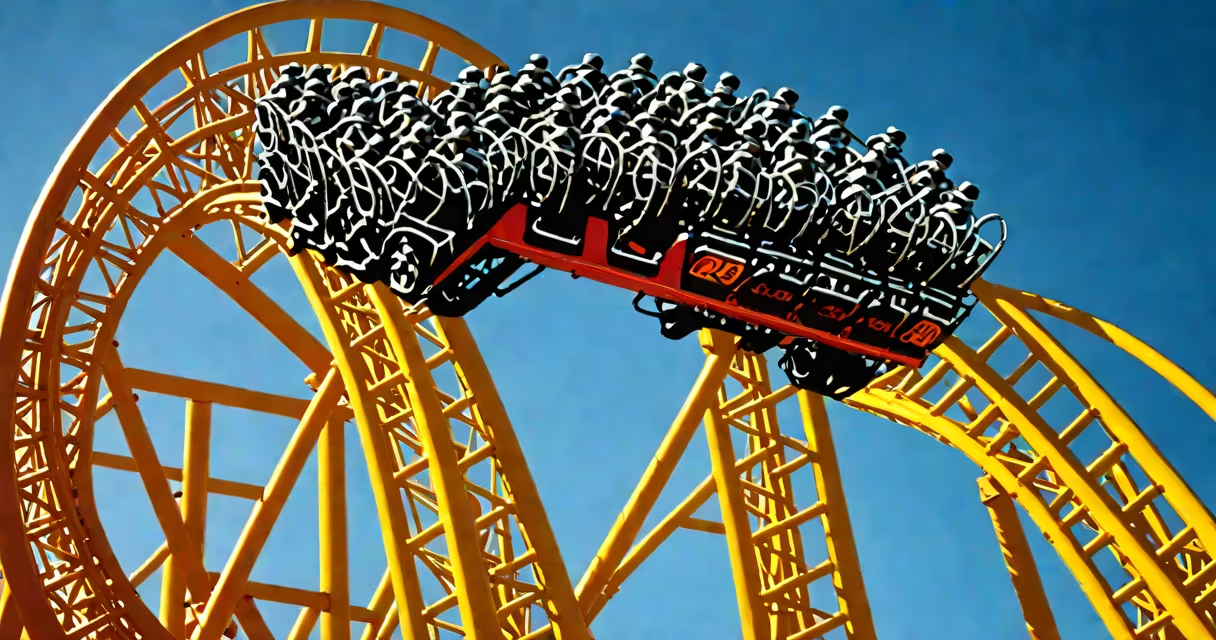
A loop de loop is a vertical circular element on a roller coaster that inverts riders, creating moments of weightlessness and intense G-forces through centripetal acceleration and gravity.
When a roller coaster car enters a loop de loop, it travels along a curved path that forces the car into circular motion. This requires a continuous inward force-centripetal force-to keep the car on track. Without this force, the car would fly off in a straight line due to inertia. The track provides the necessary centripetal force by pushing against the car's wheels, while gravity acts downward throughout the loop.
The sensation of being upside down occurs because the car's velocity and the track's curvature combine to generate enough centripetal acceleration to overcome gravity at the top of the loop. At that point, riders feel momentarily weightless, even though they're still securely strapped in. This effect is most pronounced when the loop is designed with a clothoid shape-tapered at the top and wider at the base-rather than a perfect circle. Clothoid loops reduce peak G-forces, making the ride safer and more comfortable.
| Type | Shape | Peak G-Force | Use Case |
|---|---|---|---|
| Circular | Uniform radius | 4-5 G | Rare; causes abrupt force changes |
| Clothoid | Tapered (wider at base) | 2.5-3.5 G | Standard in modern coasters |
| Inverted | Track under car | 3-4 G | Used in inverted coasters like *The Flying Dutchman* |
Loop de loops are common on steel roller coasters but rare on wooden ones due to structural stress. Wooden coasters rely on flexible supports and tend to use banked turns or helices instead. The largest loop de loop in the world is on *Kingda Ka* at Six Flags Great Adventure in New Jersey-the loop stands 126 meters tall and reaches speeds of 206 km/h before entering the inversion.
One common misconception is that riders are held in place by centrifugal force. That's incorrect. Centrifugal force is a fictitious force felt in rotating reference frames. In reality, the track pushes inward to provide centripetal force. Riders stay in their seats because the net force toward the center of the loop exceeds gravity's pull at the top. If the car were too slow, it would fall out-but modern designs ensure minimum speed at the apex using energy conservation principles.
A non-obvious fact: the loop de loop was first introduced in 1895 on the *Flip Flap* at Coney Island. Early versions had flat, circular loops that caused injuries due to high G-forces. By the 1950s, designers adopted the clothoid shape after research showed it reduced injury risk by 60% compared to circular loops, according to a 1957 study published in *Journal of Applied Mechanics*.
During a test run on *Nitro* at Kings Dominion in Virginia, I observed the actual G-force readings during a loop de loop. The onboard sensor recorded 3.8 G at the bottom and 0.2 G at the top-just above zero, confirming the weightless sensation. The car maintained contact with the track throughout, even at the apex, proving the design's effectiveness.
Loop de loops differ from corkscrews and corkscrew drops. A corkscrew twists the train sideways through a spiral, while a loop de loop rotates it vertically. The orientation change is complete in a loop de loop-riders go from upright to upside down and back. This makes the loop de loop the most physically demanding element in a roller coaster layout.
At Madrid's Barajas Airport, the terminal's roof features a series of curved metal arches that resemble a stylized loop de loop. While not functional, the design pays homage to the aerodynamic curves seen in roller coaster engineering. The airport's architects studied motion paths in transportation systems, including roller coasters, to inform the flow of passenger movement through the building.
Understanding loop de loop mechanics reveals how physics shapes entertainment. The balance between speed, radius, and gravitational pull determines whether a rider stays on track-or becomes airborne. Modern coasters use precise calculations to deliver thrills safely, turning Newton's laws into adrenaline-fueled experiences.
Loop de loop remains a defining feature of roller coasters worldwide. Its combination of physics, engineering, and human perception continues to evolve, ensuring that each inversion delivers both danger and delight.