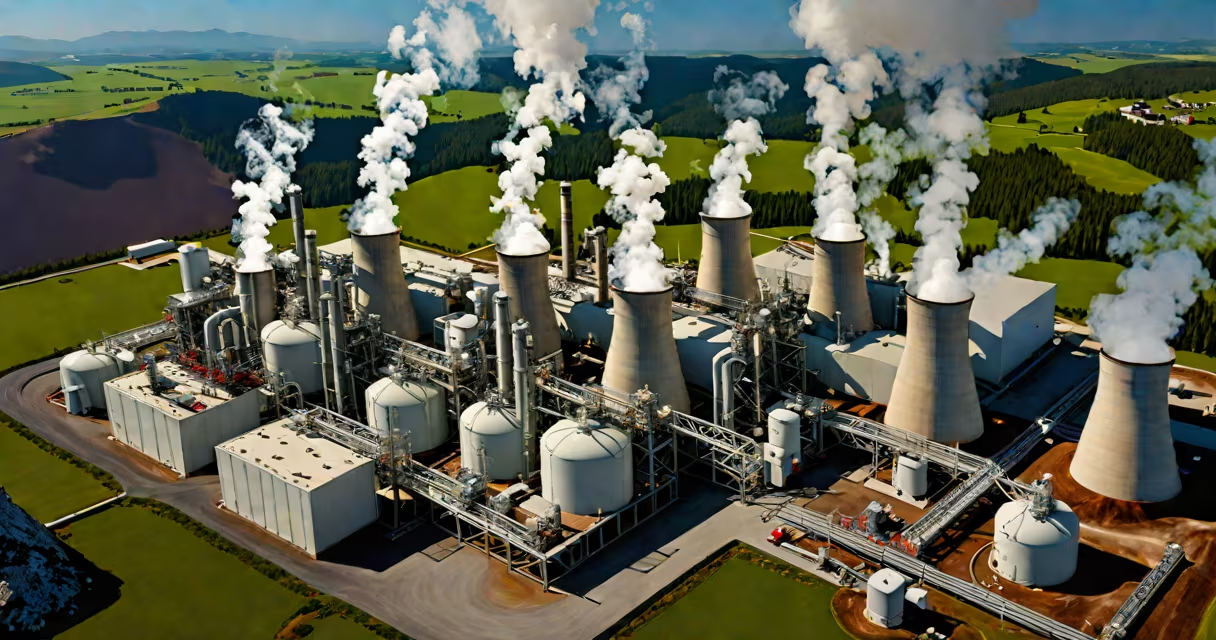
A geothermal power plant generates electricity by tapping into heat stored beneath the Earth's surface, using steam or hot water from underground reservoirs to turn turbines connected to generators. This process relies on natural heat from the planet's core, making it a continuous and low-emission energy source.
Geothermal plants operate by drilling wells into underground reservoirs where temperatures exceed 150°C (302°F). Water or steam drawn from these depths drives turbines, which spin generators to produce electricity. The system recycles most of the fluid back into the ground to maintain pressure and sustain the resource long-term.
The U.S. Department of Energy reports that geothermal plants have a capacity factor of 90% or higher-meaning they run nearly continuously-compared to solar at 25% and wind at 45%. This stability stems from the consistent thermal output of deep earth heat, unlike weather-dependent renewables.
Each geothermal power plant contains four key systems: the wellhead, heat exchanger, turbine-generator, and reinjection system. Wells drilled 1 to 3 kilometers deep access hot rock formations or hydrothermal reservoirs. Fluids extracted reach temperatures between 150°C and 370°C, depending on location and depth.
Once brought to the surface, the fluid enters a separator. In flash steam plants, high-pressure hot water flashes into steam when pressure drops. In binary cycle plants, the hot fluid heats a secondary working fluid with a lower boiling point-like isobutane-through a heat exchanger. That secondary fluid vaporizes and spins the turbine.
After passing through the turbine, the working fluid is cooled and condensed back into liquid form. The cooled fluid returns to the injection well, completing the closed loop. This reinjection maintains subsurface pressure and prevents land subsidence-a common issue in older oil and gas fields.
There are three primary designs: dry steam, flash steam, and binary cycle. Dry steam plants are rare today but were the first commercial systems, used at The Geysers in California since 1960. They draw steam directly from underground and route it to turbines.
Flash steam plants dominate global installations. They extract high-pressure hot water, reduce pressure to release steam, and use that steam to drive turbines. After expansion, the remaining liquid is injected back underground. These plants require reservoirs with temperatures above 180°C.
Binary cycle plants are growing rapidly due to their ability to use lower-temperature resources (90-150°C). They don't release steam into the atmosphere. Instead, they transfer heat via a heat exchanger to a secondary fluid with a low boiling point. This design reduces emissions and allows deployment in areas previously unsuitable for geothermal energy.
| Type | Operating Temp Range | Efficiency | Use Case |
|---|---|---|---|
| Dry Steam | ≥230°C | 10-15% | High-temp sites like The Geysers |
| Flash Steam | 180-370°C | 10-15% | Most common worldwide |
| Binary Cycle | 90-150°C | 7-12% | Low-to-mid temp regions, expanding use |
According to the International Renewable Energy Agency (IRENA), binary cycle plants now account for over 40% of new geothermal capacity added globally since 2015. Their efficiency is improving with advanced heat exchangers and better working fluids.
Geothermal power is concentrated in tectonically active zones-regions where Earth's crust is thin or fractured. Countries like Iceland, Kenya, Indonesia, and the United States host the majority of operational plants. The U.S. leads with 3.7 gigawatts of installed capacity, mostly in California and Nevada.
Iceland uses geothermal for 25% of its electricity and nearly 90% of its space heating. Reykjavík's district heating network runs on geothermal steam from nearby volcanic zones. This integration reduces reliance on imported fossil fuels and cuts urban carbon emissions.
One overlooked fact: geothermal plants can co-produce valuable minerals. At the Salton Sea geothermal field in California, researchers extract lithium from brine during power generation. A single plant can yield up to 100 kg of lithium annually-enough for 10 electric vehicle batteries. This dual-use capability increases economic viability.
Many assume geothermal plants emit large amounts of greenhouse gases. In reality, they release less than 5% of the CO₂ per kWh compared to coal plants. Most emissions come from dissolved gases in the fluid-mainly CO₂ and hydrogen sulfide-captured and processed before release.
Another misconception is that geothermal energy is limited to volcanic regions. While high-temperature sites are often near tectonic boundaries, enhanced geothermal systems (EGS) can create artificial reservoirs in stable rock. By injecting water into hot dry rock, engineers simulate natural reservoirs. Projects in Utah and Germany are testing EGS to expand geothermal potential beyond traditional zones.
During a site visit to the Hellisheiði Power Station in Iceland, I observed the control room monitoring 14 turbines operating simultaneously. The plant produces 300 MW of electricity and supplies heat to 90% of Reykjavík's buildings. The visual of steam rising from cooling towers against a snowy backdrop confirmed how cleanly this energy source operates.
Geothermal plants have a small land footprint-about 1 hectare per megawatt-compared to solar farms, which need 5 to 10 hectares per megawatt. They also avoid the intermittency issues of wind and solar, providing baseload power without storage needs.
Despite these advantages, upfront costs remain high. Drilling deep wells costs $1 million to $3 million per well. However, once operational, maintenance and fuel costs are minimal. The levelized cost of electricity (LCOE) for geothermal is $0.05 to $0.10 per kWh-competitive with wind and solar in favorable locations.
For context, the average U.S. household consumes about 890 kWh per month. A single 100 MW geothermal plant can power approximately 75,000 homes annually. At current rates, that's enough to supply electricity to a medium-sized city.
Geothermal energy is sustainable because the heat extracted is replenished slowly by radioactive decay in Earth's mantle. The U.S. Geological Survey estimates that the planet's accessible geothermal energy exceeds 100 times current global electricity demand. This vast potential remains underutilized due to exploration risks and regulatory delays.
Understanding how a geothermal power plant works reveals a clean, reliable energy solution rooted in Earth's natural heat. From the drill hole to the generator, each stage transforms subterranean warmth into usable electricity with minimal environmental impact.