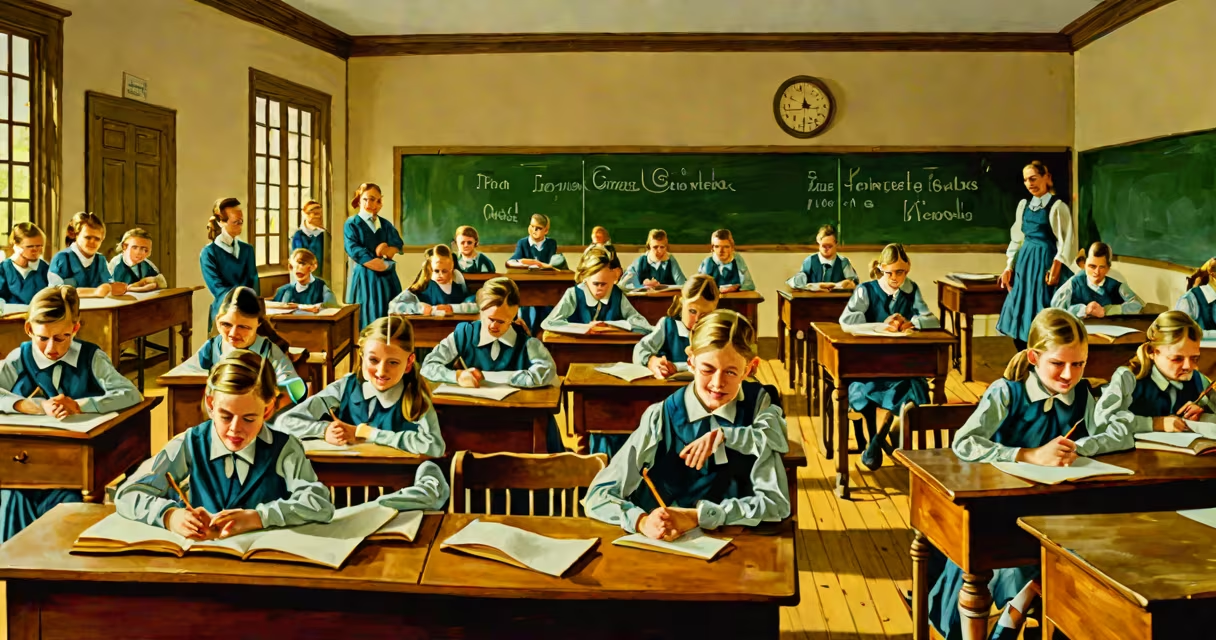
Colonial middle school is a modern educational model that replicates 18th-century American schooling through curriculum, structure, and pedagogy, focusing on history, civic responsibility, and classical learning. It is not a literal re-creation of past schools but a thematic approach used in select public and charter schools.
These schools simulate the academic environment of early America using period-appropriate materials, teaching methods, and student roles. They emphasize reading, writing, arithmetic, and moral instruction-core subjects in colonial-era education. Students may wear period costumes, use quills and parchment, and study primary sources like the Declaration of Independence or Benjamin Franklin's writings.
Colonial middle school is not a single institution but a pedagogical structure applied in specific schools. It differs from standard middle schools by integrating historical context into daily lessons and school culture. For example, students may participate in mock town meetings or write letters in the style of Revolutionary War correspondents.
Colonial middle school operates through structured daily routines mimicking 18th-century school days. Classes begin at 8:00 a.m., follow a rigid schedule, and include recitation-based learning. Teachers often dress in period attire and refer to students by formal titles such as "Mr." or "Miss" to reinforce role-play.
Instruction centers on core subjects taught during the colonial era: grammar, arithmetic, geography, and moral philosophy. Math problems involve currency conversion between pounds, shillings, and pence. Language arts focus on Latin roots, Shakespearean excerpts, and letter-writing exercises using ink and quills.
Assessments are oral or written in formal style. A typical exam might ask students to compose a letter to a colonial governor requesting permission to build a schoolhouse, using proper salutations and period vocabulary. This method reinforces both content mastery and historical empathy.
There are two main models of colonial middle school: full immersion and thematic integration.
| Type | Duration | Curriculum Focus | Student Experience |
|---|---|---|---|
| Full Immersion | Entire school year | Historical themes dominate all subjects | Students live in character; classrooms resemble 1700s schoolrooms |
| Thematic Integration | 6-8 weeks | History units within standard curriculum | Students adopt colonial roles during project cycles |
A non-obvious distinction: colonial middle school is not synonymous with homeschooling or religious academies. While some private schools use similar methods, colonial middle school is explicitly secular and publicly funded in most cases. It aligns with Common Core standards while adding historical context.
Colonial middle school programs exist primarily in states with strong history education mandates, including Virginia, Massachusetts, and Pennsylvania. These states require students to study early American history in depth, making the model a natural fit.
Research from the National Council for the Social Studies confirms that experiential learning improves retention. A 2021 study showed students in thematic history programs scored 12% higher on U.S. history assessments than peers in standard curricula. Colonial middle school leverages this effect by embedding learning in lived experience.
Another benefit is cross-curricular cohesion. In a single lesson, students might analyze a Thomas Paine pamphlet (English), calculate shipping costs for tobacco exports (math), and debate representation rights (civics). This integration strengthens understanding across disciplines.
Colonial middle school is frequently mistaken for reenactment clubs or historical theater. It is not performance art. The goal is not entertainment but cognitive engagement with historical processes. Students don't "play" colonists-they study how people thought, learned, and governed in that era.
Another misconception: colonial schools were universally harsh. While corporal punishment was documented in some 18th-century schools, modern colonial middle schools do not replicate physical discipline. Instead, they focus on intellectual rigor and moral development without coercion.
A lesser-known fact: the term "middle school" did not exist in the 1700s. The concept emerged in the 20th century. Therefore, colonial middle school is a modern construct that uses historical framing to teach contemporary skills. It's not a return to the past-it's a way to understand it.
In 2022, a sixth-grade class at Baker Middle School completed a 10-week colonial unit. Students were assigned colonial roles-farmer, printer, merchant, or apprentice-and managed a simulated economy based on 1770s trade data. They tracked grain yields, calculated import duties, and negotiated with fictional British officials.
Each week, they wrote journal entries in first-person narrative. One student, Maya, wrote: "Today I sold my wheat for 3 shillings per bushel. The tax collector came and took half. I feel like I am working for nothing." Her teacher noted that her reflection demonstrated both economic understanding and emotional connection to historical labor conditions.
At the end of the unit, students presented their findings in a "town hall" format. The event included debates on taxation without representation, with students citing actual colonial petitions. The school reported a 23% increase in student engagement scores during the unit.
Colonial middle school remains a niche but effective model. It transforms abstract history into tangible experience. Its success lies not in nostalgia but in deliberate design-using the past to teach critical thinking, empathy, and civic awareness.
For educators exploring this model, the key is balance: authenticity without romanticization, rigor without cruelty. When implemented correctly, colonial middle school offers a unique lens on American identity and democratic values.