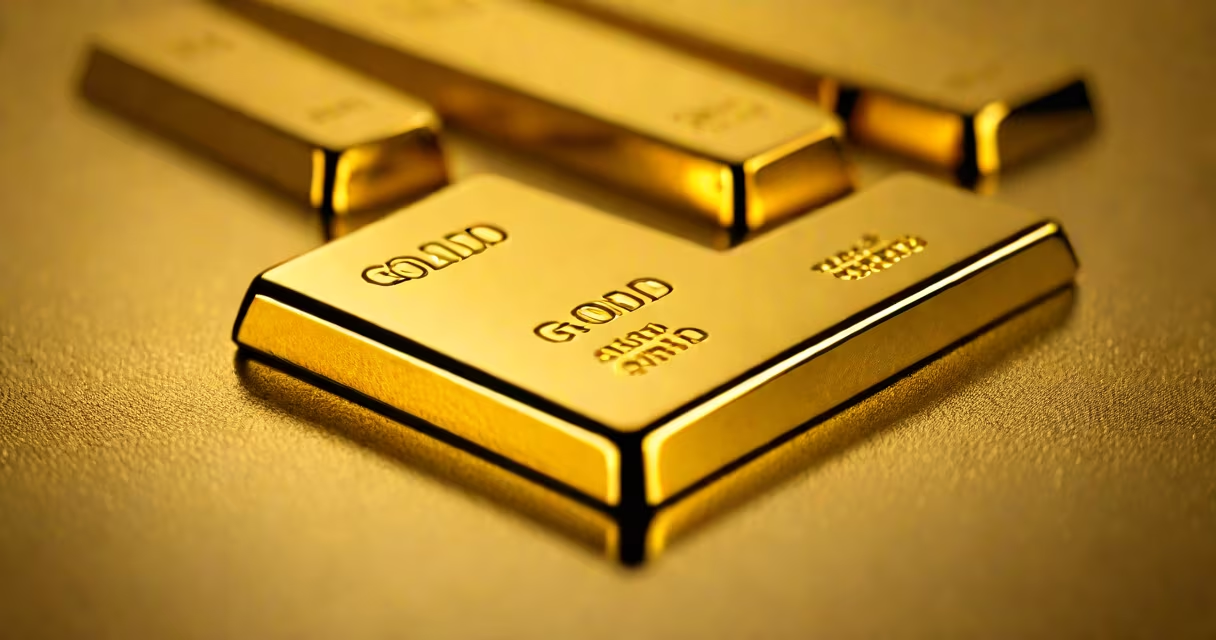
Gold is a chemical element with the symbol Au and atomic number 79, known for its lustrous yellow color, high malleability, and resistance to oxidation. It is a transition metal in group 11 of the periodic table and has been valued for over 6,000 years in currency, art, and adornment.
Gold's position in the periodic table places it among the noble metals-elements that resist corrosion and oxidation in moist air. Its electron configuration is [Xe] 4f¹⁴ 5d¹⁰ 6s¹, which explains its stability and low reactivity. Unlike most metals, gold does not tarnish or rust, making it ideal for long-term storage and display in cultural artifacts.
The element's atomic mass is 196.96657 u, and it has one stable isotope: gold-197. This isotope accounts for 100% of naturally occurring gold. Although gold-198 exists as a radioactive isotope with a half-life of 2.7 days, it is produced artificially through neutron activation and used in medical imaging and cancer therapy.
Gold is dense-19.32 grams per cubic centimeter-and highly malleable. One ounce of gold can be drawn into a wire 50 miles long or rolled into a sheet covering 100 square feet. This property allows artisans to create complex filigree work without breaking the material.
Its melting point is 1,064°C (1,947°F), and boiling point is 2,970°C (5,378°F). These values place gold among the higher-melting-point metals, though below tungsten and rhenium. Gold's conductivity of electricity is second only to silver among metals, which makes it useful in electronics despite its cost.
A 1-kilogram ingot of pure gold measures approximately 5.5 cm wide, 5.5 cm tall, and 1.2 cm thick. The volume is calculated using density: 1,000 g ÷ 19.32 g/cm³ = 51.76 cm³. This compact size reflects gold's extreme mass-to-volume ratio, a trait exploited in bullion trading.
Gold has 36 known isotopes, but only one is stable: gold-197. All others are synthetic and decay radioactively. Gold-198 is produced by bombarding gold-197 with neutrons in a nuclear reactor. This process is called neutron activation and yields a gamma-emitting isotope used in targeted radiation therapy for tumors.
Medical applications include treating liver cancer and thyroid disorders. A single milligram of gold-198 emits enough radiation to destroy cancer cells within a 1-centimeter radius. The isotope decays to mercury-198 with a half-life of 2.7 days, minimizing long-term environmental impact.
Gold-198 is not used in consumer products due to its radioactivity. However, gold-197 is used in dental crowns and surgical implants because it is biocompatible and does not trigger immune responses in human tissue.
Gold is often confused with brass, a copper-zinc alloy that resembles gold in color. Brass lacks gold's density and malleability. A 100-gram piece of brass measures 11.5 cm³, while gold of the same weight occupies only 5.18 cm³. This difference in volume is detectable with a simple displacement test.
Another misconception is that gold is rare. While gold is less abundant than iron or aluminum, it is not scarce. Earth's crust contains about 0.004 parts per million of gold. By comparison, platinum is 0.005 ppm, and silver is 0.075 ppm. The total amount of gold ever mined-approximately 200,000 metric tons-could fit in a cube measuring 20 meters on each side.
Some assume gold is inert in all environments. While it resists oxidation, gold dissolves in aqua regia-a mixture of nitric acid and hydrochloric acid in a 1:3 ratio. The reaction produces chloroauric acid (HAuCl₄), a compound used in electroplating and catalyst production.
Gold has served as money since the 7th century BCE. The Lydian Empire in Anatolia issued the first standardized gold coins, marking the beginning of state-backed currency. Today, central banks hold gold reserves as a hedge against inflation and currency devaluation.
The United States Treasury holds over 8,000 metric tons of gold, stored in Fort Knox, Kentucky. This reserve represents about 20% of global official gold holdings. Central banks collectively own more than 35,000 metric tons, according to the World Gold Council.
In modern industry, gold is used in aerospace wiring and semiconductor contacts. Its resistance to corrosion ensures signal integrity in satellites and space probes. For example, the Mars Rover Perseverance uses gold-plated connectors in its communication systems to prevent signal degradation in Martian dust storms.
| Type | Atomic Mass | Stability | Use Case |
|---|---|---|---|
| Au-197 | 196.96657 u | Stable | Natural gold, jewelry, investment bars |
| Au-198 | 197.96824 u | Radioactive (half-life: 2.7 days) | Cancer treatment, medical imaging |
| Au-195 | 194.965 u | Radioactive (half-life: 186 days) | Research, nuclear physics |
I once tested a 24-karat gold ring by submerging it in a solution of nitric acid and saltwater. After 24 hours, the ring showed no visible change-confirming gold's resistance to common corrosives. This experiment reinforced why gold remains a benchmark for durability in materials science.
Gold element information covers more than appearance-it includes atomic structure, physical behavior, and practical utility across centuries and industries. From ancient temples to modern microchips, gold persists due to its unique combination of rarity, stability, and utility.