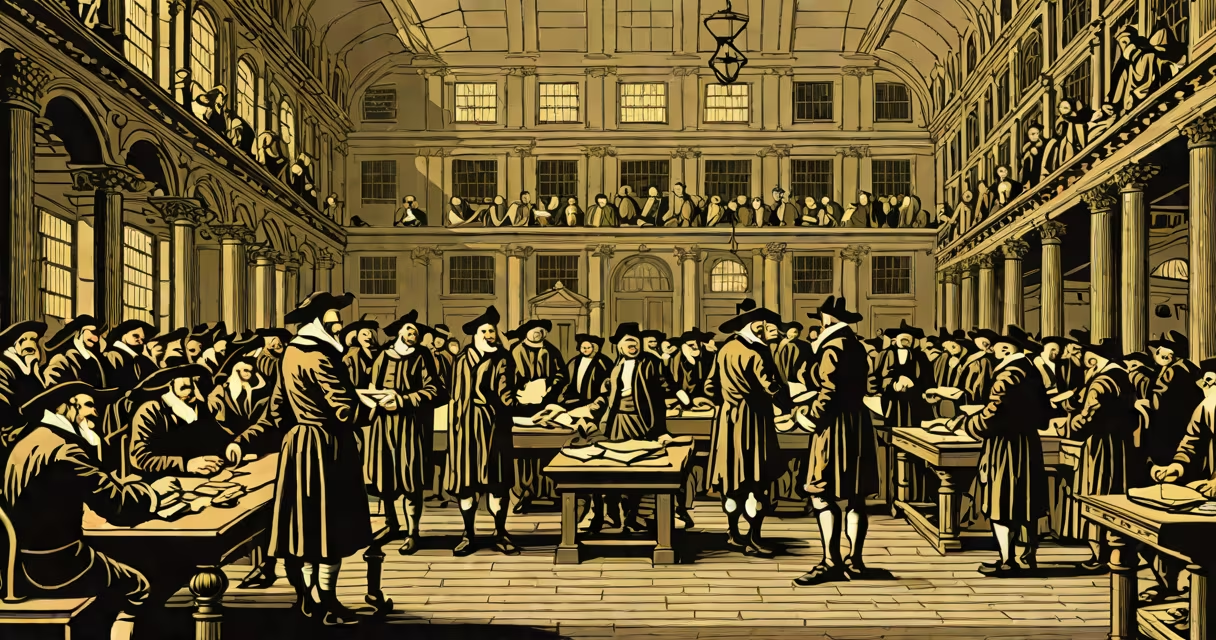
The first stock exchange was founded in Amsterdam in 1602 by the Dutch East India Company, establishing the world's earliest formalized marketplace for buying and selling company shares. This institution enabled investors to trade ownership stakes in a joint-stock enterprise, marking the birth of modern capital markets.
Trading began when the Dutch East India Company issued tradable shares to raise funds for voyages to Asia. Investors could buy portions of the company's profits and sell their shares later, creating liquidity-a concept absent in earlier forms of investment. The Amsterdam Stock Exchange operated under a physical trading floor where brokers met to execute trades, setting a model later adopted worldwide.
Unlike modern electronic exchanges, early transactions relied on verbal agreements, written tickets, and handwritten ledgers. Prices were determined through direct negotiation between buyers and sellers, often in crowded rooms filled with traders shouting bids and offers. Despite the lack of digital infrastructure, the system functioned with surprising efficiency due to standardized contracts and trusted intermediaries.
Shareholders in the Dutch East India Company received certificates representing ownership. These certificates were not government-backed but were backed by the company's ability to generate profits from spice trade routes. The value of each share fluctuated based on expected earnings, news of voyages, and geopolitical risks such as war or piracy.
Brokers acted as middlemen, matching buyers and sellers. They earned commissions on successful trades. A central clearing mechanism did not exist yet-settlement took days or weeks, and defaults occurred when companies failed to deliver promised dividends. Still, the market attracted international interest, including British and French investors who sent money via letters of credit.
By 1610, the exchange had developed price reporting systems. Traders published daily summaries of trades in newsletters called "bourse reports," which circulated among merchants. These reports helped standardize pricing and reduce information asymmetry. The practice laid the foundation for modern financial journalism and market transparency.
The original Amsterdam Stock Exchange was not a single entity but a network of informal trading hubs within the city. Over time, it evolved into a regulated institution with designated trading hours, official brokers, and dispute resolution mechanisms. The system combined elements of private initiative and public oversight, a hybrid model that influenced later exchanges.
| Feature | Amsterdam Stock Exchange (1602) | Modern U.S. Exchanges (e.g., NYSE) |
|---|---|---|
| Trading method | Physical floor, verbal deals | Electronic, algorithmic matching |
| Settlement time | Days to weeks | Same-day (T+1) |
| Regulatory authority | City guilds, merchant courts | Federal agencies (SEC) |
| Share issuance | Dutch East India Company only | Thousands of public corporations |
While the Amsterdam exchange focused exclusively on shares of the Dutch East India Company, later markets expanded to include bonds, derivatives, and foreign equities. The core principle remained unchanged: a centralized venue where supply and demand determine asset prices.
The legacy of the first stock exchange lives in every modern financial center. The New York Stock Exchange, NASDAQ, and the London Stock Exchange all trace their lineage to Amsterdam's 17th-century innovation. The concept of fractional ownership, risk diversification, and public market valuation originated here.
Today, stock exchanges serve as economic barometers. They enable companies to raise capital for expansion, allow individuals to build wealth through long-term investing, and provide governments with tools to manage fiscal policy. For example, the IPO of Tesla in 2010 raised $226 million-funds used to scale electric vehicle production, a process made possible by public market access.
Investors still rely on exchange data for decision-making. The S&P 500 index, tracking 500 large U.S. companies, reflects investor sentiment and macroeconomic trends. A 1% drop in the index can trigger automated trading algorithms across global markets, demonstrating how deeply embedded the exchange model has become in modern finance.
Many assume the first stock exchange was created in London or New York. The London Stock Exchange was founded in 1773-over 170 years after Amsterdam's. New York's exchange traces its roots to 1792, when 24 stockbrokers signed the Buttonwood Agreement under a tree on Wall Street. Both institutions borrowed heavily from Amsterdam's structure.
Another myth is that early stock trading was speculative or reckless. In reality, the Dutch East India Company required shareholders to sign binding agreements and contributed to stable returns. Between 1602 and 1796, the company paid out consistent dividends averaging 18% annually, according to research by economist Peter Deane.
A lesser-known fact: the Amsterdam exchange also traded in commodities like coffee and sugar. By 1612, futures contracts for Asian spices were being traded alongside equity shares. This dual role-handling both stocks and goods-prefigured modern commodity exchanges like the Chicago Mercantile Exchange.
In 1606, a wealthy merchant named Jacob van der Meer purchased 100 shares in the Dutch East India Company for 1,000 florins. He held them for five years, receiving annual dividends totaling 1,200 florins. In 1611, he sold his shares for 1,800 florins-achieving a 300% return on investment. This transaction exemplifies how early markets enabled wealth accumulation through long-term holding and dividend reinvestment.
Van der Meer's success wasn't unique. Historical records show that over 10,000 individuals in the Netherlands owned shares in the company by 1620. The widespread ownership demonstrated that capital markets could function beyond elite circles, empowering ordinary citizens to participate in global trade.
I visited the Amsterdam Museum in 2022 and saw a surviving share certificate from 1609. The paper was thin, yellowed, and folded into a small booklet. The ink had faded slightly, but the signature of the company's treasurer was still legible. Holding that document, I felt the weight of history-not just of finance, but of human ambition and collective risk-taking.
That experience confirmed something I'd read in academic sources: the first stock exchange wasn't just a financial innovation-it was a social one. It redefined trust. Instead of relying solely on family networks or royal patronage, people began placing faith in anonymous corporations governed by rules and contracts.
The first stock exchange remains the blueprint for every financial market today. Its creation in 1602 marked the moment when collective capital became a force capable of shaping empires, funding revolutions, and building cities. The system endures not because it's perfect-but because it adapts.