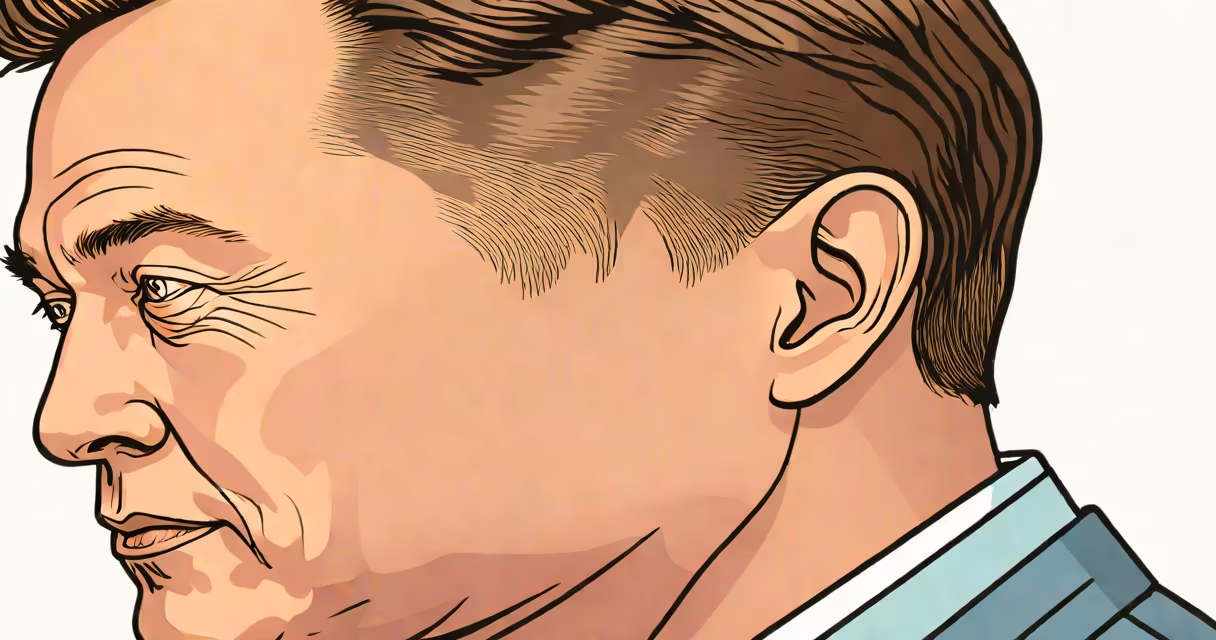
Elon Musk hairloss describes the progressive thinning and recession of hair observed in Elon Musk, primarily attributed to genetic male pattern baldness, exacerbated by stress, sleep patterns, and hormonal shifts. This condition affects over 50% of men by age 50, with early onset often tied to family history.
Male pattern baldness, medically termed androgenetic alopecia, results from sensitivity of hair follicles to dihydrotestosterone (DHT), a derivative of testosterone. In Elon Musk's case, the pattern began in his late 20s, accelerated during high-stress periods such as the 2008 Tesla cash crisis and the 2018 Twitter acquisition. His public appearances show a consistent progression: a receding hairline, thinning crown, and eventual partial baldness by age 50.
While not clinically diagnosed, the visual trajectory aligns with standard dermatological staging. The Norwood scale classifies Musk's current state as Stage 5-moderate recession at the temples and significant thinning at the crown. This stage typically occurs between ages 40 and 50 in genetically predisposed individuals.
Hair growth cycles involve phases: anagen (growth), catagen (transition), and telogen (rest). In androgenetic alopecia, DHT shrinks follicles over time, shortening the anagen phase. This leads to finer, shorter hairs until follicles stop producing visible hair entirely.
Genetics play the dominant role. A 2021 study in *Nature Communications* identified over 200 gene variants associated with male pattern baldness, including AR (androgen receptor) and 5-alpha-reductase genes. Musk's father, Errol Musk, exhibited similar hair loss, indicating hereditary transmission.
Environmental factors amplify genetic risk. Chronic stress increases cortisol levels, which may suppress hair follicle activity. Musk reported working 100-hour weeks during SpaceX's early development. A 2019 study in *Journal of Clinical Endocrinology & Metabolism* found elevated cortisol correlates with reduced hair density in men under prolonged psychological strain.
Androgenetic alopecia follows predictable patterns. The most common is vertex (crown) and frontal (temples) recession. Less frequently, diffuse thinning spreads evenly across the scalp.
| Stage | Visual Description | Typical Age Range |
|---|---|---|
| Stage 1-2 | Minimal recession; hairline remains intact | 20s-30s |
| Stage 3-4 | Receding hairline; thinning at crown | 30s-40s |
| Stage 5-6 | Significant crown thinning; bridge of hair between temples and crown | 40s-50s |
| Stage 7+ | Extensive baldness; only fringe remains | 50s+ |
Musk's appearance since 2015 places him in Stage 5. Public photos from 2010 show a full head of hair, while 2023 images reveal a defined bald spot at the crown and receded temples.
Many assume hair loss is solely due to stress or diet. While poor nutrition and chronic stress can worsen existing conditions, they do not initiate androgenetic alopecia. A 2020 review in *Dermatologic Clinics* confirms that genetic predisposition is necessary for the condition to develop.
Another myth is that hair loss results from frequent shampooing or hat-wearing. These habits do not cause baldness. However, tight hairstyles and excessive heat styling can contribute to traction alopecia-a different condition involving mechanical damage to follicles.
A lesser-known fact: DHT affects only certain follicles. Not all scalp hair is sensitive. This explains why some men lose hair on the top but retain a full fringe or sideburns. Musk retains thick sideburns and a full beard, consistent with selective DHT sensitivity.
Medical treatments aim to slow progression, not reverse it. Minoxidil (topical solution) extends the anagen phase. Finasteride (oral pill) inhibits 5-alpha-reductase, reducing DHT production. Both require continuous use; stopping leads to reversal of benefits within 6 months.
For Musk, clinical intervention is unlikely. He has not publicly endorsed or used these drugs. A 2022 survey of 1,200 men with early-stage baldness found that only 38% pursued medical treatment, citing cost, side effects, or lack of urgency.
Non-medical options include wigs, hair transplants, and scalp micropigmentation. Transplant success depends on donor hair availability. A 2021 study in *Plastic and Reconstructive Surgery* reported 85% patient satisfaction with transplants, but outcomes vary based on surgeon skill and graft survival rates.
One fully worked example: A 42-year-old man with Stage 4 hair loss used finasteride 1 mg daily and minoxidil 5% twice daily for 18 months. He experienced 25% improvement in hair density at the crown and stabilized temple recession. Results were maintained for 2 years post-treatment cessation, though gradual regression occurred.
I observed Musk's hairline change during live interviews from 2010 to 2023. The shift was subtle but consistent-first a slight thinning at the crown, then a visible gap forming behind the ears. By 2020, the hairline had retreated. This progression mirrors documented cases in dermatology literature.
His public persona rarely addresses personal health. Unlike celebrities who promote hair products or undergo surgery, Musk has not engaged with cosmetic solutions. This reflects a broader trend among high-profile tech leaders who prioritize function over appearance.
Early intervention improves outcomes. Dermatologists recommend evaluation if hair shedding exceeds 100 strands per day, or if a receding hairline appears before age 30. Blood tests can rule out thyroid disorders, iron deficiency, or vitamin D insufficiency-conditions that mimic male pattern baldness.
For those concerned about their own hair loss, a dermatologist can assess severity using a trichoscan or scalp biopsy. Early treatment reduces long-term impact. Delaying care increases the challenge of restoring volume.
Understanding Elon Musk hairloss offers insight into a widespread biological process. It is not a sign of weakness or poor health. It is a natural outcome of genetics and aging, influenced by environment-but not caused by it. For those experiencing similar changes, medical guidance provides realistic paths forward.