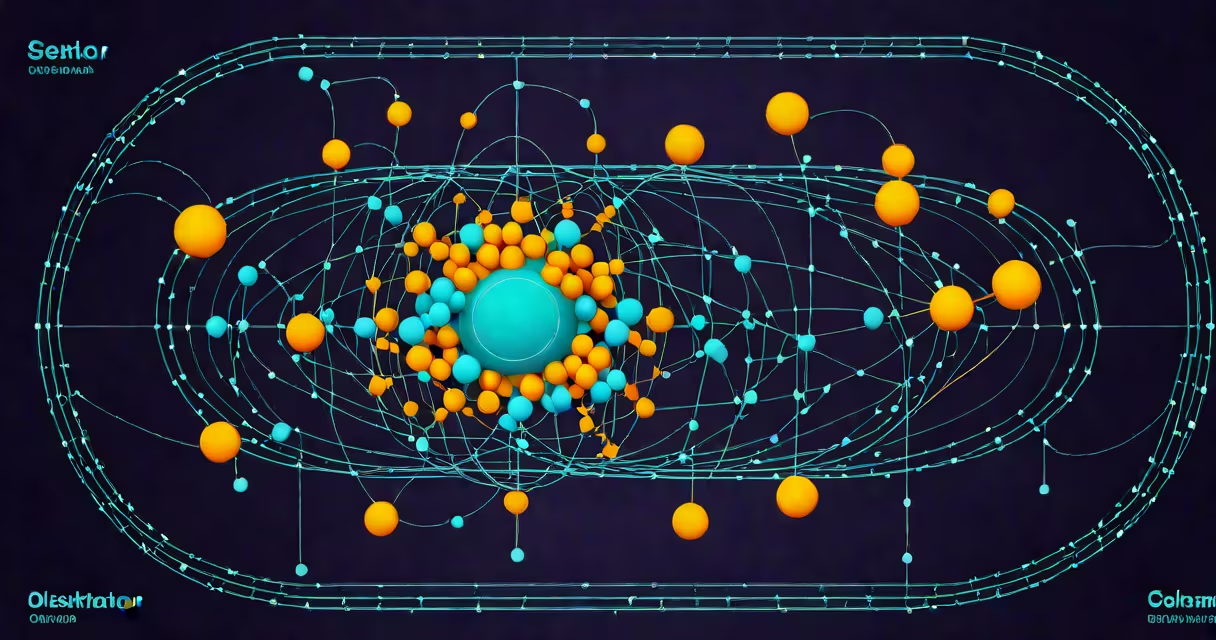
The electronic structure of an atom describes how electrons are arranged in orbitals around the nucleus based on energy levels, angular momentum, and spin. This arrangement determines an element's chemical properties, reactivity, and position in the periodic table.
Electrons do not follow fixed paths. Instead, they exist in regions of probability called orbitals, governed by quantum mechanics. These orbitals group into shells (principal energy levels) and subshells (s, p, d, f), each with distinct shapes and capacities. The full configuration-how many electrons fill each orbital-is unique to each element and dictates bonding patterns.
For example, hydrogen (atomic number 1) has one electron in the 1s orbital. Oxygen (atomic number 8) has the configuration 1s² 2s² 2p⁴-two electrons in the 1s subshell, two in the 2s, and four in the 2p. This arrangement explains why oxygen forms two covalent bonds: it needs two more electrons to complete its outer shell.
Electrons occupy orbitals following three principles: the Aufbau principle, Pauli exclusion principle, and Hund's rule. The Aufbau principle states that electrons fill the lowest available energy level first. For instance, the 1s orbital fills before 2s, which fills before 2p.
The Pauli exclusion principle limits each orbital to two electrons with opposite spins. A single s orbital holds two electrons; a p subshell has three orbitals (px, py, pz), each holding two electrons-six total. The d subshell holds ten electrons across five orbitals, and f holds fourteen across seven.
Hund's rule adds that electrons occupy degenerate orbitals (same energy level) singly before pairing. In nitrogen (1s² 2s² 2p³), the three 2p electrons reside in separate orbitals with parallel spins. This maximizes stability and influences magnetic behavior.
Each electron is described by four quantum numbers:
| Quantum Number | Symbol | Meaning | Allowed Values |
|---|---|---|---|
| Principal | n | Energy level (shell) | 1, 2, 3,... |
| Azimuthal | l | Subshell shape (angular momentum) | 0 (s), 1 (p), 2 (d), 3 (f) |
| Magnetic | ml | Orientation of orbital | -l to +l |
| Spin | ms | Electron spin direction | +½ or -½ |
For example, in the 2p subshell (n=2, l=1), ml can be -1, 0, or +1-three orbitals. Each can hold two electrons with opposing spins. So the 2p subshell holds six electrons total.
Subshells define electron behavior. s orbitals are spherical; p orbitals are dumbbell-shaped. d and f orbitals have complex nodal structures. These shapes influence how atoms bond-p orbitals allow directional bonding, enabling molecules like CO₂ to be linear.
A common misconception is that electrons "orbit" the nucleus like planets. They don't. Orbitals represent probability clouds. An electron in a 2p orbital is most likely found in a lobed region, not along a path. This was confirmed by quantum simulations and experimental electron density maps from X-ray crystallography.
Electronic structure underpins chemistry. It explains why sodium (1s² 2s² 2p⁶ 3s¹) readily loses one electron to form Na⁺, while chlorine (1s² 2s² 2p⁶ 3s² 3p⁵) gains one to form Cl⁻. Their configurations lead to ionic bonding in NaCl.
In materials science, electronic structure predicts conductivity. Metals have partially filled d or s bands, allowing electron flow. Semiconductors like silicon have a small band gap-electrons can jump to conduction band with heat or light. This enables solar cells and transistors.
When I worked in a lab studying transition metal complexes, I used electron configuration to predict color. Chromium(III) ions absorb specific wavelengths due to d-d transitions-their electronic structure causes visible absorption. A solution turned green because electrons jumped between d orbitals, absorbing red and blue light.
People often confuse electronic structure with electron configuration. Configuration is a shorthand notation (e.g., Ne: 1s² 2s² 2p⁶). Electronic structure includes orbital shapes, energy levels, and spin states-more detailed than configuration alone.
Another error: assuming all elements follow the Aufbau order strictly. Exceptions occur in chromium (Cr: [Ar] 4s¹ 3d⁵) and copper (Cu: [Ar] 4s¹ 3d¹⁰). Half-filled or fully filled d subshells are more stable. This stability arises from symmetry and exchange energy-confirmed by spectroscopy and computational chemistry.
Some think electron shells are equally spaced. They're not. Energy differences grow smaller with higher n. The gap between n=1 and n=2 is larger than between n=4 and n=5. This affects ionization energies-removing an electron from n=1 requires far more energy than from n=4.
The electronic structure of an atom governs its identity and interactions. It is not a static diagram-it's a changing model rooted in quantum physics. Understanding it reveals why elements behave as they do, from forming water to powering electronics.