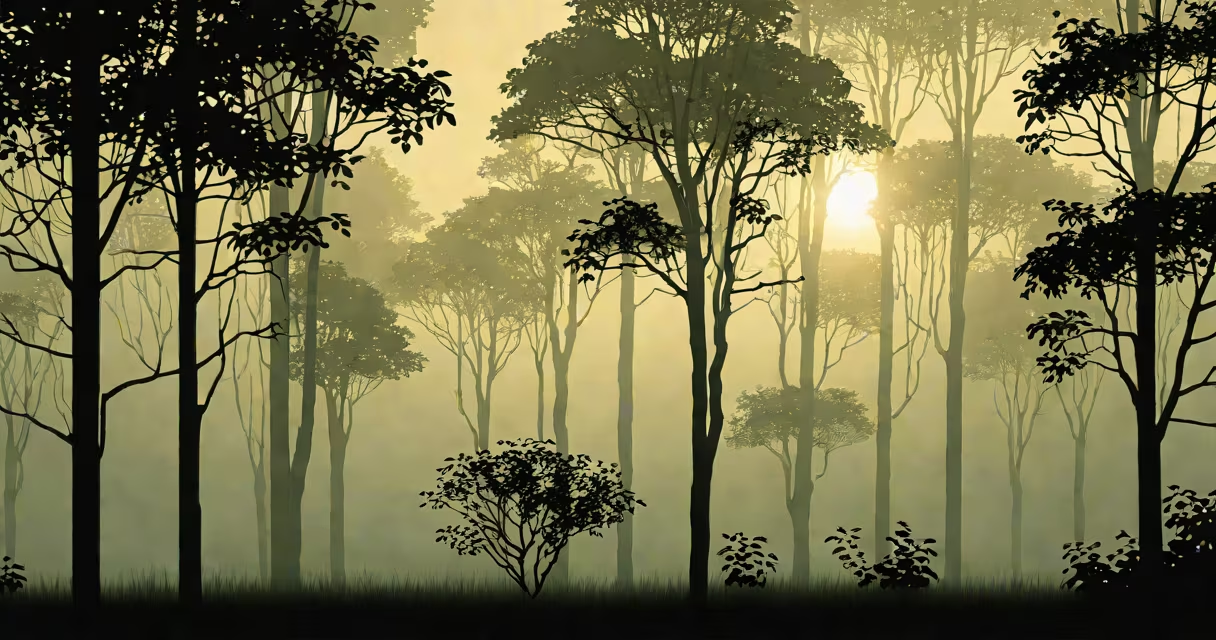
A copse is a small group of trees growing closely together, often in a wooded area. Writers use "copse in a sentence" to evoke quiet, enclosed spaces rich in atmosphere and natural detail.
Copse derives from Old French *cops* and from Latin *cupressus*, meaning cypress. By the 16th century, it referred to a clump of trees, especially in a field context. It's not a formal botanical term but a poetic one, favored in literature for its evocative weight.
When placed in a sentence, "copse" functions as a noun. It appears most often in descriptive prose or poetry where mood, isolation, or natural beauty matters. A single sentence using "copse" can establish setting, emotion, or symbolic meaning.
"Copse" adds texture to a scene. It implies density, enclosure, and quiet. Unlike "forest," which suggests scale and depth, or "grove," which may suggest openness, a copse feels intimate and sheltered.
Consider this example: *She stepped into the copse, where the air was thick with the scent of damp earth and pine.* The sentence establishes physical space and sensory detail. The word "copse" signals a confined, green pocket within a larger field. It's not just trees-it's a place with presence.
Writers use "copse in a sentence" to imply concealment or transition. In narrative, entering a copse often marks a shift-into memory, danger, or introspection. For instance, in *The Lord of the Rings*, Frodo and Sam pass through a copse near the edge of Mordor, a moment of fragile peace amid looming threat.
While "copse" is singular in form, it appears in various contexts:
| Context | Usage Example | Purpose |
|---|---|---|
| Literary fiction | *The old man sat beneath the copse, watching the sky darken.* | Builds atmosphere and solitude |
| Nature writing | *A sudden rustle came from the copse-then silence.* | Creates suspense and tension |
| Historical narrative | *They hid in the copse during the raid, their breath shallow.* | Implies safety and secrecy |
Modern usage favors "copse" in creative nonfiction and poetry. It rarely appears in technical or scientific writing, where precision outweighs imagery. According to the Oxford English Dictionary, "copse" is marked as "chiefly literary" and "poetic."
One non-obvious distinction: "copse" describes a grouping of trees, not a single tree. It's not synonymous with "wood" or "thicket," though those terms overlap. A copse is smaller and more compact than a wood, and less chaotic than a thicket. It's a deliberate arrangement, often suggesting human influence or natural selection.
"Copse" is frequently mistaken for "coppice," a related but distinct term. A coppice refers to a method of woodland management where trees are cut back regularly to encourage regrowth. This practice dates to medieval England and is still used in sustainable forestry.
Using "coppice" in place of "copse" changes the meaning entirely. For example: *The villagers returned to the coppice each spring to harvest young shoots.* This sentence describes a managed system, not a natural cluster. Confusing the two distorts both ecological accuracy and literary intent.
Another error: treating "copse" as a verb. It is not. You cannot "copse" something. The confusion arises from rare archaic forms, but none survive in modern usage. Always use "copse" as a noun.
Let's build a sentence step-by-step using "copse." Start with a setting: a rural path at dusk. Add a character: a woman walking alone. Introduce sensory detail: cold air, distant sound. Finally, embed "copse" to anchor the moment.
At twilight, she turned off the path and entered the copse, where the wind carried whispers through the thinning leaves and the ground crunched underfoot like dried bones.
This sentence uses "copse" to mark a psychological boundary. The shift from path to copse signals movement into uncertainty. The sensory details-sound, touch, temperature-build unease. The metaphor "crunched like dried bones" amplifies tension. All of this hinges on the precise placement of "copse" as a spatial and emotional threshold.
I once wrote a short story where a character returns to the same copse every year on her birthday. The trees were older, the clearing smaller. Each visit revealed subtle changes-fewer birds, deeper shadows. The copse became a silent witness to time passing. That's the power of "copse in a sentence": it holds memory, change, and mood in a single word.
Understanding "copse in a sentence" improves grasp of adjacent concepts. For example, "me or i in a sentence" clarifies pronoun usage in personal narratives-critical when describing actions within a copse. A sentence like *I stepped into the copse, afraid of what I might find* relies on correct subject-verb agreement and pronoun clarity.
Even contrastive conjunctions matter. Using "but" in a sentence with "copse" can create dramatic reversal. Consider: *The path led to the copse, but the trees stood still, as if holding their breath.* The word "but" introduces tension, contrasting motion with stillness. More on this in that guide.
"Copse in a sentence" is not just a phrase-it's a tool for shaping perception. It allows writers to compress time, place, and feeling into a single, resonant word. Used well, it turns a description into a moment.