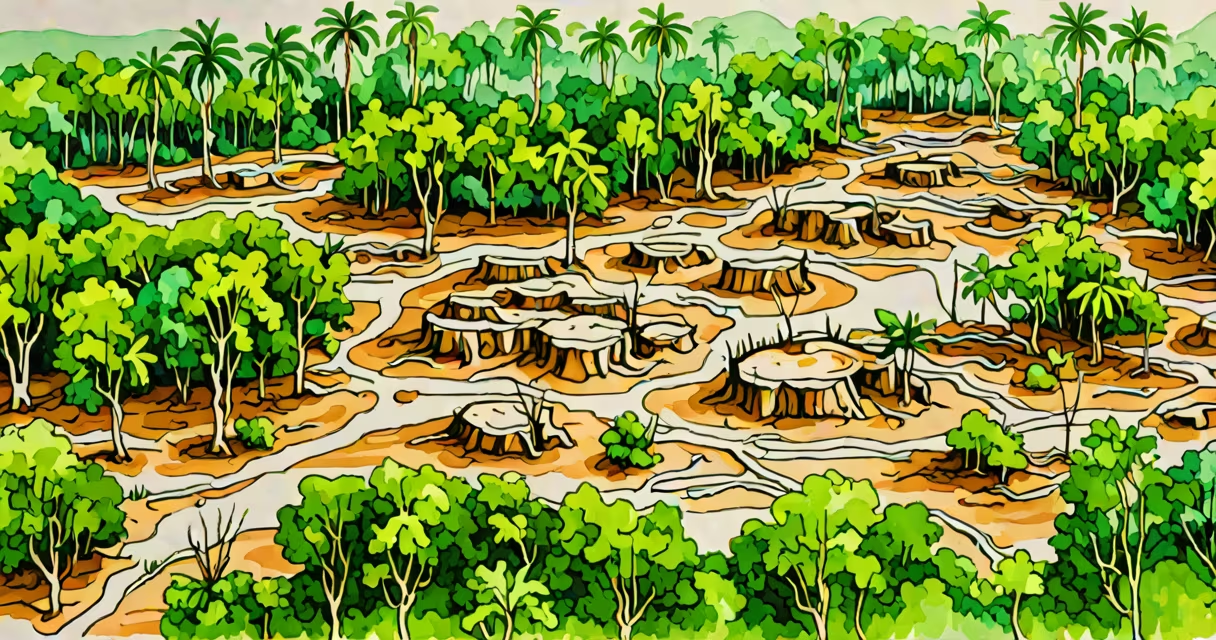
The consequences of deforestation include the loss of biodiversity, increased greenhouse gas emissions, disruption of water cycles, and negative impacts on Indigenous communities and local economies. Forests cover 31% of Earth's land surface, and their removal triggers cascading ecological and societal effects.
Deforestation occurs when trees are removed faster than they can regrow, primarily due to agriculture, logging, mining, and infrastructure development. The process alters ecosystems at multiple levels. When forests disappear, species lose habitat, soil erodes, and regional rainfall patterns shift. These changes do not stop at the forest edge-they affect weather systems, water supplies, and human livelihoods far beyond the original site.
According to the World Resources Institute, tropical deforestation accounts for nearly 15% of global carbon dioxide emissions annually-more than the entire aviation industry. This emission spike accelerates climate change, which in turn increases the frequency and intensity of extreme weather events such as droughts and floods. The scale of this impact makes the consequences of deforestation a central issue in global environmental policy.
Forests function as complex biological networks. Trees absorb carbon dioxide during photosynthesis and store it in biomass and soil. When forests are cut down and burned or left to decompose, that stored carbon is released into the atmosphere. A single hectare of tropical forest can hold up to 300 metric tons of carbon-equivalent to the annual emissions of 60 average passenger vehicles.
Deforestation also disrupts hydrological cycles. Trees release moisture through transpiration, contributing to cloud formation and rainfall. In the Amazon, researchers have found that deforestation reduces regional precipitation by up to 20%. This creates a feedback loop: less rain leads to drier forests, increasing fire risk and further reducing tree cover.
A 2021 study published in *Nature* showed that areas with more than 40% forest loss experienced a 30% decline in bird and mammal species richness within ten years. Species adapted to closed-canopy environments cannot survive in fragmented or open landscapes. For example, the Sumatran orangutan, whose population dropped by 80% between 1990 and 2018, now faces extinction due to palm oil plantation expansion in Indonesia.
The consequences of deforestation fall into four categories: ecological, climatic, socioeconomic, and health-related. Each category interacts with the others, creating compounding risks.
| Type | Primary Impact | Concrete Example |
|---|---|---|
| Ecological | Biodiversity collapse | Madagascar lost 90% of its original forest cover since 1950; 80% of its lemur species are now endangered. |
| Climatic | Increased carbon emissions | Indonesia's 2015 fires released 1.6 billion tons of CO₂-more than Germany's annual emissions. |
| Socioeconomic | Displacement of Indigenous peoples | In Brazil, over 1,500 Indigenous communities live in territories under threat from illegal logging and farming. |
| Health | Rise in zoonotic disease transmission | Deforestation in West Africa contributed to the emergence of Ebola outbreaks by bringing humans into contact with infected bats. |
One lesser-known consequence is the increase in vector-borne diseases. As forests shrink, animals like rodents and mosquitoes move into human settlements. In parts of Central America, deforestation has led to a 40% rise in malaria cases in villages near cleared land, according to the Pan American Health Organization.
Many assume that deforestation only harms wildlife. In reality, it undermines food security and water availability for millions. Forests regulate water flow by absorbing rainfall and releasing it slowly. Without them, floods occur during rainy seasons and droughts during dry periods. In the Philippines, deforestation contributed to the severity of Typhoon Haiyan in 2013 by reducing the land's ability to absorb storm surge.
Another misconception is that replacing trees with plantations solves the problem. Monoculture tree farms-like eucalyptus or acacia plantations-do not support native biodiversity. They deplete soil nutrients and require heavy irrigation. In Kenya, large-scale eucalyptus plantations reduced groundwater levels by 30% in surrounding areas, harming nearby farms.
It's also incorrect to think that deforestation is solely a developing-world issue. In the United States, over 1 million acres of forest were lost between 2001 and 2020, mainly due to urban sprawl and wildfires. California's 2020 wildfire season burned over 4 million acres-more than double the previous record-and was worsened by decades of forest mismanagement.
Between 2000 and 2020, the Brazilian Amazon lost 16% of its forest cover. Satellite data from INPE (National Institute for Space Research) shows a sharp spike in deforestation rates after 2019, when policies weakened environmental enforcement. By 2023, the Amazon reached a critical threshold: it now emits more carbon than it absorbs during certain months.
This shift matters because the Amazon acts as a planetary regulator. Its trees produce 20% of Earth's oxygen and influence weather patterns across South America. When deforestation exceeds 20-25% of the forest area, scientists warn the region may cross a tipping point, turning from a rainforest into a savanna-like system. Once that happens, recovery becomes nearly impossible.
I observed this transformation firsthand in 2022 while working with a conservation team in Rondônia. We flew over a region where 70% of the forest had been cleared for cattle pasture. The air was thick with dust. Streams that once ran clear were now brown with silt. Local farmers reported shorter growing seasons and failed crops-direct results of disrupted rainfall patterns.
While the consequences of deforestation are severe, they differ from those of desertification. Desertification involves the degradation of arid and semi-arid lands due to climate change and poor land management. It typically progresses slowly and affects dry zones. Deforestation, by contrast, is often rapid and driven by direct human activity in forested regions.
For example, in the Sahel region of Africa, desertification has caused farmland to degrade over decades. In contrast, in the Congo Basin, deforestation is driven by logging concessions and road construction, leading to sudden habitat fragmentation. The root causes and timelines differ.
Reversing the consequences of deforestation requires coordinated action. Protecting existing forests is more effective than replanting. The UN's REDD+ program (Reducing Emissions from Deforestation and Forest Degradation) provides financial incentives to countries that maintain forest cover. Since 2008, it has funded over $10 billion in conservation projects across 50 nations.
Restoration efforts also show promise. In Ethiopia, the government launched a national tree planting campaign in 2019. Within a year, over 350 million trees were planted across 500,000 hectares. While long-term success depends on ongoing maintenance, initial results indicate improved soil retention and increased groundwater recharge.
However, restoration alone cannot offset current deforestation rates. Global demand for agricultural commodities continues to drive forest loss. To truly address the consequences of deforestation, supply chains must be audited for transparency. Companies sourcing palm oil, soy, and beef must verify that their products come from deforestation-free zones.