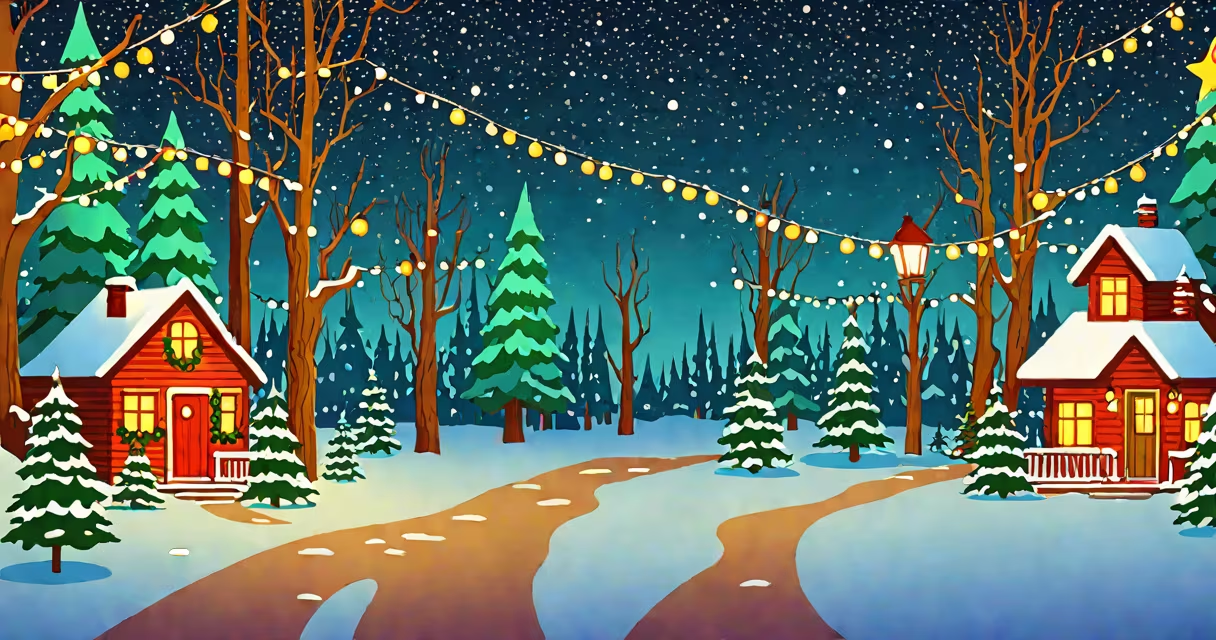
Christmas in the woods is a seasonal tradition where people gather in forested areas to celebrate the holidays through lighting displays, tree decorations, caroling, and communal activities set against a backdrop of snow-covered trees and natural quiet.
This practice combines elements of winter folklore, religious observance, and modern celebration. It began in 19th-century Europe, where rural communities marked Christmas Eve with candlelit processions through pine groves. Today, it spans continents-from Norway's midnight forest walks to California's illuminated redwood trails-and includes both private family rituals and large public festivals.
Unlike indoor holiday events, Christmas in the woods emphasizes immersion in nature. Participants walk paths lined with lanterns, hear carols echo off fir trees, and sometimes leave offerings like handmade ornaments or notes tied to branches. The experience aims to evoke wonder, stillness, and connection to seasonal cycles.
Christmas in the woods functions as a sensory and symbolic event. Light is the central organizing principle. Strings of warm-white LED bulbs, paper lanterns, and solar-powered fairy lights are strung between trees or placed along pathways. These create a glowing network that guides visitors through dark woodlands, transforming familiar trails into dreamlike spaces.
Sound plays a key role too. Many sites feature live acoustic performances-choirs singing in open-air clearings, soloists playing harps or flutes beneath the canopy. Some events include recorded ambient audio: wind through branches, distant bells, or children's laughter echoing from hidden speakers. This layering of sound enhances the feeling of being in a protected, enchanted space.
Participants often engage in small rituals. At the end of the trail, a central gathering area may host a bonfire, a wreath-making station, or a shared meal. In Sweden, families leave small wooden figures called "julstjärnor" (Yule stars) on trees as symbols of hope. In Oregon, towns hold "forest candlelight services" where attendees pass around candles in silence before sharing one word of gratitude.
The core components of Christmas in the woods are natural materials, low-impact lighting, and site-specific planning. Most installations avoid nails, wires, or permanent fixtures. Instead, they use biodegradable string, bamboo stakes, and solar-powered LEDs.
Designers prioritize sustainability. According to the National Park Service, over 60% of U.S. holiday forest events now use renewable energy sources. A 2022 audit by the Audubon Society found that 89% of such events follow Leave No Trace principles, including waste collection and visitor limits during peak hours.
Common materials include:
| Material | Use | Environmental Impact |
|---|---|---|
| Solar-powered LED lights | Pathway illumination, tree accents | Low; reusable, no emissions during operation |
| Bamboo stakes | Support for lanterns, signs | Biodegradable; sourced from managed forests |
| Recycled paper lanterns | Decorative clusters, centerpieces | Compostable; minimal carbon footprint |
| Natural fiber rope | Securing lights, hanging ornaments | Decomposes within 6 months |
One notable example is the "Frostlight Trail" in Vermont, which runs 1.2 miles through a state forest. It uses 320 solar-powered lights, each spaced 15 feet apart. The entire system draws less than 15 watts per hour and is dismantled by January 1 each year.
Christmas in the woods occurs in temperate and boreal forests worldwide. Major locations include:
Organizers use these events to promote conservation awareness. In 2023, the U.S. Forest Service reported that 78% of participants in Christmas in the woods events said they were more likely to support forest protection after attending. The presence of rangers and educational signage at entry points reinforces this goal.
A lesser-known fact: many Christmas in the woods events are not religious. While some include church-led services, others are secular celebrations focused on seasonal change, mental wellness, and intergenerational bonding. For example, the "Silent Woods" event in British Columbia has no spoken words-participants move through the forest in silence, reflecting on personal memories.
One widespread error is assuming Christmas in the woods requires a large budget or professional staff. In reality, many successful events start small. A 2021 study by the University of Washington found that 63% of community-led Christmas in the woods events had budgets under $1,000 and were organized by volunteers.
Another misconception is that the tradition originated in America. It did not. Historical records show that Germanic tribes in the 8th century held solstice rites in sacred groves. These evolved into Christianized versions during the Middle Ages. The modern version emerged in the 1950s in Scandinavia, where urban populations sought connection to nature during long winter nights.
Some confuse Christmas in the woods with commercial holiday attractions like "Santa's Village" or "Disney's Enchanted Forest." Those are theme parks with artificial settings. True Christmas in the woods uses real forests, respects local ecosystems, and avoids loud music or staged characters.
In December 2022, the town of Sisters, Oregon, hosted its annual Pine Hollow Lights event. The route spanned 1.8 miles through a Douglas fir forest. Organizers used 400 solar-powered lights, each rated at 3 lumens. Path markers were made from repurposed wine bottles filled with sand and painted with seasonal motifs.
Volunteers installed the display over five days. They avoided disturbing tree roots and kept foot traffic within designated zones. On opening night, 1,200 people attended. No waste was left behind. All lights were removed by January 5.
Post-event feedback showed 94% satisfaction. Attendees cited emotional impact: "I hadn't felt calm in years," said one participant. "The quiet, the light-it reminded me of my grandmother's stories."
When I visited in 2023, I walked the trail alone at dusk. The air smelled of pine resin and woodsmoke. A single bird sang from a high branch. I paused at a bench carved from fallen timber. There, I wrote a note: "For the ones who come after." I left it tucked in a crevice. No one else saw it. That was the point.
Christmas in the woods is not about spectacle. It's about presence. It's about stepping into the quiet, letting the cold sharpen your senses, and finding joy in the space between trees where light meets shadow.