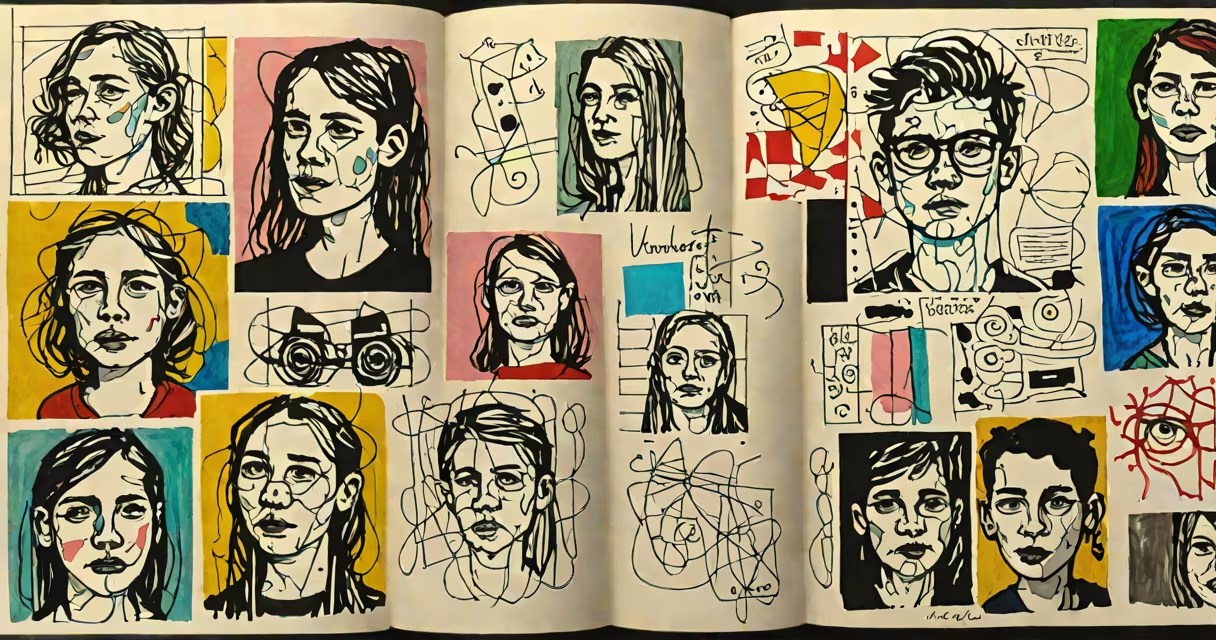
Artwork for 13 year olds includes creative projects that match their growing cognitive abilities, emotional awareness, and technical skills. These pieces often explore identity, social dynamics, and personal interests through drawing, painting, collage, and digital tools.
At 13, children are transitioning into early adolescence. Their artwork reflects increased self-awareness and a desire to express individuality. They move beyond basic shapes and colors toward narrative depth, perspective, and symbolic content. Projects may include self-portraits with layered emotions, storyboards for imagined worlds, or mixed-media representations of personal values.
The National Endowment for the Arts notes that teens aged 12-15 benefit most from art experiences that allow choice and autonomy. When given freedom to select themes and materials, they show higher engagement and improved problem-solving skills. Artwork for 13 year olds thrives when it supports exploration, not just execution.
Art for 13-year-olds functions as both a cognitive and emotional outlet. Brain development during early adolescence enhances visual-spatial reasoning and abstract thinking. This allows teens to depict complex scenes, use symbolism, and experiment with composition.
A typical project might involve creating a comic strip based on a school conflict. The student draws characters with exaggerated expressions, uses speech bubbles to convey dialogue, and adds background details that reflect mood. This process integrates storytelling, emotional recognition, and visual planning.
Research from the American Psychological Association shows that adolescents who engage in regular creative expression report lower levels of anxiety and greater resilience. Artwork for 13 year olds isn't just about aesthetics-it's a tool for processing feelings, testing ideas, and building confidence.
Teens at this age often work with a mix of traditional and digital tools. The following table outlines common mediums and their typical applications:
| Medium | Typical Use | Example Project |
|---|---|---|
| Pencil & charcoal | Sketching, shading, gesture drawings | Changing figure study of dancers in motion |
| Watercolor | Layered washes, mood-based landscapes | Abstract cityscape reflecting inner tension |
| Acrylic paint | Textured surfaces, bold color contrasts | Self-portrait using fragmented mirrors as symbols |
| Digital tools (Procreate, Adobe Fresco) | Animation frames, concept art, digital collage | Animated short about a robot learning empathy |
Each medium offers different feedback loops. Charcoal allows quick, expressive marks; watercolor demands timing and control. Digital tools enable undoing mistakes and layering effects, which suits experimental approaches.
One non-obvious fact: Teens often prefer working with materials that feel "grown-up." A 13-year-old may reject crayons not because they're childish, but because they lack tactile resistance. A pencil with a firm lead or a brush with visible bristles provides sensory feedback that feels more mature and intentional.
Artwork for 13 year olds appears in classrooms, youth programs, online communities, and family spaces. Schools use it to assess understanding in subjects like history (e.g., illustrating a scene from the Civil Rights Movement) or science (e.g., depicting cellular structures).
Youth centers and after-school programs often host themed art challenges. For example, a summer program might ask teens to create a mural representing "belonging" using recycled materials. The resulting artwork becomes a shared statement about community.
Online platforms like DeviantArt and ArtStation feature portfolios from 13-year-olds. Some have gained attention for detailed character designs or emotionally charged illustrations. These platforms offer visibility but also expose teens to critique and comparison, which requires guidance.
I once observed a group of 13-year-olds in a community art class. One girl spent two weeks building a diorama of her neighborhood after a storm. She used crumpled paper for debris, colored pencils for rain, and a small LED light to represent a streetlamp. Her piece wasn't technically perfect-but it conveyed memory, loss, and quiet hope. That's the power of artwork for 13 year olds: it captures lived experience.
Many assume artwork for 13 year olds must be realistic or technically advanced. But research from the Journal of Youth Studies shows that symbolic and abstract work is equally valid. A drawing of a person with no face, surrounded by tangled lines, can express anxiety better than a photorealistic portrait.
Another misconception: that art must be "original" to be meaningful. A 13-year-old copying a favorite anime character isn't failing-they're practicing form, proportion, and line weight. Repetition builds muscle memory and confidence. Originality develops later, through experimentation.
Parents sometimes mistake messy studios or unfinished pieces as signs of disengagement. In reality, clutter often indicates active creation. A workspace covered in half-finished sketches, spilled paint, and crumpled paper is a sign of deep involvement-not neglect.
Here's a fully worked example of a project suitable for 13-year-olds:
This project combines visual literacy, emotional reflection, and hands-on craft. It results in a personal artifact that can be shared or kept private. It's also adaptable-students can switch from ink to digital brushes, or turn the zine into a slideshow.
Artwork for 13 year olds is not about producing museum-ready pieces. It's about offering space for growth, curiosity, and voice. When supported with access to materials, time, and respectful feedback, it becomes a foundation for lifelong creativity.