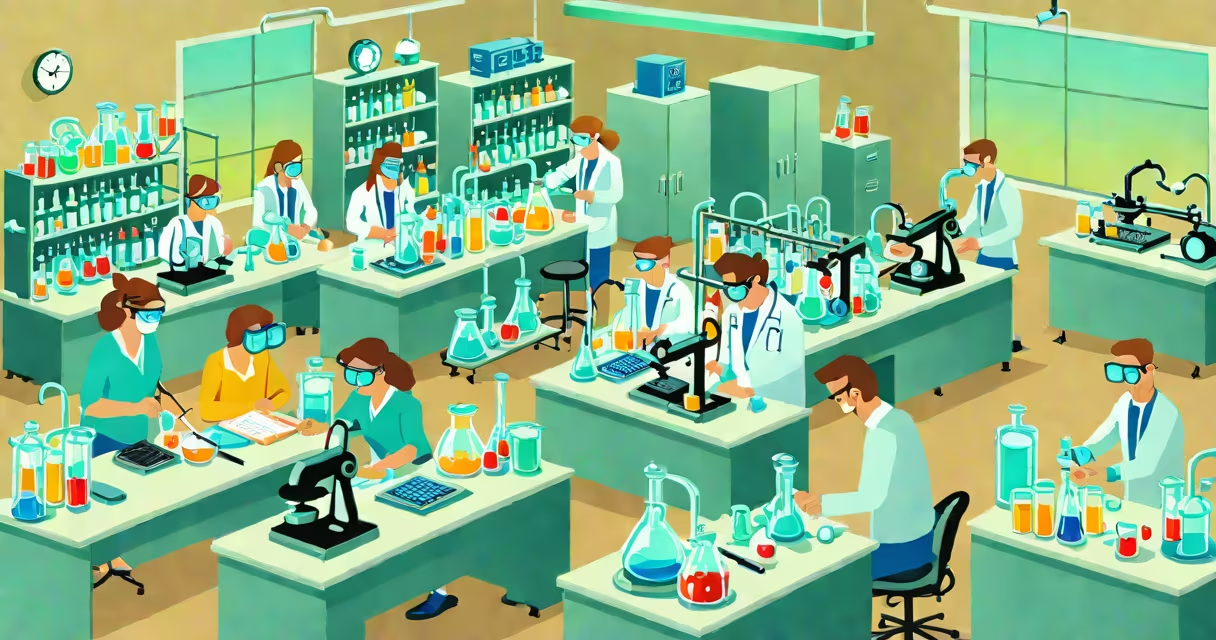
Chemical engineering classes needed include foundational sciences like chemistry and physics, core engineering subjects such as thermodynamics and fluid dynamics, and specialized courses in transport phenomena and process control. These courses prepare students to design and improve industrial-scale systems for producing chemicals, fuels, pharmaceuticals, and materials.
Undergraduate chemical engineering programs require a structured sequence of courses that build technical knowledge progressively. Students begin with general education and math prerequisites before advancing into discipline-specific subjects. The curriculum emphasizes quantitative reasoning, material and energy balance calculations, and system modeling-skills essential for solving complex industrial challenges.
According to the American Institute of Chemical Engineers (AIChE), accredited programs must cover key areas including mass and energy balances, heat and mass transfer, reaction engineering, and process dynamics. These standards ensure graduates meet industry expectations for safety, efficiency, and innovation in manufacturing environments.
The most critical chemical engineering classes needed focus on physical principles governing how materials move, change state, and interact under different conditions. These include:
Each subject uses mathematical models derived from conservation laws. For example, in a batch reactor, reaction rates depend on concentration and temperature, governed by differential equations solved using numerical methods taught in computational methods courses.
A typical first-year course load includes calculus I-III, differential equations, and introductory chemistry. By sophomore year, students take physical chemistry and engineering graphics. Junior year introduces advanced topics like process control and unit operations labs. Senior year focuses on capstone design projects integrating all prior knowledge.
Many assume chemical engineering is synonymous with chemistry. While both involve molecular interactions, chemical engineering applies scientific principles to scale reactions from test tubes to industrial plants. A chemist may develop a new catalyst in a lab; a chemical engineer designs the reactor, ensures safe handling of hazardous intermediates, and optimizes throughput.
Another misconception is that only theoretical knowledge matters. In reality, hands-on experience is central. Most programs require participation in lab courses such as pilot plant operations or distillation column experiments. For instance, at the University of California, Berkeley, students operate a continuous stirred-tank reactor (CSTR) to study residence time distribution-a concept important in pharmaceutical production.
Some believe all chemical engineers work in oil refineries. While petrochemical processing remains a major sector, nearly half of U.S. chemical engineers now work in biotechnology, environmental engineering, or materials science. The Bureau of Labor Statistics reports that employment in renewable energy sectors grew 18% between 2020 and 2023, driven by demand for sustainable chemical processes.
Understanding the role of each class type helps clarify why certain courses are mandatory. Below is a breakdown of common course categories and their purpose:
| Course Type | Examples | Purpose |
|---|---|---|
| Foundational Sciences | General Chemistry, Organic Chemistry, Physics I-II | Build understanding of atomic and molecular behavior; required for advanced modeling. |
| Mathematical Tools | Calculus, Differential Equations, Linear Algebra | Enable formulation and solution of engineering models. |
| Core Engineering | Thermodynamics, Fluid Mechanics, Heat Transfer | Provide frameworks for analyzing energy and material flows. |
| Specialized Topics | Process Control, Separation Processes, Reaction Engineering | Apply theory to real systems like distillation columns or catalytic converters. |
For example, a student learning about distillation must understand vapor-liquid equilibrium (from thermodynamics), momentum transfer (fluid mechanics), and heat exchange (heat transfer). Without all three, they cannot predict how efficiently a column separates ethanol from water.
Consider a project to design a biodiesel production facility. The chemical engineering classes needed come together in this scenario:
This integrated approach reflects how chemical engineering classes needed are not isolated subjects-they form a cohesive system for solving large-scale problems. One failure in any component risks inefficiency or safety hazards.
I once observed a student team at MIT simulate a continuous fermentation process for bioethanol. They initially ignored heat removal capacity, leading to microbial death due to temperature spikes. After recalculating cooling requirements using heat transfer equations, they stabilized the process. This experience underscored that theoretical knowledge must be paired with practical awareness.
Chemical engineering classes needed are not just academic hurdles. They are tools for creating safer, more efficient, and sustainable technologies that power industries worldwide.