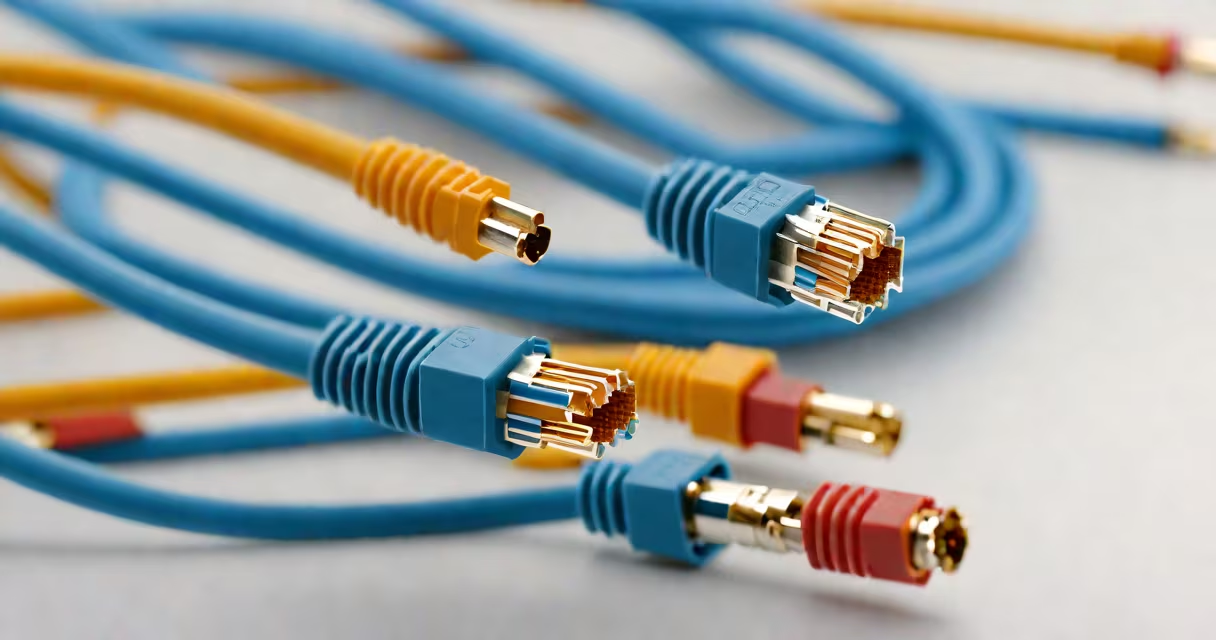
cat cable standards are industry-defined performance specifications for twisted-pair Ethernet cables, setting limits for bandwidth, crosstalk, signal attenuation, and maximum transmission distance. These standards, maintained by the Telecommunications Industry Association (TIA) and the International Organization for Standardization (ISO), determine how well a cable supports data speeds like 1 Gbps, 10 Gbps, or higher.
The most common standards are Cat 5e, Cat 6, Cat 6a, Cat 7, and Cat 8. Each builds on the last with stricter requirements for interference resistance, frequency range, and connector quality. A cable meeting Cat 6 standards, for example, supports up to 10 Gbps over 55 meters and operates reliably at frequencies up to 250 MHz.
These standards are not optional-they're enforced through certification testing. A cable labeled "Cat 6" must pass tests for near-end crosstalk (NEXT), power sum crosstalk (PSNEXT), and return loss. Without passing these, the cable fails compliance and cannot be legally marketed as Cat 6.
Cat cable standards specify electrical performance metrics measured under controlled lab conditions. They don't describe physical construction alone-though wire gauge, insulation thickness, and twist rate matter. Instead, they define measurable outcomes: how much data a cable can carry without errors over a given distance.
For example, Cat 6 requires a minimum of 250 MHz bandwidth, meaning signals can be transmitted at frequencies up to 250 million cycles per second. This allows 10 Gbps speeds over 55 meters. Cat 6a increases the limit to 500 MHz, enabling 10 Gbps over 100 meters. Cat 7 raises the bar further with 600 MHz and full shielding.
Testing happens using specialized equipment like a Fluke DSX-5000 or similar certified tester. The test measures parameters such as insertion loss, far-end crosstalk (FEXT), and channel return loss. Results are compared against TIA/EIA-568-C.2 and ISO/IEC 11801 standards. Only cables passing all thresholds earn the official rating.
Each category offers different capabilities. The table below compares key specs:
| Standard | Max Bandwidth | Max Speed | Max Distance | Shielding |
|---|---|---|---|---|
| Cat 5e | 100 MHz | 1 Gbps | 100 m | Unshielded |
| Cat 6 | 250 MHz | 10 Gbps | 55 m | Unshielded or screened |
| Cat 6a | 500 MHz | 10 Gbps | 100 m | Shielded (S/FTP) |
| Cat 7 | 600 MHz | 10 Gbps | 100 m | Shielded (S/FTP) |
| Cat 8 | 2000 MHz | 40 Gbps | 30 m | Shielded (S/FTP) |
Shielding is critical. Cat 6 and earlier often use foil or braided shielding around individual pairs or the entire cable. Cat 7 and Cat 8 require double shielding-both and per-pair-to reduce electromagnetic interference (EMI) in high-noise environments like industrial settings or server rooms.
Network administrators choose cat cable standards based on required speed, environment, and budget. Cat 6 is standard in most office installations due to its balance of cost and capability. It supports 10 Gbps over short distances and handles typical office EMI.
In data centers, Cat 6a or Cat 7 is preferred. These cables maintain signal integrity over longer runs and resist interference from adjacent cables. A single rack with 48 servers running at 10 Gbps each demands low crosstalk and stable impedance-features guaranteed only by compliant Cat 6a or Cat 7 cabling.
Home users often install Cat 5e or Cat 6 for internet, streaming, and gaming. A 1 Gbps connection over Cat 5e is sufficient for most residential needs. But upgrading to Cat 6 improves stability during peak usage, especially if multiple devices are connected simultaneously.
One non-obvious fact: Cat 6a and Cat 7 cables are thicker than Cat 6. Their shielding adds bulk. This affects routing through conduit or tight spaces. A Cat 7 cable may not fit in a standard wall plate unless the box is modified. I learned this installing a home office network-the cable wouldn't seat properly until I replaced the faceplate with a deeper model.
Many assume Cat 7 is twice as fast as Cat 6. That's incorrect. Both support 10 Gbps at 100 meters. The difference lies in noise rejection and long-term reliability under stress. Cat 7's shielding reduces signal degradation over time, making it better for future-proofing.
Another misconception: all Cat 6 cables perform equally. Not true. A poorly manufactured Cat 6 cable may fail NEXT tests despite being labeled as such. Certification matters. Always verify that cables are tested and labeled with the correct standard.
Some brands market "Cat 6" cables with unshielded pairs and no grounding. These do not meet the full Cat 6 specification. They may work in low-interference areas but fail in real-world deployments. Always look for cables rated to TIA/EIA-568-C.2 or ISO/IEC 11801.
When choosing between standards, consider the network's purpose. For a small business with 20 users and 1 Gbps internet, Cat 6 is sufficient. For a university campus with 10,000 devices and 10 Gbps core links, Cat 6a or Cat 7 is necessary. The standard isn't just a label-it's a performance contract.
For high-performance applications requiring 40 Gbps or more, Cat 8 is the current benchmark. Its 2 GHz bandwidth and 30-meter reach make it ideal for server-to-switch connections in data centers. However, it's not backward compatible with older ports and requires special connectors.
Always test installed cables. Even a compliant Cat 7 cable can fail if bent too sharply or crushed during installation. A single kink can increase attenuation by 3 dB-enough to drop a 10 Gbps link to 1 Gbps.
cat cable standards are not optional. They are the foundation of reliable wired networks. Choose based on performance needs, not marketing claims. A properly specified cable ensures consistent speed, reduced latency, and fewer troubleshooting hours.