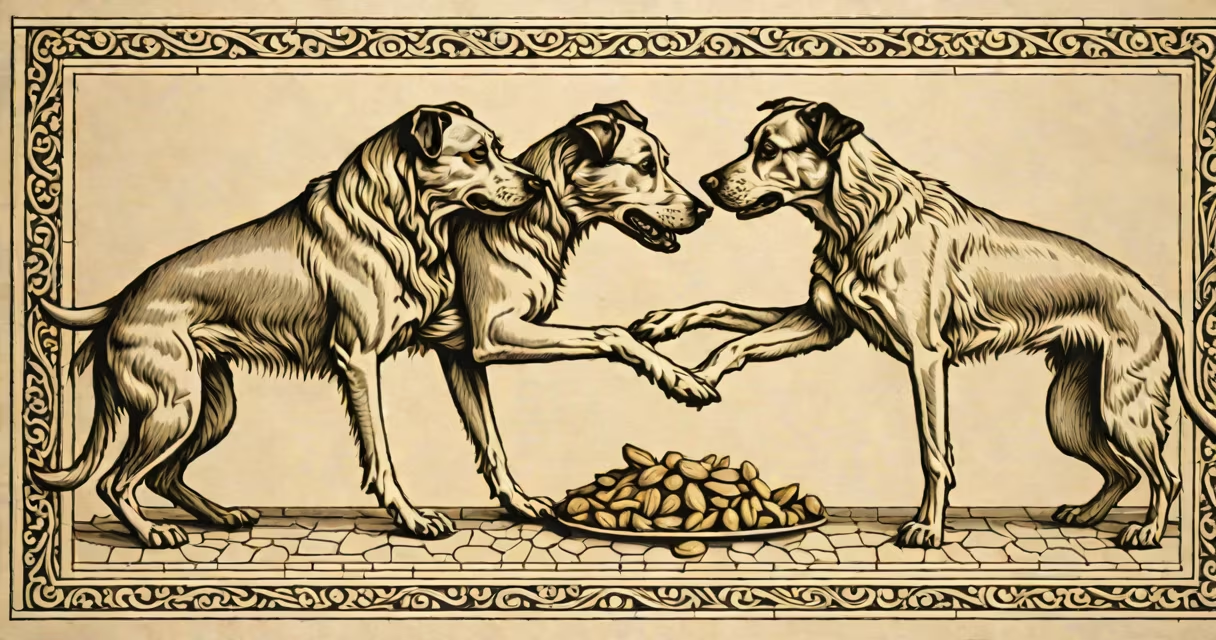
"Canis canem edit" is a Latin phrase meaning "The dog eats the dog." It describes a situation where individuals or groups compete so intensely that they destroy each other, often through betrayal, violence, or ruthless ambition. This expression reflects a harsh reality of dominance and survival in competitive environments.
The phrase originates from ancient Roman literature and was used to illustrate moral decay, social conflict, and the breakdown of trust. It appears in the works of Juvenal, a satirist from the 1st century CE, who wrote about societal corruption and the erosion of virtue. In Satire 6, Juvenal uses the line to describe how people turn against one another, even within families or communities, driven by greed and power.
Modern usage of "canis canem edit" extends beyond literal animal behavior. It applies to corporate takeovers, political rivalries, and internet culture where public figures attack each other relentlessly. The phrase captures the idea that in high-stakes environments, cooperation gives way to mutual destruction.
Latin grammar structures the phrase with a subject ("canis" - dog), direct object ("canem" - dog), and verb ("edit" - eats). The repetition of "canem" in both subject and object positions creates a rhythmic, almost poetic effect that emphasizes symmetry and inevitability. This structure makes the line memorable and impactful.
Despite its brevity, the phrase functions as a complete metaphor. It doesn't require context to convey meaning. When someone says "canis canem edit," listeners understand the core idea: internal conflict, self-destruction, or zero-sum struggle. The lack of qualifiers makes it universally applicable across cultures and time periods.
For example, during the 2008 financial crisis, journalists used "canis canem edit" to describe how banks that had once collaborated began collapsing each other through risky lending and predatory practices. The phrase highlighted how institutions that were supposed to support one another ended up destroying their own stability.
While "canis canem edit" is uniquely Latin, similar expressions exist in many languages. These variants share the same underlying concept: competition leading to mutual annihilation.
| Language | Phrase | Literal Translation | Meaning |
|---|---|---|---|
| English | "Dog eat dog" | Same as Latin | Ruthless competition |
| Spanish | "El perro se come al perro" | The dog eats the dog | Survival of the strongest |
| German | "Der Hund frisst den Hund" | The dog eats the dog | Internal conflict in groups |
| Japanese | "犬が犬を食う" (Inu ga inu o ku) | Dog eats dog | Self-destructive rivalry |
These parallels show that the idea behind "canis canem edit" transcends language. It reflects a universal human observation: when resources are scarce or power is contested, alliances break down, and individuals turn on each other.
Many assume "canis canem edit" means "dogs fight each other." That's incorrect. The phrase focuses on consumption, not combat. It's not about physical fights or territorial disputes-it's about one entity consuming another, either literally or symbolically.
Another misconception is that the phrase is biblical or religious. It is not. While the Bible contains imagery of wolves and sheep, or lions and lambs, it does not include "canis canem edit." The phrase is purely secular and rooted in Greco-Roman satire.
A third error is treating it as a standalone quote. In reality, it appears in longer passages. Juvenal's original line is: "Non est in coelis, sed in terris, canis canem edit." Translated: "There is no such thing in heaven, but on earth, the dog eats the dog." This version adds a layer of irony-suggesting that such behavior is not divine or natural, but a human failing.
In business, "canis canem edit" describes market dynamics where companies eliminate competitors through aggressive pricing, legal action, or sabotage. For instance, in the early 2000s, Microsoft faced criticism for using its dominant position in operating systems to undermine rivals like Netscape and Sun Microsystems. Critics labeled this strategy "canis canem edit" because the company leveraged its power to consume smaller players.
In politics, the phrase applies to factionalism within parties. During the 2016 U.S. presidential election, some analysts described the Republican primary as "canis canem edit" due to the intense personal attacks between candidates like Donald Trump and Ted Cruz. Their rhetoric focused on discrediting each other rather than policy discussion.
Even in online communities, the phrase holds relevance. Reddit threads on r/antiwork or r/entitlement often feature users accusing others of betraying the group's values. When members turn on each other over minor disagreements, the environment becomes "canis canem edit"-a space where solidarity collapses under pressure.
I once observed a small nonprofit board dissolve into infighting after receiving a large grant. Initially united around a mission, board members began accusing each other of mismanagement. One member accused another of hoarding funds. The accusations escalated until the organization lost its funding and disbanded. Watching that unfold felt like witnessing "canis canem edit" in real time-where shared goals vanished under suspicion and fear.
According to the Oxford Classical Dictionary, "canis canem edit" is cited as a prime example of Roman satirical language used to critique societal decline. The entry notes that Juvenal employed such phrases to show moral decay in imperial Rome.
Harvard University's Loeb Classical Library edition of Juvenal's Satires confirms the original Latin text and provides commentary on the phrase's rhetorical function. The editors state that the line exemplifies *arsis*-a literary device where repetition intensifies emotional impact.
"Canis canem edit" remains relevant today. It's not just a relic of ancient satire. It's a warning: when competition replaces collaboration, everyone loses. Whether in business, politics, or personal relationships, recognizing the signs of "canis canem edit" helps prevent self-destruction.
If you're managing a team or going through a tense situation, consider whether the changing resembles mutual consumption rather than mutual growth. Understanding this Latin phrase offers clarity in complex conflicts.