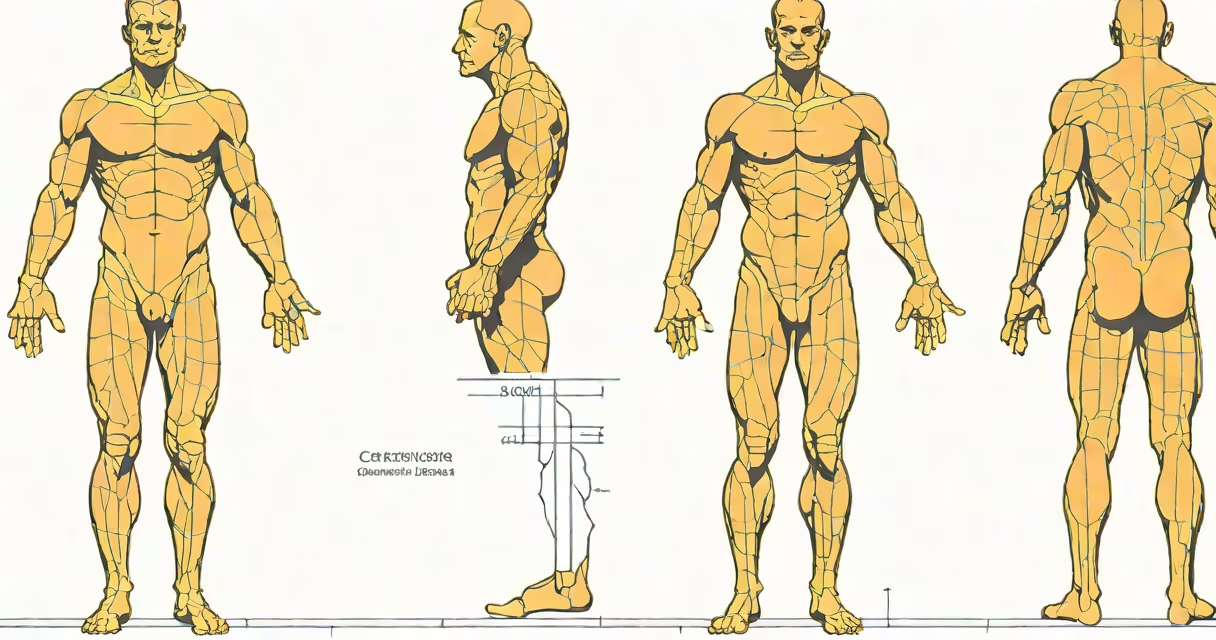
A body reference drawing is a detailed visual guide showing human anatomy in specific poses, used to ensure accurate proportions, muscle placement, and movement in artwork. It serves as a foundation for figure drawing, animation, and character design.
These drawings are typically created from live models, photographs, or digital scans. They include visible skeletal structure, major muscle groups, and changing lines indicating weight distribution and balance. Artists use them to study how limbs bend, torsos twist, and joints articulate under stress or motion.
For example, a body reference drawing of a runner in mid-stride shows the contraction of the quadriceps, the extension of the hamstrings, and the forward lean of the torso-all critical for conveying realistic motion. Without such references, figures often appear stiff or anatomically incorrect.
They function as a bridge between observation and representation. An artist sees a model or photo, then translates that into a simplified yet accurate diagram highlighting key anatomical landmarks: the clavicle, iliac crest, greater trochanter, and knee joint. These points form a structure for scaling and positioning limbs.
Each reference drawing includes gesture lines-curved strokes that capture the flow of movement. A quick gesture line through the spine and limbs can convey energy and direction. This allows artists to test a pose's viability before committing to a finished piece.
Professional studios often use standardized reference sheets. For instance, Disney's animation team historically developed a series of body reference drawings called "The Twelve Principles of Animation," which included annotated poses showing weight shifts, squash and stretch, and anticipation. These were not just artistic tools-they were engineering blueprints for believable motion.
Body reference drawings come in several forms, each suited to different stages of creation:
| Type | Use Case | Example |
|---|---|---|
| Line-only | Quick gesture sketches, planning layouts | Thumbnail drawings with minimal detail |
| Anatomical overlay | Studying muscle activation, biomechanics | Drawings with labeled muscles like biceps brachii or gluteus maximus |
| Proportion grid | Ensuring consistent scale across multiple figures | Grid-based templates using head-height units (e.g., 7.5 heads tall for adult males) |
| Changing action pose | Animating characters, creating dramatic compositions | Figure mid-leap with exaggerated perspective and tension lines |
Some artists create layered reference sheets-overlays of bone structure, muscle mass, and surface contour. These are especially useful in digital painting, where layers can be toggled on and off during the drawing process.
One non-obvious fact: many professional references are not drawn from life but are digitally generated based on 3D scans. The Human Pose Estimation project by the Max Planck Institute uses AI to map human bodies from video frames, producing highly accurate reference skeletons. These are then adapted into hand-drawn reference sheets used in animation studios worldwide.
Body reference drawings are essential in fields requiring precise human representation: animation, comic art, medical illustration, fashion design, and video game character modeling.
In animation, a single reference sheet may show a character performing a jump, with each frame annotated for timing and spacing. Pixar's rigging teams use thousands of these sheets to define how a character's limbs move across time. A misaligned elbow in one frame can break the illusion of realism.
Fashion illustrators rely on body reference drawings to depict clothing draping correctly over the body. A poorly drawn shoulder seam can make a dress look like it's floating. Reference drawings ensure folds follow the underlying form.
I once spent a week refining a reference sheet for a comic book character. I used a mannequin in my studio, photographed it from five angles, then traced the silhouette onto graph paper. I added muscle lines based on Gray's Anatomy and labeled joint angles. When I later drew the character in combat, the stance felt grounded because I had the reference to fall back on.
Many beginners think body reference drawings are meant to be copied exactly. That's not the goal. The purpose is to internalize structure so you can draw from memory or imagination. Copying a reference doesn't build skill-it reinforces dependence.
Another misconception is that only realistic art needs references. But even stylized or cartoonish characters require accurate proportions. Think of a classic Disney princess: her long legs and small waist are exaggerated, but they're based on real human ratios. Without a reference, those exaggerations would feel arbitrary.
Some confuse body reference drawings with generic "reference images." A reference image might be a photo of a person in a pose-but it lacks the clarity and annotation needed for learning. A true body reference drawing isolates key elements: axis lines, center of gravity, and muscle tension zones.
Start with simple gesture drawings-10-second sketches capturing the motion. Then refine with longer studies focusing on proportion and anatomy. Use references to check your work, not replace your eye.
Build a personal library of reference sheets. Organize them by category: standing, running, sitting, lifting. Label each with the intended use and the number of head heights it represents. Keep them accessible during sessions.
When working digitally, use reference layers. Set opacity to 50% so the reference guides without overpowering your line work. Always compare your drawing to the reference-not just the outline, but the weight distribution and implied motion.
Finally, remember: the best body reference drawings aren't perfect-they're functional. A rough sketch with clear lines and labeled joints is more useful than a polished image with cluttered details.
Mastering body reference drawing improves accuracy, speed, and confidence. a lifelike portrait, relying on a solid reference ensures your figure feels real-even when it's not.