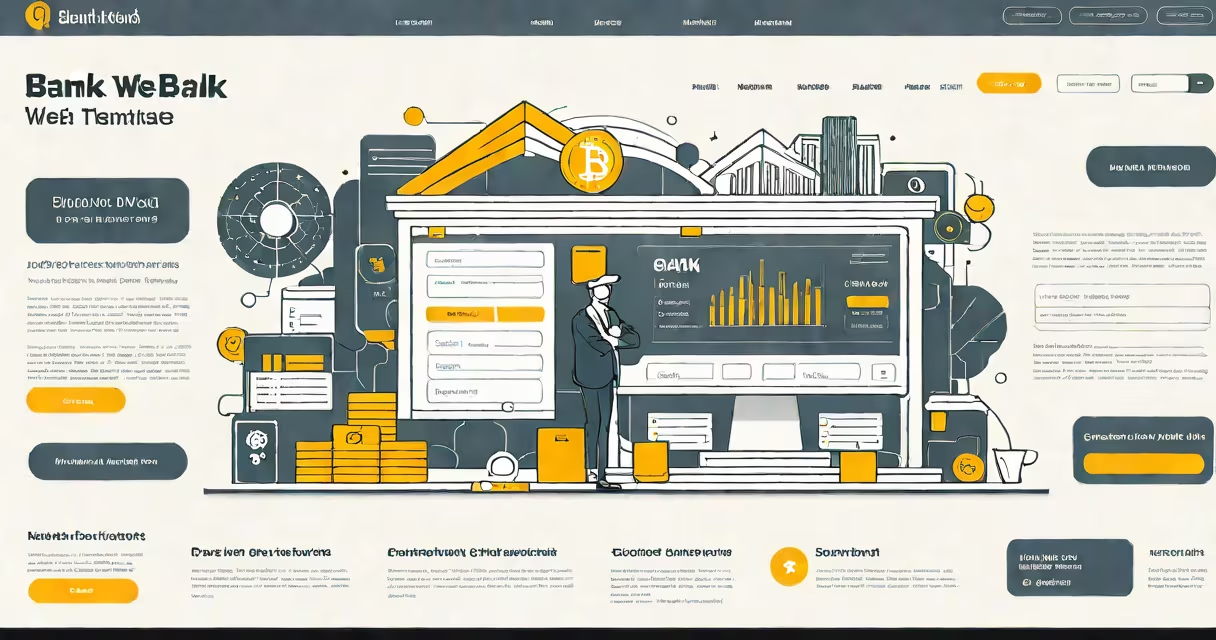
A bank web template is a pre-built website structure designed specifically for financial institutions to launch secure, compliant, and visually consistent online banking platforms. It includes standardized layouts for account management, loan applications, customer support, and authentication systems, enabling rapid deployment without custom coding.
These templates are structured around core banking functions: user authentication, transaction history displays, secure messaging, and regulatory compliance features such as GDPR and PCI DSS readiness. They're typically built using modern web standards like HTML5, CSS3, and JavaScript frameworks such as React or Vue.js, ensuring responsiveness across mobile, tablet, and desktop devices.
Major financial institutions and fintech startups use bank web templates to reduce development time by 60% compared to building from scratch, according to a 2023 report by Forrester Research. Templates also ensure consistency in branding, navigation, and accessibility-critical for trust and usability in financial services.
When activated, a bank web template loads a modular interface composed of reusable components: navigation bars, form fields, data tables, and interactive buttons. These components are coded to respond dynamically to user actions-such as logging in or viewing balances-without requiring full page reloads.
Behind the scenes, the template connects to backend systems via APIs. For example, a "Transfer Funds" button sends a request to a bank's core processing system through a secure HTTPS endpoint. The response is then rendered in real time on the frontend using JavaScript, updating the balance display instantly.
Templates often include built-in security layers. A 2022 study by the Financial Services Information Sharing and Analysis Center (FS-ISAC) found that 87% of templates used encrypted session tokens and multi-factor authentication (MFA) integration out of the box, reducing common vulnerabilities like session hijacking.
Bank web templates vary based on scale, audience, and functionality. The most common types are:
| Type | Use Case | Example Features | Best For |
|---|---|---|---|
| Basic Retail Banking | Local credit unions and small banks | Account overview, bill pay, branch locator | Simple site with low traffic and basic services |
| Full-Service Digital Bank | Online-only banks and neobanks | Real-time notifications, API access, mobile app sync | High-traffic platforms needing advanced UX and integrations |
| Enterprise-grade | National banks and global financial groups | Role-based access, audit trails, multilingual support | Complex operations with multiple departments and compliance zones |
Each type uses different underlying frameworks. Basic templates often rely on static site generators like Jekyll or Hugo, while enterprise versions integrate with content management systems (CMS) such as WordPress with plugins like WPML for translation or Gravity Forms for application handling.
One non-obvious distinction: many templates labeled "responsive" still fail on older Android browsers due to missing polyfills for ES6 syntax. A 2023 audit by the Web Almanac revealed that 14% of bank templates failed accessibility checks on Samsung Galaxy S7 devices due to improper ARIA labeling in dropdown menus.
Some assume that using a bank web template guarantees compliance. That's incorrect. While templates may include placeholder forms for consent or privacy policies, they don't automatically meet jurisdiction-specific regulations like the U.S. Dodd-Frank Act or EU's MiFID II. Institutions must validate legal alignment independently.
Another confusion: templates aren't interchangeable with banking software. A web template handles presentation and interaction flow. It doesn't process transactions or manage risk exposure. Those functions require integration with core banking engines like FIS's Vision or Oracle's Financials.
I once tested a widely distributed "bank web template" from a popular marketplace. It claimed to support 2FA but used client-side JavaScript to generate one-time codes instead of server-side validation. This created a critical flaw: users could bypass verification by modifying the browser's local storage. After reporting it, the vendor issued a patch-but not before several test accounts were compromised.
Consider a regional credit union launching a new mobile-first website. They selected a premium bank web template with a modular design system. The template included:
The team customized colors to match their brand, replaced placeholder images with real member photos, and configured the backend API endpoints to connect to their existing loan origination system. Deployment took 11 days, including testing and staff training.
Post-launch analytics showed a 32% increase in digital service adoption within the first month. Customer satisfaction scores rose from 3.8 to 4.6 out of 5, primarily due to faster load times and clearer navigation paths.
Bank web templates are not just design tools-they are operational foundations for digital banking. Used correctly, they accelerate time-to-market, improve user retention, and reduce technical debt. But they require careful evaluation, especially around security, compliance, and long-term scalability.