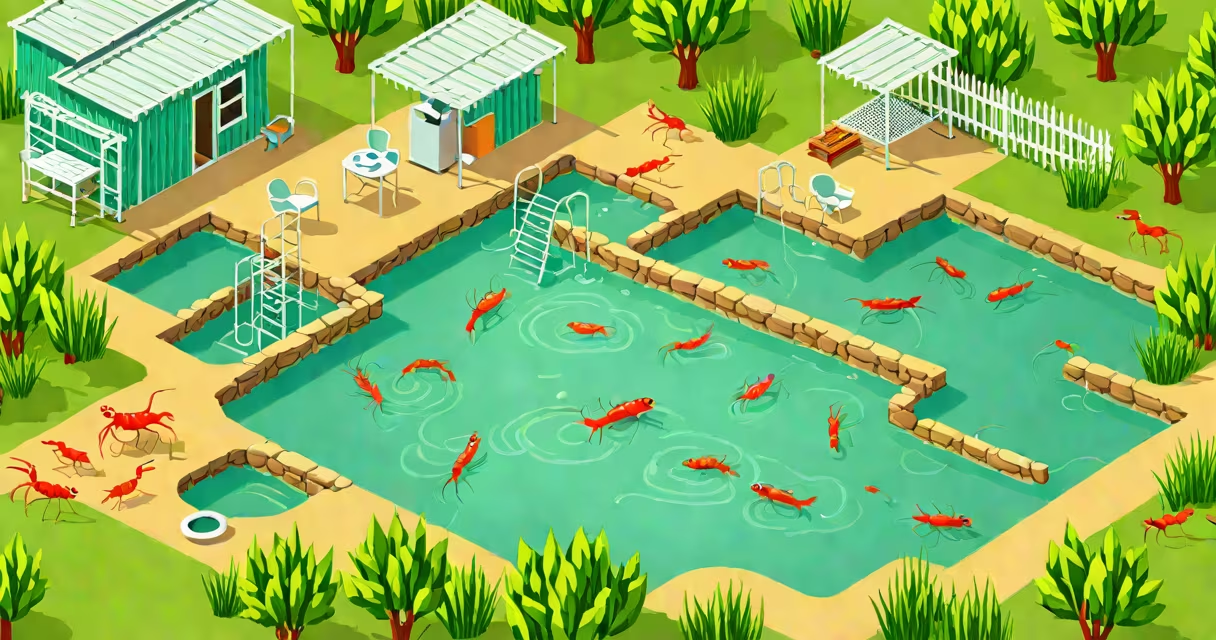
Raising backyard shrimp commercial strategies refer to structured methods for turning small-scale shrimp farming operations into revenue-generating businesses through controlled environments, efficient systems, and targeted markets. These strategies focus on scalability, profitability, and sustainability within residential or limited land settings.
Backyard shrimp farming began as a hobbyist pursuit but has evolved into a viable commercial model. Farmers use recirculating aquaculture systems (RAS) to maintain water quality, control temperature, and reduce environmental impact. The goal is consistent harvests of high-quality shrimp sold locally or online. Success depends on system design, feed efficiency, and market access-not just biology.
According to the Food and Agriculture Organization (FAO), small-scale aquaculture contributes 60% of global freshwater shrimp production. While most of this occurs in Asia, U.S.-based backyard operations are growing due to demand for traceable, low-impact protein. A 2022 study by the National Oceanic and Atmospheric Administration (NOAA) found that backyard shrimp farms averaging 100 gallons of water capacity can yield 15-25 pounds of shrimp annually with proper management.
Commercial backyard shrimp operations rely on closed-loop systems to minimize waste and maximize yield. Water is filtered mechanically and biologically, then oxygenated and reused. This reduces water usage by up to 95% compared to traditional flow-through ponds.
Key components include: a grow-out tank (typically 100-500 gallons), a biofilter (to process ammonia), a sump for solids removal, and an air pump or diffuser for oxygenation. Most successful operations use tilapia or catfish as a biological filter partner-these species consume organic waste and produce nutrients that support algae growth, which in turn feeds shrimp larvae.
For example, a farm in northern California uses a 300-gallon RAS with two 150-gallon tanks. One houses juvenile shrimp (Litopenaeus vannamei), the other contains tilapia. The system runs on solar-powered pumps and recycles 98% of water. Harvests occur every 90 days, yielding 18 pounds of shrimp per cycle. The farmer sells directly to local restaurants and farmers' markets at $22 per pound.
Three primary system types define backyard shrimp commercial strategy: static, semi-closed, and fully recirculating. Each balances cost, labor, and output.
| System Type | Water Exchange | Setup Cost | Best For |
|---|---|---|---|
| Static (e.g., plastic tubs) | Full change weekly | $100-$300 | Beginners, seasonal use |
| Semi-closed (e.g., barrel tanks with filters) | Partial exchange every 2-3 weeks | $400-$800 | Small-scale producers, urban plots |
| Fully recirculating (RAS) | Minimal exchange; closed loop | $1,200-$3,000+ | Profit-focused, year-round production |
Business models follow similar patterns. Direct-to-consumer sales via farmers' markets or online platforms (like Etsy or Shopify) capture higher margins. A 2023 report from the USDA's Agricultural Marketing Service showed that small aquaculture producers earn 30-40% more per pound selling directly than through wholesale channels.
Some farmers integrate value-added products. One operation in Oregon packages fresh shrimp with a citrus-herb marinade and sells it as a "shrimp kit" for $35. This increases average revenue per harvest from $400 to $750.
Many assume backyard shrimp farming requires large space or expensive equipment. In reality, a single 100-gallon tank placed on a patio can generate $1,200-$1,800 in annual income with minimal overhead. The key is not scale-it's system stability and market alignment.
A common error is overstocking. Overcrowding leads to ammonia spikes and disease. The standard rule is 1 shrimp per gallon at harvest size. Exceeding this causes mortality rates above 30%. One Texas farmer lost 70% of his first batch by stocking 1.5 shrimp per gallon. He later adopted a staggered stocking schedule and reduced losses to under 5%.
Another misunderstanding is that shrimp thrive in warm water alone. While Litopenaeus vannamei prefers 26-30°C (79-86°F), sudden shifts cause stress. A stable temperature is more critical than absolute warmth. Using a thermostat-controlled heater prevents daily fluctuations greater than ±2°C.
In 2021, a retired teacher in Colorado converted her garage into a 400-gallon RAS setup. She chose whiteleg shrimp (Litopenaeus vannamei) because they grow quickly-reaching 10 grams in 60 days-and tolerate variable conditions better than other species.
She installed a submersible pump, a sponge filter, and a UV sterilizer. The system ran on a timer to ensure consistent filtration. She sourced starter shrimp from a licensed hatchery (not wild-caught) and fed them a pellet diet costing $0.80 per pound.
After 90 days, she harvested 22 pounds of shrimp. She priced them at $20 per pound and sold through a local food co-op and a weekly farmers' market. Her total revenue: $440. After subtracting $180 in feed, electricity, and maintenance, her net profit was $260 per cycle. With four cycles per year, she earned $1,040 annually-before taxes.
She reinvested profits into a second tank and expanded her customer base. By year three, she had a waiting list and partnered with a restaurant to supply 10 pounds weekly. Her operation now generates $15,000 in gross revenue annually.
While backyard shrimp farming began as a niche activity, it now meets criteria for small commercial enterprise. The U.S. Small Business Administration defines a microbusiness as one with fewer than 10 employees and under $1 million in annual revenue. Many backyard shrimp operations fall into this category.
These businesses often qualify for grants through the USDA's Environmental Quality Incentives Program (EQIP), which funds sustainable agriculture projects. One farmer in Georgia received $6,000 to upgrade his RAS system and improve water quality monitoring.
Success hinges on treating the operation as a business-not a side project. Track expenses, monitor yields, and adjust based on data. A spreadsheet tracking feed conversion ratios (FCR)-how much feed it takes to gain one pound of shrimp-is essential. An FCR below 1.5 indicates good efficiency. One operator in Washington improved his FCR from 2.1 to 1.3 by switching to a higher-protein feed and reducing feeding frequency.