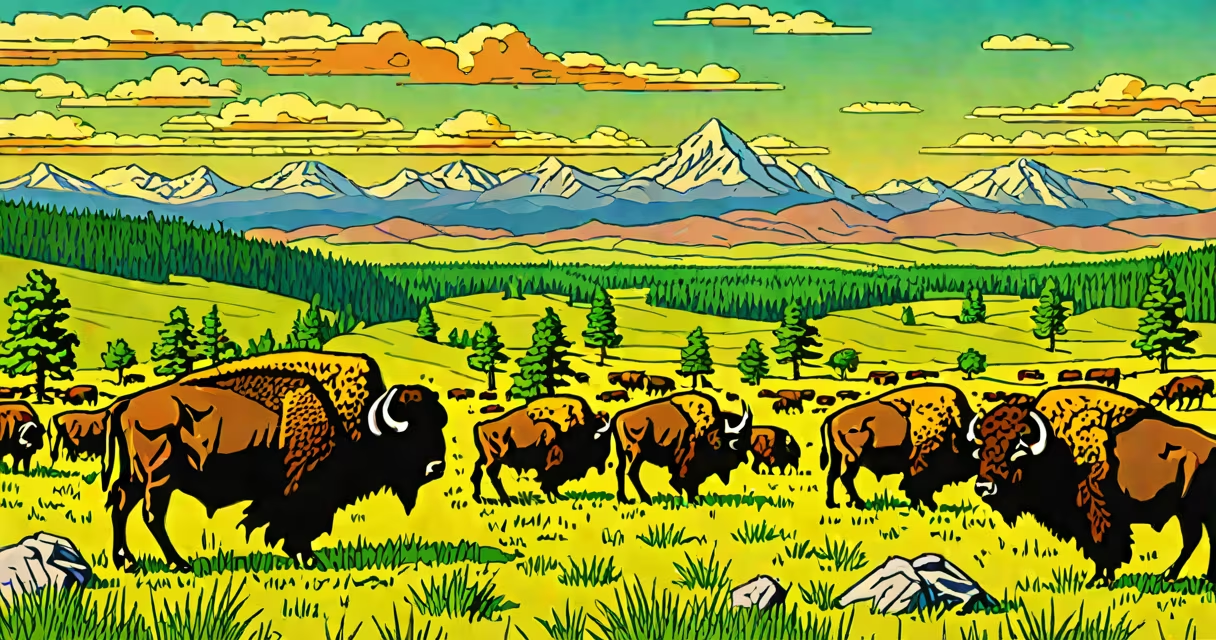
American bison are not extinct. They survive in wild and managed herds across North America, particularly in national parks and tribal reserves. Once numbering in the tens of millions, their population plummeted to fewer than 1,000 individuals by the late 1800s due to commercial hunting and habitat loss.
The species' survival hinges on deliberate conservation efforts. Today, over 500,000 bison exist in North America, though most are domesticated and bred for meat. Only about 15,000 are considered genetically pure and free-ranging, primarily in protected areas like Yellowstone and Glacier National Parks.
Despite recovery, the term "buffalo" often causes confusion. True buffalo - such as the African Cape buffalo or Asian water buffalo - are unrelated to American bison. The name "buffalo" persists in common usage for bison due to early European settlers misidentifying them as African buffalo.
Bison nearly vanished in the 1800s. U.S. government policy and private enterprise drove mass slaughter. By 1889, fewer than 1,000 wild bison remained. Their decline was not accidental - it was strategic. Removing bison disrupted Indigenous nations reliant on them for food, clothing, and culture, facilitating westward expansion.
Recovery began in the early 1900s. Private ranchers like William Hornaday and Charles Goodnight started breeding bison in captivity. The creation of Yellowstone National Park in 1872 became critical - it offered a sanctuary where bison could live undisturbed. By 1905, the park's herd had grown to 200 animals.
Today, federal and tribal programs manage bison populations. The Interagency Bison Management Plan (IBMP), formed in 2000, coordinates efforts between the National Park Service, USDA, and tribes including the Lakota, Cheyenne, and Blackfeet. This plan aims to balance ecological health, disease control (especially brucellosis), and cultural significance.
Two distinct subspecies exist: the plains bison (Bison bison bison) and the wood bison (Bison bison athabascae). Plains bison dominate current herds, while wood bison are larger and adapted to boreal forests. Both are listed as "Near Threatened" by the International Union for Conservation of Nature (IUCN).
Genetic purity matters. Many bison herds today carry cattle DNA due to historical crossbreeding. Pure bison are defined by mitochondrial DNA testing and absence of cattle alleles. Organizations like the American Bison Society and the InterTribal Buffalo Council work to identify and preserve genetically intact herds.
| Type | Scientific Name | Population Estimate | Conservation Status |
|---|---|---|---|
| Plains bison | Bison bison bison | ~450,000 | Near Threatened (IUCN) |
| Wood bison | Bison bison athabascae | ~15,000 | Near Threatened (IUCN) |
| Genetically pure wild bison | - | ~15,000 | Endangered (U.S. Fish & Wildlife Service) |
Only about 15,000 bison are considered genetically pure and free-ranging. These numbers reflect both progress and ongoing challenges. The U.S. Fish and Wildlife Service lists pure wild bison as endangered under the Endangered Species Act, citing threats from interbreeding, disease, and limited habitat.
"Buffalo" and "bison" are often used interchangeably, but they are not the same. True buffalo belong to the Bubalus genus and are native to Africa and Asia. American bison are part of the Bison genus and are endemic to North America. Confusing them leads to misunderstandings about ecology, evolution, and conservation priorities.
Another misconception: bison are "wild" simply because they roam freely. Many herds are managed. For example, the National Park Service removes bison from Yellowstone annually to prevent overgrazing and reduce disease transmission. Some are relocated to tribal lands through the InterTribal Buffalo Treaty.
A lesser-known fact: bison are keystone species. Their grazing patterns create diverse grassland habitats. A single bison can alter soil composition and promote plant diversity. Research from the University of Montana shows that bison-grazed prairies support 30% more bird species than cattle-grazed ones.
Yellowstone National Park hosts the largest wild bison herd in the U.S., estimated at 4,500 animals in 2023. The herd descends from just 23 bison released into the park in 1902. Since then, it has grown steadily, though annual culling occurs to manage brucellosis risk.
In 2022, park officials removed 600 bison and sent them to tribal reservations. One group went to the Fort Peck Reservation in Montana, where the Assiniboine and Sioux Tribes have restored bison to ceremonial and subsistence use. The tribe now raises over 1,000 bison annually, using traditional practices passed down for generations.
This effort reflects a shift from colonial conservation to Indigenous-led stewardship. Tribal nations now manage over 50% of wild bison herds in North America. Their success underscores that recovery isn't just biological - it's cultural and political.
I visited the Wind River Reservation in Wyoming in 2021. There, the Eastern Shoshone Nation maintains a herd of 300 bison. The animals move slowly across sagebrush plains, their dark coats catching the afternoon light. A tribal elder explained that bison are not just animals - they are relatives. They taught him how to read tracks, interpret behavior, and understand migration cycles through oral tradition.
That visit reshaped my view of conservation. Success isn't measured solely by numbers. It's also measured by who gets to decide what recovery looks like. The fact that bison still exist today is not just a victory for science - it's a triumph of resilience, memory, and justice.
Are buffalo extinct? No. But their survival depends on continued protection, accurate naming, and inclusive management. Recognizing the difference between bison and buffalo, supporting genetically pure herds, and honoring Indigenous leadership are essential steps forward.