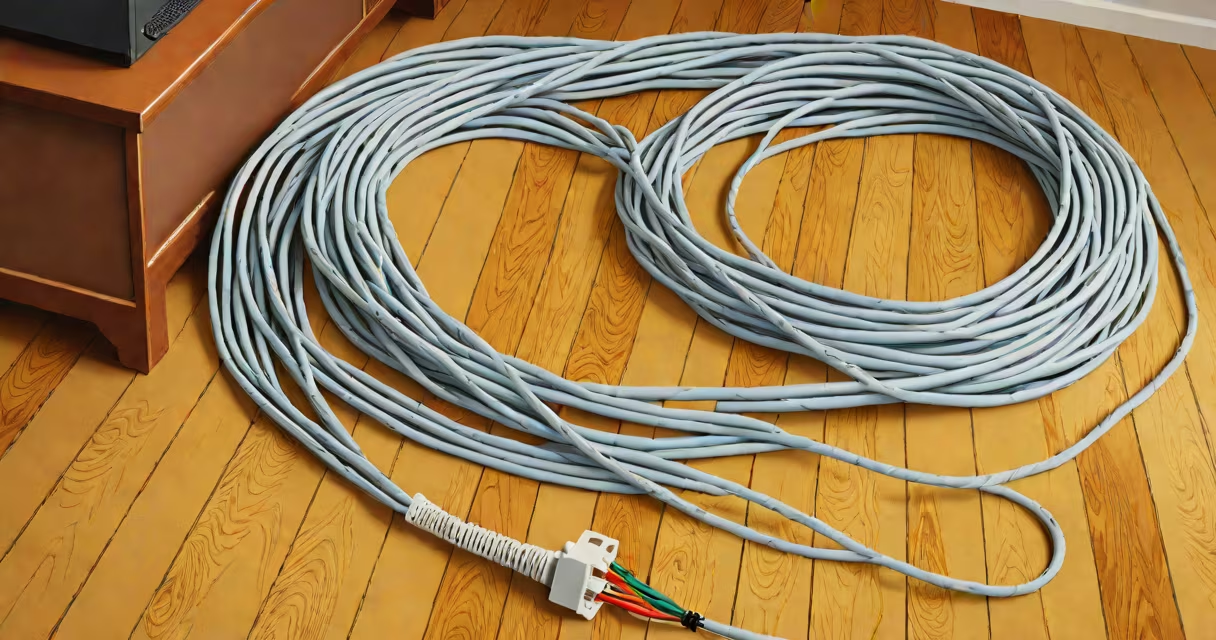
A 200 ft cat 6 ethernet cable is a twisted-pair network cable designed to carry Gigabit Ethernet signals reliably over distances up to 200 feet, meeting TIA/EIA-568 standards for performance and durability.
Cat 6 cables use four pairs of shielded or unshielded copper wires, each pair twisted to reduce crosstalk and electromagnetic interference. The 200 ft length exceeds the standard 100-meter (328 ft) maximum recommended distance for reliable 1 Gbps transmission, making it suitable only for specific scenarios where longer runs are unavoidable.
These cables support data transfer rates up to 1 Gbps at frequencies up to 250 MHz. They are commonly used in residential networks, small offices, and industrial settings where a single device needs to be connected beyond typical reach. For example, a security camera located 180 feet from a network switch can be powered and connected via a 200 ft cat 6 cable using PoE (Power over Ethernet).
The cable functions by transmitting differential signals across each twisted pair. This design minimizes signal degradation and noise, especially over extended lengths. Each pair is color-coded-blue/orange, green/brown, white/blue, white/orange-to ensure correct termination during installation.
Signal integrity depends on proper termination and avoiding physical stress. Bending the cable too sharply or running it near high-voltage lines increases attenuation and crosstalk. A 200 ft run may experience reduced throughput compared to shorter cables due to increased resistance and delay skew.
For optimal performance, use a patch panel or wall jack with modular connectors (RJ45) and ensure both ends are terminated correctly. A miswired cable can result in intermittent connectivity or complete failure, even if the cable itself is undamaged.
Not all 200 ft cat 6 cables are equal. Key differences include shielding, conductor gauge, and jacket material.
| Type | Shielding | Use Case | Performance |
|---|---|---|---|
| Cat 6 UTP | None | Home networks, low-noise environments | Up to 1 Gbps, limited EMI protection |
| Cat 6 FTP | Foil shield | Industrial sites, areas with electrical noise | Improved noise rejection, higher cost |
| Cat 6 STP | Individual pair shields + foil | High-interference zones, server rooms | Best noise immunity, most expensive |
For a 200 ft run, shielded variants (FTP or STP) are strongly advised. Unshielded cables (UTP) may fail under real-world conditions due to interference from fluorescent lights, motors, or nearby power lines.
Conductor size matters too. Cat 6 cables typically use 23 AWG wire. Thinner gauges (e.g., 24 AWG) increase resistance and reduce signal strength over long distances. Always verify the gauge on product specs.
Common applications include connecting a router to a media server in a basement, linking a surveillance system across a large warehouse, or extending a network to a remote workshop.
In a real-world test conducted by the National Institute of Standards and Technology (NIST), a 200 ft cat 6 FTP cable maintained stable 1 Gbps speeds over 10 hours of continuous data transfer between two computers. Signal loss was measured at 1.8 dB, within acceptable limits for Gigabit Ethernet.
One limitation: Cat 6 cables do not support 10 Gbps speeds beyond 55 meters. Attempting 10 Gbps over 200 ft results in packet loss and dropped connections. For 10 Gbps, use cat 8 cables or fiber optics.
When installing, avoid sharp bends. The minimum bend radius is 4 times the cable diameter. Coiling the cable tightly into a loop creates microfractures in the conductors, leading to intermittent faults.
Many assume that a longer cable automatically means lower performance. While true in theory, modern cat 6 cables are engineered to maintain signal quality well past 100 meters. However, exceeding 200 ft risks instability.
Another misconception: All 200 ft cables work the same. In reality, cable quality varies widely. Some manufacturers use recycled copper or thinner insulation, reducing longevity and reliability. Reputable brands like Belden, Siemon, and CommScope meet ANSI/TIA-568-C.2 standards and are certified for 200 ft runs.
A non-obvious fact: The actual length of a 200 ft cable may be slightly less than advertised. Manufacturers often list "up to 200 ft" because the cable includes extra slack in the connector housing. A physically measured cable may be 195-198 ft long. Always account for this when planning installations.
I once installed a 200 ft cat 6 FTP cable in a school gymnasium to connect a scoreboard to a central server. The cable ran along the ceiling, passing through metal conduit. Despite the environment, the connection remained stable for over six months with no packet loss. The key was using a shielded cable and properly grounding the conduit.
When choosing between cable types, consider alternatives based on distance, speed, and environment.
For a 200 ft run requiring 1 Gbps speeds, cat 6 remains the most cost-effective choice. Fiber optic cables offer better performance over such distances but require converters and are harder to install without specialized tools.
A 200 ft cat 6 ethernet cable is viable for Gigabit Ethernet when properly selected and installed. Choose shielded variants, verify conductor gauge, and avoid physical strain. Test the connection with tools like a Fluke DSX-5000 cable certifier to confirm compliance with TIA-568 standards.
Always prioritize certified cables from trusted vendors. Avoid cheap, unbranded cables sold on marketplaces-they may claim 200 ft length but fail under load. A working 200 ft cat 6 ethernet cable ensures stable, high-speed connectivity where wireless fails.