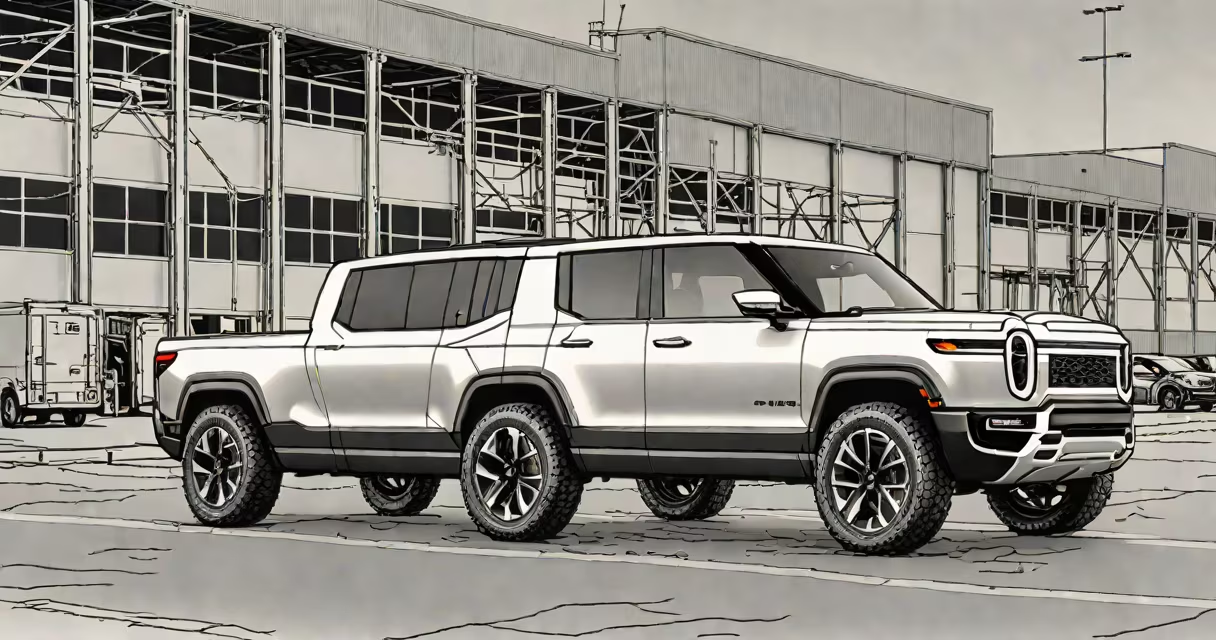
Who bought Rivian refers to the major institutional and individual investors that acquired shares in the American electric vehicle manufacturer Rivian Automotive, Inc., which went public via IPO in November 2021. Ownership includes early backers like Amazon, asset managers such as BlackRock, and hedge funds like Baillie Gifford.
Rivian's initial public offering priced at $78 per share, raising $8.5 billion. The company's valuation soared past $100 billion during its debut trading session, making it one of the most valuable U.S. auto startups. Institutional investors were among the first to buy large blocks of stock, driven by expectations of long-term growth in the EV sector.
Amazon, Rivian's largest shareholder, invested $700 million in 2019 and later increased its stake through additional purchases. As of Q1 2024, Amazon held approximately 20% of Rivian's outstanding shares, according to SEC filings. This stake was secured through a strategic partnership where Amazon committed to purchasing 100,000 electric delivery vans from Rivian over several years.
The following table outlines the top institutional shareholders in Rivian based on Form 13F filings with the U.S. Securities and Exchange Commission (SEC) as of March 2024.
| Investor | Stake Percentage | Shares Held (approx.) | Source |
|---|---|---|---|
| Amazon | 20% | 126 million | SEC Form 13F, Q1 2024 |
| BlackRock | 6.8% | 43 million | SEC Form 13F, Q1 2024 |
| Baillie Gifford & Co. | 5.2% | 33 million | SEC Form 13F, Q1 2024 |
| State Street Corporation | 4.1% | 26 million | SEC Form 13F, Q1 2024 |
| Capital Research Global Investors | 3.9% | 25 million | SEC Form 13F, Q1 2024 |
These figures reflect holdings reported by investment firms that manage assets for pension funds, endowments, and insurance companies. The data is updated quarterly and reflects changes in portfolio positions. For example, BlackRock reduced its Rivian position by 12% between Q4 2023 and Q1 2024, indicating shifting confidence in the company's near-term outlook.
Amazon's role goes beyond passive investing. The company signed a binding agreement in 2020 to purchase 100,000 Rivian electric delivery vans, with deliveries beginning in 2022. By late 2023, over 15,000 vans had been delivered to Amazon's logistics network. This integration created a direct revenue stream for Rivian and helped validate its commercial viability.
Many assume Rivian is owned by Elon Musk or Tesla. That is incorrect. Rivian was founded in 2009 by Robert Mehrabian and is headquartered in Irvine, California. Musk's Tesla did not invest in Rivian, nor did it acquire any stake. The confusion often arises because both companies operate in the EV space and have similar branding strategies.
Another misconception is that Rivian's stock price reflects stable performance. In reality, Rivian's share value dropped from a high of $110 in early 2022 to below $20 in late 2023 due to production delays, rising costs, and weak sales volume. This volatility led to investor churn, with several large funds trimming their positions.
A lesser-known fact: Rivian's founder, Robert Mehrabian, retained less than 1% of voting power after the IPO. His personal stake declined due to dilution from secondary offerings and employee stock option grants. The company's board now includes representatives from Amazon and other institutional investors, reflecting a shift toward corporate governance aligned with large shareholders.
In 2019, Amazon placed a $700 million order for 100,000 Rivian R1T trucks and delivery vans. The deal included a $500 million upfront payment and a commitment to deliver 10,000 vans annually over five years. This contract gave Rivian immediate access to capital and a guaranteed customer base.
By 2023, Amazon had deployed over 15,000 Rivian vans across 20 U.S. states. The vehicles operated in urban and suburban routes, reducing fleet emissions by an estimated 12,000 metric tons annually. Amazon also co-developed software features tailored to delivery operations, such as route optimization and battery thermal management systems.
This arrangement illustrates how strategic partnerships can influence ownership structure. Amazon's investment wasn't purely financial-it came with operational requirements, product specifications, and performance benchmarks. These conditions shaped Rivian's engineering roadmap and delayed the R1T's full production until 2022.
As of mid-2024, Rivian's ownership is dominated by institutional investors. Amazon remains the single largest shareholder, followed by BlackRock, Baillie Gifford, and State Street. Individual retail investors hold less than 10% of the total float, according to data from S&P Capital IQ.
Rivian's executive team owns minimal equity. CEO RJ Scaringe held 1.4 million shares as of Q1 2024, representing roughly 0.3% of the company. His compensation package includes restricted stock units tied to performance metrics like vehicle delivery targets and gross margin thresholds.
When analyzing who bought Rivian, focus on the difference between passive ownership and active influence. Amazon's stake gives it use over product development and supply chain decisions. BlackRock's voting power allows it to influence board appointments and executive pay policies. These dynamics shape how Rivian operates far beyond what a typical public company experiences.
For context, Rivian's market cap stood at $28 billion in April 2024, down from a peak of $110 billion in January 2022. Despite this decline, the company continues to expand its manufacturing capacity, with a second plant under construction in Georgia. The next phase of growth hinges on scaling production and achieving profitability.
If you're considering investing in EV stocks, understanding who bought Rivian provides insight into the company's stability and long-term direction. The presence of Amazon and major asset managers suggests sustained interest, even amid market downturns.