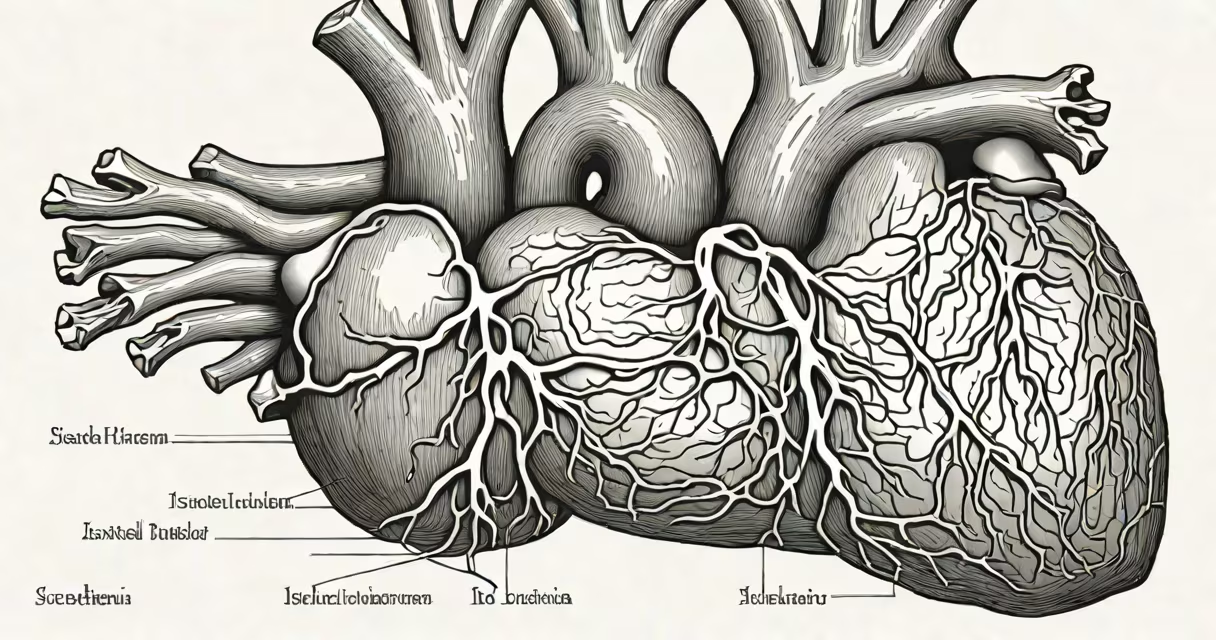
Ischemia is a medical condition characterized by restricted blood flow to a part of the body, leading to insufficient oxygen delivery to tissues. This oxygen deficiency impairs cellular function and can result in tissue damage if prolonged. The term originates from Greek roots meaning "to hold back" or "to obstruct," reflecting its core mechanism.
Ischemia occurs when blood vessels narrow or become blocked, reducing perfusion. Common sites include the heart (myocardial ischemia), brain (cerebral ischemia), and limbs (peripheral ischemia). Without adequate oxygen, cells switch to anaerobic metabolism, producing lactic acid and disrupting normal function. Prolonged ischemia leads to infarction-tissue death-when blood flow remains cut off.
The American Heart Association defines ischemia as "a decrease in blood supply to an organ or tissue, resulting in inadequate oxygen delivery." The National Institutes of Health notes that ischemia underlies many acute events, including heart attacks and strokes. Early recognition is critical because reversing blood flow restoration within minutes can prevent permanent damage.
Ischemia begins when vascular resistance increases or blood volume drops. Arteries may constrict due to spasm, plaque buildup, or clot formation. For example, atherosclerotic plaques in coronary arteries reduce lumen diameter, limiting oxygen-rich blood to cardiac muscle. When oxygen demand exceeds supply-such as during exercise-the imbalance triggers ischemic symptoms.
Cells respond to low oxygen by activating stress pathways. ATP production declines, ion pumps fail, and intracellular calcium rises. These changes disrupt membrane integrity and trigger inflammatory signals. If blood flow resumes quickly-within 20 to 30 minutes in the heart-cells may recover. Delayed reperfusion causes reperfusion injury, where oxidative stress damages tissue further.
Electrocardiogram (ECG) changes often signal myocardial ischemia. ST-segment depression or T-wave inversion appears during episodes. In the brain, transient ischemic attacks (TIAs) cause temporary neurological deficits lasting minutes to hours. These warning signs precede full stroke in up to 30% of cases, according to the CDC.
Ischemia varies by location and underlying cause. The most common forms include:
| Type | Primary Cause | Common Symptoms | Associated Conditions |
|---|---|---|---|
| Myocardial | Coronary artery narrowing | Chest pain, shortness of breath | Coronary artery disease, angina |
| Cerebral | Carotid or cerebral artery occlusion | Weakness, slurred speech, vision loss | Stroke, TIA, hypertension |
| Peripheral | Arteriosclerosis in legs | Leg cramps, cold extremities | PAD, diabetes, smoking |
| Renal | Renal artery stenosis | Hypertension, decreased urine output | Chronic kidney disease, aortic aneurysm |
Non-vascular causes also contribute. Severe anemia reduces oxygen-carrying capacity, mimicking ischemia. Shock from trauma or sepsis lowers systemic blood pressure, impairing perfusion. Certain medications, such as beta-blockers or vasoconstrictors, can worsen ischemia in vulnerable individuals.
A lesser-known factor is microvascular ischemia-damage in tiny vessels not visible on standard angiograms. This form affects up to 40% of women with chest pain and normal coronary arteries, according to research published in *Circulation*. It underscores that ischemia isn't always detectable via traditional imaging.
Ischemia is often mistaken for infarction. While both involve poor blood flow, infarction refers to irreversible tissue death. Ischemia is reversible if treated promptly. A patient with stable angina experiences ischemia without infarction-symptoms resolve with rest or medication.
Another confusion arises between ischemia and hypoxia. Hypoxia means low oxygen levels in the blood or tissues. Ischemia specifically implies reduced blood flow, which causes hypoxia. But hypoxia can occur without ischemia-such as in high-altitude exposure or lung disease-where blood flow remains normal.
Some assume ischemia only affects older adults. However, young people with congenital heart defects, sickle cell disease, or autoimmune disorders like lupus can develop ischemia. A 2021 study in *The Lancet* reported that 15% of ischemic strokes in patients under 50 were linked to undiagnosed vasculitis.
Consider a 62-year-old man with known coronary artery disease. He experiences crushing chest pain while climbing stairs. His ECG shows ST-segment depression in leads II, III, and aVF-indicating inferior wall ischemia. Blood tests reveal elevated troponin, signaling myocardial injury.
Emergency angiography reveals a 90% blockage in the right coronary artery. After balloon angioplasty and stent placement, blood flow returns. Within 90 minutes, chest pain resolves. The episode was ischemia, not infarction-because tissue recovery occurred before necrosis set in.
This case illustrates the time-critical nature of ischemia. The "golden hour" rule applies: interventions within 60 minutes of symptom onset improve outcomes. Delay beyond two hours increases mortality risk by 30%, per data from the American College of Cardiology.
Ischemia is a silent precursor to major events. Up to 50% of heart attacks begin with unstable angina-unstable ischemia-without warning. Identifying early ischemic patterns allows preventive treatment. Beta-blockers, statins, and antiplatelets reduce risk by 30-50% in high-risk groups, per guidelines from the European Society of Cardiology.
Neurologists monitor for cerebral ischemia using diffusion-weighted MRI, which detects changes within minutes. This sensitivity enables earlier stroke intervention. In peripheral ischemia, ankle-brachial index testing identifies at-risk patients before symptoms appear.
During my time working in a cardiology clinic, I observed a patient whose ECG showed subtle ST changes during a stress test. He had no symptoms. Further evaluation revealed significant coronary stenosis. Early detection prevented a major event. This highlights that ischemia often presents subtly-its danger lies in invisibility.
Understanding the definition of ischemia is essential for recognizing early warning signs. It's not merely a lack of blood flow-it's a physiological crisis that demands immediate attention. Knowing the difference between ischemia and infarction, or ischemia and hypoxia, prevents misdiagnosis and improves outcomes.
For those managing long-term health risks, awareness of ischemia helps inform lifestyle choices and medical follow-up. If you're concerned about cardiovascular health, reviewing your financial and health planning options can support access to care and preventive services.