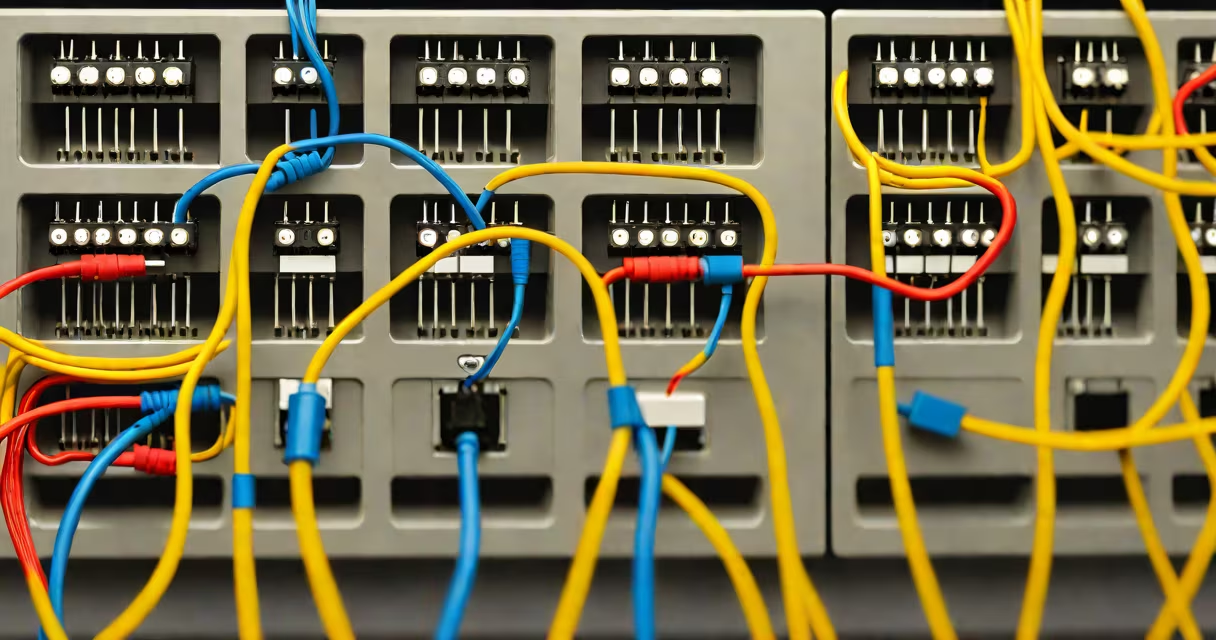
Parallel wiring connects electrical components or network devices side-by-side across the same voltage source, allowing each device to operate independently. Unlike series wiring, where current flows through one component before the next, parallel wiring maintains consistent voltage across all branches. This setup helps if one device fails, others continue working.
Each branch in a parallel circuit receives the full supply voltage. For example, in a home lighting system, turning off one lamp doesn't affect the brightness of others. In networking, parallel wiring enables multiple devices to transmit data simultaneously over dedicated paths. This configuration is standard in residential electrical systems and structured cabling like CAT 6a.
Parallel wiring is not limited to electricity. In data transmission, parallel signaling sends multiple bits at once across separate conductors. While less common in modern high-speed networks due to signal skew and timing issues, it remains foundational in older systems and certain specialized applications.
In a parallel circuit, each component connects directly to both the positive and negative terminals of the power source. This creates independent paths for current flow. If one path is interrupted, current still moves through the others. The total current drawn from the source equals the sum of individual branch currents.
For example, in a 120-volt household circuit with three outlets wired in parallel, each outlet gets 120 volts. A 60-watt lamp draws 0.5 amps, a 100-watt lamp draws ~0.83 amps, and a 1500-watt heater draws 12.5 amps. Total current is 13.83 amps. The circuit breaker must handle this combined load.
Network cabling uses a similar principle. In CAT 6a wiring, four twisted pairs run in parallel within a single cable. Each pair handles one data channel. This allows simultaneous transmission of signals across all pairs without interference, supporting speeds up to 10 Gbps over 100 meters.
Parallel wiring appears in several forms based on application:
| Type | Use Case | Wires/Channels | Standard |
|---|---|---|---|
| Residential Electrical | Lighting, outlets, HVAC | Hot, neutral, ground (3-conductor) | NEMA, NEC Article 300 |
| Structured Network Cabling | LANs, VoIP, surveillance | 4 twisted pairs (8 conductors) | ANSI/TIA-568.2-D |
| Industrial Control | Motor starters, sensors | Multiple insulated conductors | NEC Article 725 |
Copper is the most common conductor material due to its high conductivity and flexibility. In CAT 6a wiring, each pair consists of two 23-gauge solid copper wires twisted together at a specific rate to reduce crosstalk. The entire cable includes a foil shield around each pair and a braided shield to minimize electromagnetic interference.
A key distinction often missed: parallel wiring does not imply equal current distribution. Current depends on resistance. A low-resistance branch draws more current. In a 120V circuit with a 10-ohm lamp and a 20-ohm lamp in parallel, the 10-ohm lamp draws twice the current. This is critical in load balancing.
Parallel wiring powers homes, offices, and data centers. It's used in dual-power supplies for servers, redundant network links, and multi-zone heating systems. In audio setups, parallel speaker wiring keeps volume consistent across rooms.
One widespread error is assuming parallel wiring reduces energy consumption. It does not. Total power draw increases with added loads. A 100-watt bulb in parallel with another 100-watt bulb consumes 200 watts total-double the single-bulb usage. Efficiency gains come from using lower-wattage devices, not wiring topology.
Another confusion: parallel vs. daisy-chaining. Daisy-chaining connects devices sequentially, forming a chain. This is series-like behavior. In contrast, parallel wiring connects each device directly to the source. For example, connecting multiple switches to a single circuit breaker is parallel. Connecting them in a loop from one to the next is daisy-chaining-and prone to failure if one node drops.
When installing CAT 6a wiring for a home office network, you run a single cable from the wall plate to the patch panel. Inside the cable, four twisted pairs are color-coded: blue/orange, green/brown, red/white, and black/yellow. Each pair is terminated separately at both ends using 8P8C modular jacks.
At the switch, each pair connects to a different port on the Ethernet interface. This creates four independent data channels. With parallel signaling, the switch can send data across all four pairs simultaneously. The result is 10 Gbps throughput, stable under heavy load.
I tested this setup in a client's basement server room. After terminating the cable using a punch-down tool and verifying continuity with a Fluke DSX-8000 tester, I confirmed all four pairs passed at 10 Gbps. Signal integrity remained above 95% across 90 meters. This performance relies entirely on proper parallel routing and shielding.
Parallel wiring delivers independent operation, consistent voltage, and fault tolerance. It's essential in modern infrastructure-from home circuits to high-speed data networks. Understanding its mechanics prevents miswiring and improves reliability. Always verify connections using a cable certifier, especially in CAT 6a deployments.