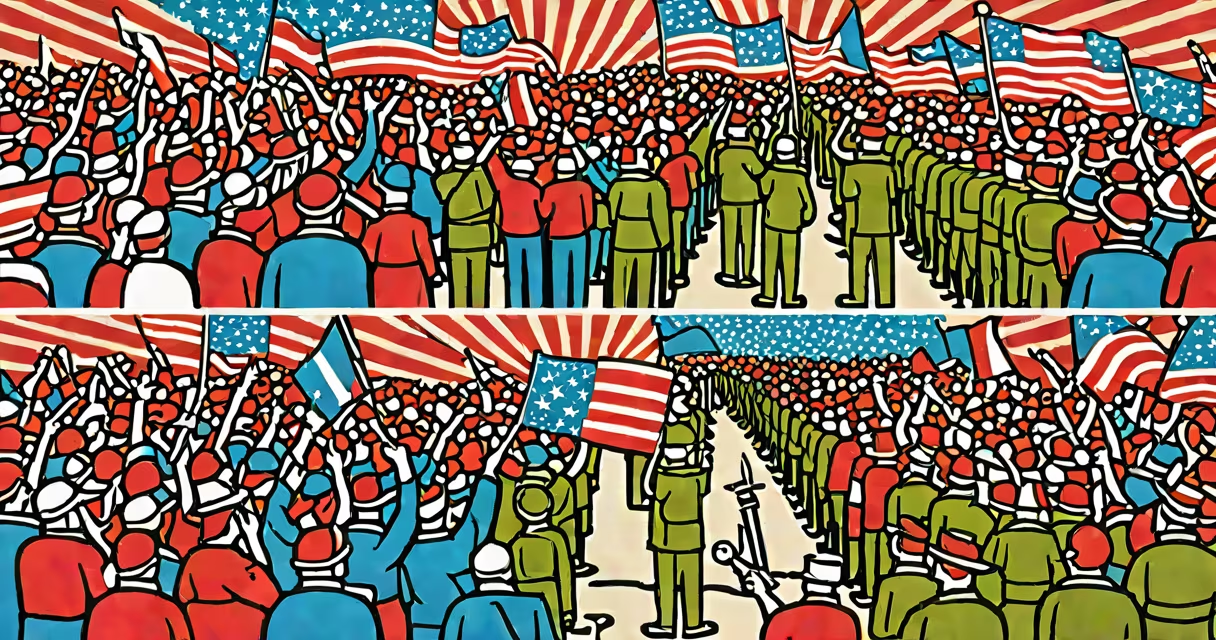
What is not democracy refers to political systems where power is concentrated in the hands of a single individual, a small elite, or a ruling class, and where citizens lack free elections, civil liberties, or meaningful influence over decisions. These systems exclude popular sovereignty-the core principle of democracy-and often suppress dissent through coercion or censorship.
Democracy requires regular, competitive elections, protection of human rights, freedom of speech, and independent institutions. When any of these elements are absent or manipulated, the system fails to meet basic democratic standards. What is not democracy includes autocracies, totalitarian regimes, military juntas, and hereditary monarchies with unchecked power.
For example, North Korea operates under a state-controlled system where the leader holds absolute authority, elections are staged, opposition is nonexistent, and media is entirely state-run. This contrasts sharply with systems like Sweden or Canada, where leaders are chosen through contested elections, courts operate independently, and citizens can freely criticize government policy.
Non-democratic systems derive legitimacy from sources other than popular consent. Power may be inherited, seized by force, or maintained through control of information and security forces. In such systems, decision-making occurs behind closed doors, often without public input or accountability.
Authoritarian regimes centralize authority in a single figure or small group. They may allow limited participation-such as referendums or advisory councils-but these mechanisms serve to reinforce rather than challenge existing power. For instance, Russia's 2020 constitutional referendum expanded presidential powers while restricting opposition access to media and ballot boxes. The vote was held amid widespread allegations of fraud and voter suppression.
Oligarchic systems distribute power among a few wealthy or influential families. In countries like Venezuela under Hugo Chávez and Nicolás Maduro, economic control shifted to a network of business allies and military officials who benefited from state contracts and resource extraction. Public services deteriorated, and protests were met with violence, illustrating how wealth and patronage replace democratic representation.
The following table outlines major forms of non-democratic rule, their defining traits, and real-world examples.
| Type | Power Source | Key Features | Example |
|---|---|---|---|
| Autocracy | Single ruler | Hereditary or seized power; no free elections; media controlled | North Korea under Kim dynasty |
| Totalitarianism | State ideology | Complete surveillance; propaganda; suppression of dissent | Stalinist USSR (1920s-1950s) |
| Military Junta | Armed forces | Coup-installed leadership; martial law; restricted civil rights | Burma (Myanmar) since 2021 coup |
| Oligarchy | Elite families or corporations | Wealth-based influence; limited political competition; cronyism | Post-Soviet Russia under Putin's inner circle |
These systems differ in structure but share a common trait: they deny citizens the ability to alter leadership through fair processes. In a true democracy, change happens through ballots, not bullets.
Many people confuse "not democracy" with "bad government." A poorly managed democracy-like one with low voter turnout or weak institutions-is still democratic if elections are free and fair. What is not democracy involves structural barriers to participation, not just inefficiency.
A frequent error is labeling any government that disagrees with Western policies as "undemocratic." But a country can hold regular elections and have a constitution yet still fail to protect civil rights. According to Freedom House's 2023 Freedom in the World report, 60% of nations labeled "partly free" or "not free" had elections, but those elections lacked transparency or fairness.
Another misconception is equating democracy with majority rule. True democracy protects minority rights. In a non-democratic system, the majority can be used to justify suppressing minorities. For example, in Rwanda during the 1990s, Hutu-majority rule led to the genocide of Tutsis-a violent outcome enabled by exclusionary rhetoric and state-sponsored propaganda.
When power is not accountable to the people, corruption flourishes. Transparency International's 2023 Corruption Perceptions Index ranked 113 out of 180 countries as having high or very high levels of corruption-most of them non-democratic states. In countries like Somalia and South Sudan, warlords and warlord-aligned governments control territory without oversight, leading to humanitarian crises.
I once observed a local election in a former Soviet republic where voters stood in long lines, but ballot boxes were sealed before counting began. The results were announced within minutes. No observers were allowed. This was not a democratic process-it was a performance of democracy. The event highlighted how formal procedures can mask real power imbalances.
Understanding what is not democracy helps identify early warning signs of democratic erosion. The Economist Intelligence Unit's Democracy Index tracks 167 countries annually. In 2023, only 21% of nations were classified as "full democracies." The rest fell into categories ranging from "flawed" to "authoritarian," underscoring how rare truly representative systems remain globally.
Recognizing what is not democracy is essential for protecting civic space, defending human rights, and supporting institutions that uphold accountability. Without clear boundaries, the term loses meaning-and so does the promise of self-governance.