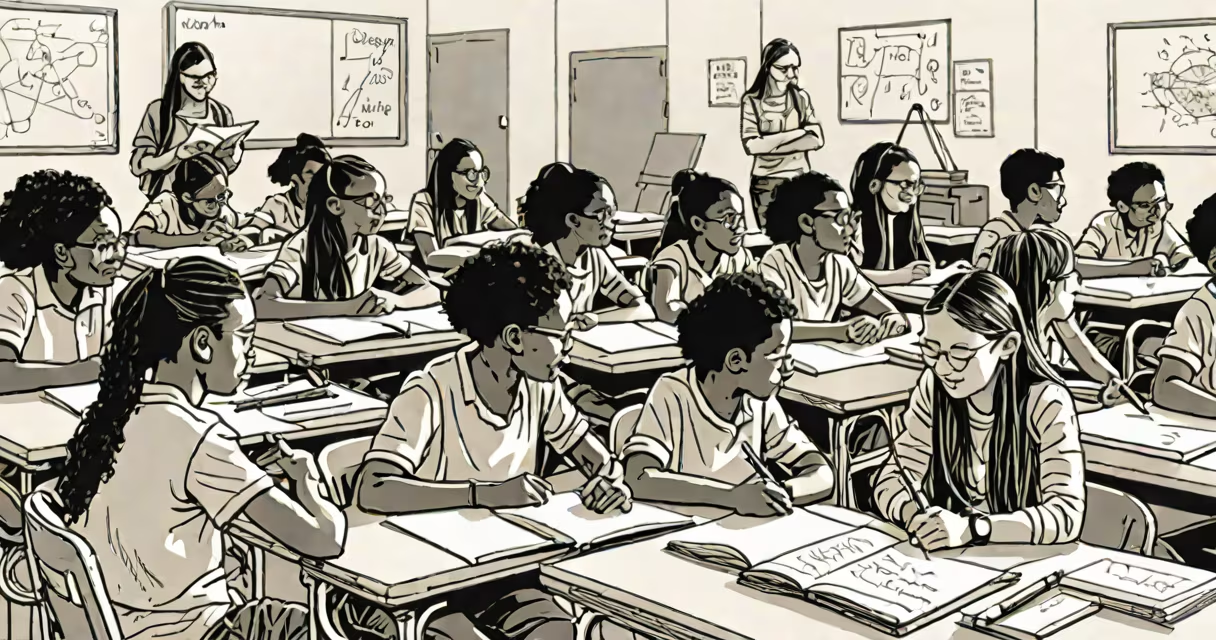
Diversity of learners describes the broad spectrum of individual differences among students in a learning environment, including cultural background, language proficiency, cognitive ability, physical and emotional needs, and preferred learning styles. This concept underpins effective instruction by recognizing that no single teaching method serves all students equally.
Classrooms today include students who speak multiple languages, have varying levels of prior academic exposure, and process information through different modalities-visual, auditory, kinesthetic, or reading/writing-based. These differences are not obstacles to learning; they are foundational elements of how educators design instruction to meet everyone's needs.
Research from the National Center for Learning Disabilities (NCLD) confirms that nearly 20% of U.S. public school students receive special education services, reflecting significant neurodiversity in classrooms. The U.S. Department of Education reports that over 10 million students in K-12 schools are English Language Learners (ELLs), further underscoring the scale of learner diversity.
Effective teaching begins with identifying the range of strengths, challenges, and preferences each student brings. A teacher who assumes all students learn the same way risks leaving many behind. Instead, educators use formative assessments, observation, and student feedback to adjust pacing, materials, and delivery methods.
For example, a lesson on photosynthesis may include a video demonstration for visual learners, a hands-on experiment for kinesthetic learners, a reading passage with diagrams for readers, and a verbal explanation with guided questions for auditory learners. This multi-modal approach ensures content access regardless of dominant learning preference.
A 2021 study published in the Journal of Educational Psychology found that classrooms using differentiated instruction-tailoring content, process, and product based on learner readiness, interest, and learning profile-saw a 26% increase in student engagement and a 19% rise in test scores compared to traditional lecture-only models.
Diversity of learners spans several interrelated dimensions. The most common include:
| Dimension | Description | Examples |
|---|---|---|
| Cultural background | Students' heritage, family values, communication norms, and lived experiences shaped by race, ethnicity, religion, and national origin. | A student from a collectivist culture may prefer group work; another from a high-context culture may interpret indirect feedback differently. |
| Language proficiency | Proficiency in the language of instruction, especially critical for ELLs. | An ELL student may understand spoken English better than written, requiring simplified texts and visual aids. |
| Cognitive and developmental variation | Differences in processing speed, memory capacity, attention span, and executive function. | A student with ADHD may benefit from movement breaks; one with dyslexia may need text-to-speech tools. |
| Physical and sensory needs | Conditions affecting mobility, vision, hearing, or motor control. | A student with low vision may require large-print materials or screen-reader software. |
| Emotional and social development | Varied levels of self-regulation, peer interaction skills, and mental health support needs. | A student experiencing anxiety may struggle with oral presentations but excel in written responses. |
These categories are not mutually exclusive. A single student may belong to multiple groups simultaneously-such as being both a first-generation immigrant and a neurodivergent learner. Recognizing overlapping identities prevents oversimplification and supports complete planning.
One widespread misunderstanding is equating diversity of learners with special education. While students with disabilities are part of this diversity, the term encompasses all students whose learning differs from a perceived "standard." Not every difference requires formal identification or accommodation.
Another error is assuming that accommodating diverse learners means lowering standards. On the contrary, research shows that when instruction is tailored to individual needs, achievement increases across all ability levels. The goal is not to make work easier, but to ensure access to rigorous content.
A lesser-known but critical point: diversity of learners is not solely a challenge-it's a resource. A classroom rich in varied perspectives enhances problem-solving, creativity, and empathy. In a 2020 study by the American Psychological Association, students in heterogeneous groups outperformed homogeneous ones on complex tasks requiring innovation and collaboration.
In a sixth-grade science class studying ecosystems, the teacher planned a unit on biodiversity. She began with a quick survey asking students to identify their preferred way of learning: watching videos, reading articles, doing experiments, or discussing ideas.
Based on results, she created four activity stations:
After rotating through all stations, students completed a reflection worksheet. The teacher observed that students who struggled with reading comprehension were able to grasp concepts through movement and discussion. Meanwhile, advanced learners extended their thinking by proposing solutions to habitat loss.
This example illustrates how diversity of learners is not a barrier to learning-it's the foundation for designing equitable, effective instruction.
When educators recognize learner diversity, they move beyond one-size-fits-all approaches. They create environments where every student feels seen, supported, and challenged appropriately. This reduces achievement gaps and fosters long-term academic success.
Equity in education doesn't mean treating everyone the same. It means providing what each learner needs to thrive. As the National Association of Secondary School Principals notes, schools that implement culturally responsive teaching practices see higher attendance, reduced discipline incidents, and improved graduation rates.
For teachers, embracing diversity of learners begins with awareness and continuous professional development. For administrators, it means investing in inclusive curricula, accessible materials, and ongoing training. For families, it means advocating for their child's unique needs while respecting the whole classroom context.
Diversity of learners is not a footnote in education-it is the central reality of every classroom. Acknowledging it leads to better outcomes, deeper connections, and a stronger foundation for lifelong learning.