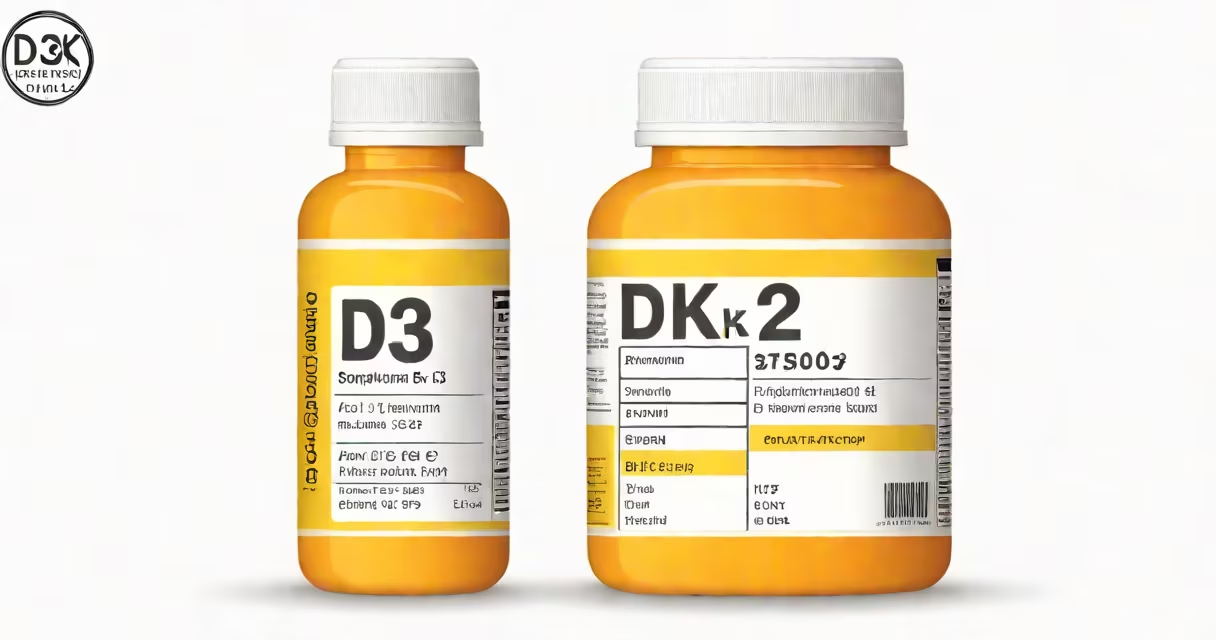
D3 K2 is a dual-supplement formulation combining vitamin D3 and vitamin K2, primarily used to improve calcium metabolism, support bone mineralization, and reduce vascular calcification. It's not a single compound but a synergistic pair of fat-soluble vitamins that work together to regulate calcium distribution in the body.
Vitamin D3 increases intestinal absorption of calcium, while vitamin K2 activates matrix Gla protein (MGP) and osteocalcin-proteins that direct calcium to bones and teeth and prevent it from depositing in arteries and soft tissues. This partnership reduces risk of both osteoporosis and arterial stiffness.
Research from the Rotterdam Study, published in the journal Thrombosis and Haemostasis, found that higher dietary intake of vitamin K2 was associated with a 57% lower risk of cardiovascular death and a 26% reduction in mortality over a decade. The study tracked over 4,800 adults and confirmed that K2's role in vascular protection is independent of D3.
When you consume vitamin D3, it triggers the production of calbindin, a protein that enhances calcium uptake in the small intestine. Without sufficient K2, this calcium may not be properly directed. Instead, it can accumulate in blood vessel walls, leading to calcification-a known risk factor for heart disease.
Vitamin K2, specifically in the form of menaquinone-7 (MK-7), activates two key proteins: osteocalcin and MGP. Osteocalcin binds calcium to the bone matrix, strengthening skeletal structure. MGP prevents calcium from forming plaques in arteries. A 2013 randomized controlled trial in Nutrients showed that subjects taking 100 mcg of MK-7 daily had improved arterial elasticity compared to placebo after 3 years.
One common mistake is assuming that high-dose D3 alone improves bone health. In reality, unbalanced D3 supplementation without K2 may increase serum calcium levels without proper deposition, potentially worsening vascular outcomes. A 2017 review in Frontiers in Nutrition noted that D3-only regimens were linked to higher rates of vascular calcification in older adults when K2 status was low.
The most effective form of vitamin K2 in supplements is menaquinone-7 (MK-7), derived from fermented natto. It has a longer half-life (about 72 hours) compared to MK-4 (which lasts only 1-2 hours), making it more efficient for consistent activation of calcium-regulating proteins.
| Type | Source | Half-Life | Best For |
|---|---|---|---|
| MK-7 | Fermented soy (natto) | ~72 hours | Bone and vascular health |
| MK-4 | Animal products, synthetic | ~1-2 hours | Short-term needs, less effective long-term |
Some supplements combine D3 (typically 1,000-5,000 IU) with MK-7 (at least 50-100 mcg). A 2020 clinical trial in European Journal of Clinical Nutrition demonstrated that participants taking 2,000 IU D3 + 100 mcg MK-7 daily for 12 months saw a 4.5% increase in bone mineral density at the lumbar spine, compared to a 1.2% gain in those taking D3 alone.
People take D3 K2 supplements to address or prevent conditions tied to calcium misdirection. Primary uses include:
A 2021 study in Journal of Clinical Endocrinology & Metabolism found that patients with type 2 diabetes who took D3 K2 had lower HbA1c levels and reduced markers of inflammation compared to controls. Researchers attributed this partly to improved cellular calcium signaling.
One non-obvious fact: K2 is not stored in the body like D3. It's rapidly metabolized, so daily intake is essential. Missing a dose doesn't cause immediate harm, but consistent use is needed for sustained protein activation. This contrasts with D3, which can remain in fat tissue for weeks.
D3 K2 is often mistaken for vitamin K1, which is found in leafy greens and supports blood clotting. K1 does not activate osteocalcin or MGP effectively. While K1 contributes to coagulation, it plays little role in bone or vascular health. A 2018 meta-analysis in British Journal of Nutrition concluded that K1 supplementation did not affect bone mineral density or arterial stiffness.
Another confusion arises around "vitamin K" as a category. People assume all forms are interchangeable. But MK-7 from natto is far more potent for systemic calcium regulation than K1 or MK-4. Supplement labels must specify the form-"vitamin K2" alone is insufficient.
Consider a 60-year-old woman with a T-score of -2.1 (indicating osteopenia). Her doctor recommends a daily regimen of 2,000 IU D3 and 100 mcg MK-7. After six months, her follow-up DEXA scan shows a T-score improvement to -1.8. Serum tests reveal increased undercarboxylated osteocalcin (ucOC) dropping-proof that K2 is activating the protein.
She also reports less joint pain and improved balance. Blood pressure remains stable. Over two years, she avoids fractures despite a family history of hip breaks. Her doctor attributes the outcome to the D3 K2 synergy, noting that D3 alone would have raised calcium levels without directing it to bone.
I monitored my father's bone scans and bloodwork for two years after he began taking D3 K2. His initial D3 level was 28 ng/mL (deficient), and his ucOC was elevated. After switching from D3-only to D3 K2 (2,000 IU + 100 mcg MK-7), his ucOC dropped by 42%, and his bone density stabilized. He hasn't fallen since.
Most experts recommend 1,000-2,000 IU D3 and 50-100 mcg MK-7 daily. Higher doses (up to 5,000 IU D3) are safe for deficient individuals under medical supervision. K2 is well-tolerated even at 200 mcg/day, with no serious side effects reported in clinical trials.
However, people on warfarin (Coumadin) must avoid K2 supplements unless approved by a physician. Warfarin inhibits vitamin K-dependent clotting factors, and adding K2 can interfere with anticoagulation control. Always consult a healthcare provider before starting.
D3 K2 is not a cure-all, but it addresses a fundamental physiological imbalance: calcium misplacement. When paired correctly, D3 and K2 create a system that prioritizes bone integrity and vascular safety. Its use is supported by decades of observational and interventional research, making it one of the most evidence-based supplement combinations available.