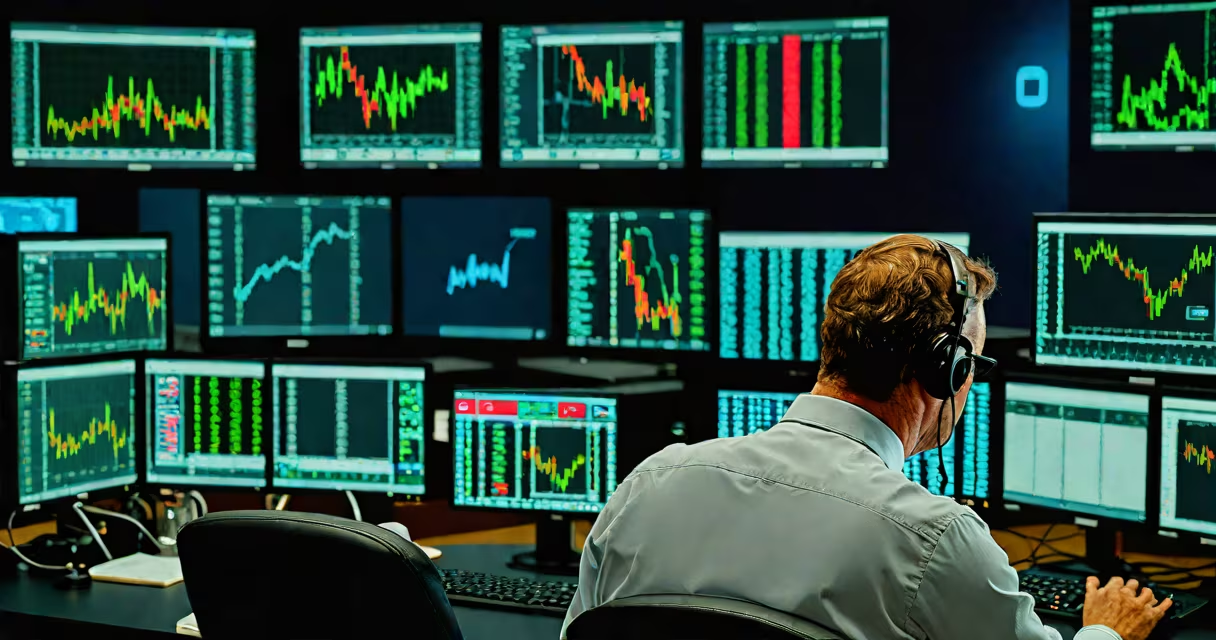
A bond trader is a financial professional who buys and sells bonds and other fixed-income securities to generate profit from short-term price changes. They work in investment banks, hedge funds, asset management firms, or independently, using market analysis, risk assessment, and rapid decision-making to capitalize on shifts in interest rates, credit quality, and supply-demand imbalances.
Bond traders operate in global markets where daily turnover exceeds $1 trillion. Their actions influence borrowing costs for governments and corporations. Unlike retail investors, they trade in large volumes-often millions of dollars per transaction-and rely on proprietary models, real-time data feeds, and algorithmic tools to stay ahead.
Bond traders analyze economic indicators such as inflation reports, central bank policy decisions, and employment data to predict how interest rates will move. Since bond prices fall when rates rise and vice versa, traders position themselves ahead of rate shifts. For example, if a trader expects the Federal Reserve to raise rates, they may sell long-duration government bonds before prices drop.
Trading happens through electronic platforms like Bloomberg Terminal, Tradeweb, or direct dealer networks. Orders are executed instantly or via negotiation. Traders often maintain a "book" of positions-long and short-to balance exposure and manage risk. A single day's activity can involve dozens of trades across multiple bond types and maturities.
High-frequency traders use algorithms to exploit microsecond delays in pricing. These systems execute thousands of trades per second based on statistical patterns, often profiting from tiny spreads between bid and ask prices. While less common among traditional bond traders, algorithmic strategies are increasingly integrated into institutional trading desks.
Bond traders focus on several categories of fixed-income instruments:
| Type | Issuer | Key Risk Factors | Typical Trader Profile |
|---|---|---|---|
| Government bonds | National governments (e.g., U.S. Treasuries) | Interest rate risk, liquidity | Rate-focused, macro-driven |
| Corporate bonds | Private companies | Credit risk, default probability | Spread trader, credit analyst |
| Municipal bonds | State and local governments | Tax status, regional economic health | Yield-focused, tax-aware |
| Agency bonds | Government-sponsored enterprises (GSEs) | Regulatory risk, implied backing | Arbitrage specialist |
For example, during the 2022 Fed tightening cycle, traders shifted from holding long-term U.S. Treasury bonds to shorter maturities. The 10-year Treasury yield rose from 1.5% to 4.0% in 12 months-a 2.5 percentage point move that erased bond values for holders of longer-duration paper. Traders who sold early avoided losses; those who bought at peak yields locked in high returns.
Contrary to popular belief, bond traders aren't solely focused on yields. While yield is a core metric, many trades are driven by relative value-comparing similar bonds across sectors or geographies. A trader might buy German Bunds while selling Italian BTPs if spreads widen beyond historical norms, betting on convergence.
Successful bond traders combine quantitative skill with deep market intuition. They must understand duration, convexity, yield curve shapes, and credit ratings. A trader managing a $50 million portfolio might use a duration model to ensure the book's sensitivity to rate changes stays within limits set by risk officers.
I once observed a trader at a major investment bank adjust a position in 10-year U.S. Treasuries during a surprise CPI report. The data showed inflation rising faster than expected. Within 90 seconds, the trader sold $10 million in bonds and hedged the exposure using Treasury futures. The move prevented a $300,000 loss over the next hour. This speed is typical in live trading environments.
Tools include real-time analytics dashboards, order routing systems, and risk engines. Traders use Bloomberg Terminal to monitor bond prices, yields, and news. They track yield curves across maturities and compare them to forward rate expectations derived from swaps markets. Some traders build custom scripts to flag anomalies-like sudden spikes in bid-ask spreads-that signal market stress.
Bond traders are not the same as bond analysts. Analysts research creditworthiness and issue recommendations; traders act on those insights. A bond analyst might rate a corporate bond "buy" due to improving cash flow, but a trader may avoid it if the yield curve is inverted and liquidity is thin.
Another misconception is that bond trading is purely mechanical. In reality, traders interpret ambiguous signals-such as conflicting central bank statements or delayed economic data. During the 2020 pandemic, central banks slashed rates and launched massive bond-buying programs. Traders had to distinguish between temporary stimulus effects and structural shifts in demand for safe assets.
Bond traders don't always aim to hold positions. Most trades are short-term. A trader might enter a position expecting a 10-basis-point move in yield over 48 hours. If the move doesn't happen, they exit quickly. Holding bonds for years is more typical of long-term investors, not traders.
Bond traders provide liquidity and price discovery in fixed-income markets. Without them, bond prices would be less efficient, and issuers would face higher borrowing costs. According to the Bank for International Settlements (BIS), the global bond market has a daily turnover of approximately $2.3 trillion, with traders facilitating nearly all transactions.
They also help transmit monetary policy. When the Federal Reserve announces a rate change, bond traders react instantly, adjusting portfolios and quoting new prices. This immediate feedback loop helps policy decisions are reflected in market prices within minutes.