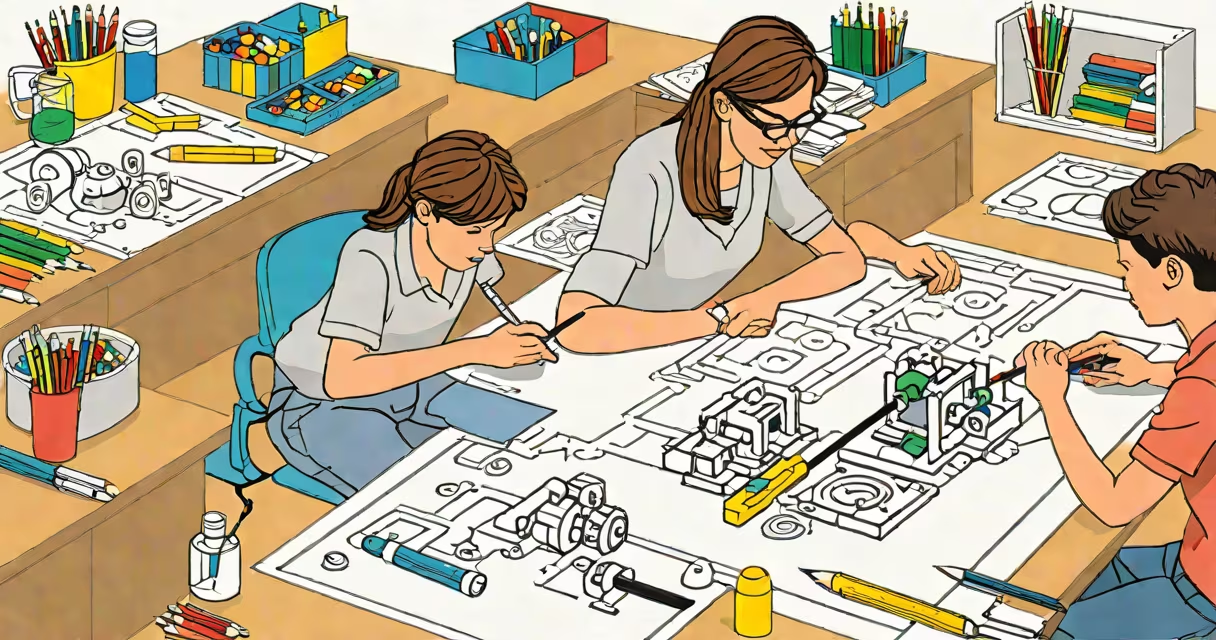
Occupational therapy in schools is a specialized service that helps students with physical, sensory, cognitive, or emotional challenges participate fully in learning and daily school activities. It focuses on improving skills like handwriting, attention, coordination, and self-regulation within the educational environment.
School-based occupational therapists assess and treat students who struggle with tasks such as holding a pencil, sitting still during lessons, organizing materials, or managing transitions between classes. These services are delivered under the Individuals with Disabilities Education Act (IDEA), ensuring eligible students receive support tailored to their Individualized Education Program (IEP).
According to the American Occupational Therapy Association (AOTA), over 60% of occupational therapists work in educational settings, supporting children from preschool through high school. Their interventions are designed to promote independence, reduce barriers to learning, and improve classroom engagement.
Therapists begin by evaluating a student's ability to perform daily school-related tasks. This includes observing how they move, interact with peers, manage time, and respond to classroom demands. Evaluations may involve standardized assessments, teacher interviews, and direct observation in the classroom or playground.
Once identified, goals are set collaboratively with educators, parents, and the student. For example, a student who avoids group activities due to sensory overload might have a goal to remain in a small-group setting for 10 minutes without leaving. The therapist then designs strategies such as using noise-canceling headphones, implementing a visual schedule, or teaching deep-pressure techniques to regulate arousal levels.
Interventions happen in context-on the playground, in the classroom, or during lunch. A therapist might modify a desk height, recommend a fidget tool, or train a teacher to cue a student during transitions. All actions aim to build functional independence, not just correct deficits.
Occupational therapy in schools most frequently supports students with autism spectrum disorder (ASD), attention-deficit/hyperactivity disorder (ADHD), learning disabilities, cerebral palsy, and developmental delays. Each condition presents unique challenges that require targeted, individualized approaches.
For a student with ADHD, the therapist may introduce a "focus kit" with tactile items like stress balls or textured pencils to help maintain attention. For a child with sensory processing disorder, the therapist might create a "calm-down corner" equipped with dim lighting, weighted blankets, and quiet music to help regulate emotions.
A 2021 study published in the Journal of Occupational Therapy, Schools & Early Intervention found that 78% of students receiving school-based OT showed measurable improvement in task completion and behavior within six weeks of intervention. One case involved a second-grader who refused to write due to poor hand strength and coordination. After eight weeks of targeted exercises and adaptive equipment, the student completed a full-page story independently.
Occupational therapy in schools operates under different models depending on student needs and district resources. Some common approaches include:
| Type | Description | When Used |
|---|---|---|
| Direct | One-on-one sessions with the student | For specific skill deficits like handwriting or fine motor control |
| Indirect | Consultation with teachers and staff | To adapt classroom environments or routines |
| Group | Therapy delivered in small groups | For social skills, sensory regulation, or peer interaction |
| Classroom Integration | Embedded support during regular class time | For students needing ongoing, subtle assistance |
Some districts use a "push-in" model, where the therapist joins the classroom to co-teach or guide activities. Others use a "pull-out" model, where students leave class briefly for focused sessions. Research shows push-in models often lead to better carryover of skills into daily routines.
Occupational therapy in schools is not the same as physical therapy or speech-language pathology, though all three may support the same student. While physical therapists focus on gross motor skills and mobility, occupational therapists emphasize the ability to perform everyday tasks-like dressing, eating, writing, and interacting socially.
Many assume OT is only for students with visible disabilities. In reality, it supports neurodivergent students, those with anxiety, executive function challenges, or even gifted learners struggling with perfectionism or organization. A student who can't sit through a lesson due to restlessness may benefit from OT just as much as one who can't hold a crayon.
A common error is equating OT with "occupational" in the adult job sense. The term "occupational" here refers to meaningful daily activities-"occupation" in the original Latin sense of *opus* (work or activity), not employment. The focus is on helping children engage in school as their primary occupation.
In a suburban elementary school, a third-grade student named Maya struggled with completing worksheets. She avoided eye contact, dropped pencils repeatedly, and cried during math time. Her teacher reported she seemed "distracted and overwhelmed."
An occupational therapy evaluation revealed difficulties with visual-motor integration and sensory modulation. The therapist recommended a weighted lap pad, a noise-reducing headset, and a structured five-minute warm-up routine before academic tasks. Teachers were trained to give verbal cues and use visual timers.
After four weeks, Maya's worksheet completion rate rose from 30% to 85%. Her teacher noted improved focus and fewer emotional outbursts. The student's mother reported she now asks to do homework independently-a shift that wasn't possible before the intervention.
Occupational therapists in schools must hold a master's or doctoral degree in occupational therapy and be licensed in their state. They typically complete a clinical internship and pass the National Board for Certification in Occupational Therapy (NBCOT) exam.
Therapists working in schools must understand federal regulations like IDEA and Section 504 of the Rehabilitation Act. These laws define eligibility, ensure confidentiality, and mandate that services be provided in the least restrictive environment.
Families can request occupational therapy services through a formal evaluation process initiated by a teacher, parent, or administrator. Once referred, the school district must conduct an assessment within 60 days. If the student qualifies, an IEP team meets to determine goals and services.
When services are needed, families can contact local school districts or seek private providers who contract with schools. Services are free under public education law, though private evaluations may incur costs.
Occupational therapy in schools is not a luxury-it's a necessity for equitable access to education. By addressing the root causes of learning barriers, it enables students to thrive not just academically, but emotionally and socially as well.
Understanding what is occupational therapy in schools reveals a useful system of support grounded in science, ethics, and student-centered care. It helps every child, regardless of ability, has the tools to succeed in the classroom and beyond.