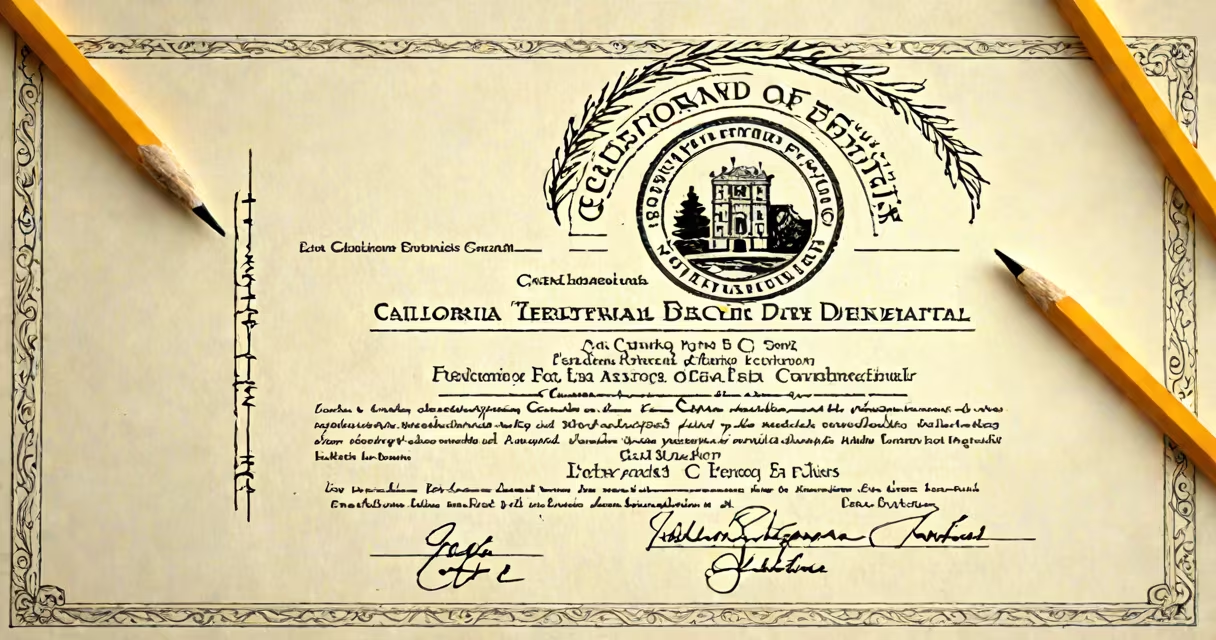
A preliminary teaching credential is a state-issued authorization that allows individuals to teach in California public schools while completing additional training and supervised experience. It is valid for five years and serves as the first step toward earning a clear credential, which grants long-term employment eligibility.
This credential is issued by the California Commission on Teacher Credentialing (CTC) and is typically earned through an approved teacher preparation program. It is not a degree, nor is it equivalent to a permanent teaching license. Instead, it is a conditional permit that requires candidates to fulfill specific requirements before transitioning to a clear credential.
For example, a recent college graduate with a bachelor's degree in biology who enrolls in a university-based teacher residency program in Los Angeles may receive a preliminary multiple subject credential after completing their student teaching semester and passing the CBEST and CSET exams. This credential permits them to teach grades K-6 in a public school setting under supervision.
The process begins with admission into an approved teacher preparation program, such as a university-led master's program, a post-baccalaureate certificate track, or a district-based residency. These programs include coursework in child development, curriculum design, classroom management, and subject-specific pedagogy.
Candidates must pass three state-mandated exams: the California Basic Educational Skills Test (CBEST), the California Subject Examinations for Teachers (CSET), and the California Teaching Performance Assessment (TPA). The CBEST measures basic reading, writing, and math skills. The CSET assesses subject matter knowledge in the candidate's chosen field. The TPA evaluates teaching performance through video recordings and lesson plans.
Once all components are completed-including 400 hours of supervised student teaching-the CTC issues the preliminary credential. The credential is then sent to the school district hiring the teacher, who verifies it before employment begins.
Preliminary teaching credentials in California fall into four main categories based on grade level and subject area:
| Type | Eligible Grades | Common Entry Path | Duration |
|---|---|---|---|
| Preliminary Multiple Subject | K-6 | Undergraduate or post-bac program | 5 years |
| Preliminary Single Subject | 7-12 | Subject-specific preparation program | 5 years |
| Preliminary Special Education | K-12 | Specialized credential program | 5 years |
| Preliminary Education Specialist | K-12 | Program focused on students with disabilities | 5 years |
Each pathway includes different course sequences and clinical experiences. For instance, a candidate pursuing a single subject credential in history must complete a CSET exam covering U.S. history, world history, and government. A special education candidate must demonstrate understanding of individualized education programs (IEPs) and behavior intervention strategies.
Non-traditional candidates-such as career changers or those with degrees in unrelated fields-often enter through alternative certification routes like the California Teaching Residency Program. These programs combine paid teaching assignments with mentorship and academic coursework, allowing participants to earn their credential while working.
The preliminary teaching credential is required for anyone seeking to teach in California public schools, including charter and district-run institutions. It is not valid in other states, though some states accept out-of-state credentials with additional steps.
Public school districts use this credential to hire teachers during staffing shortages. For example, in 2023, the Los Angeles Unified School District hired over 1,200 teachers on preliminary credentials due to high turnover and limited access to permanent applicants. These hires were placed in classrooms with mentors and required to meet annual progress benchmarks.
It is especially common in high-need areas such as urban schools, rural districts, and subjects with teacher shortages-like math, science, and special education. According to the California Department of Education, 68% of new teachers in high-need schools entered via alternative pathways, many of whom began with a preliminary credential.
Many assume a preliminary credential is temporary or less legitimate than a permanent one. This is incorrect. The credential is legally valid and recognized by school districts and state agencies. However, it does not allow independent teaching without supervision during the initial five-year period.
Another misconception is that the credential is automatically granted upon graduation. It is not. Completion of a program does not guarantee issuance-it depends on passing all exams, submitting documentation, and meeting CTC standards. In 2022, nearly 12% of applicants failed to receive their preliminary credential due to incomplete TPA submissions or failing scores.
A lesser-known fact: the preliminary credential can be renewed once for an additional five years if the teacher is making satisfactory progress toward the clear credential. This renewal requires evidence of ongoing professional development and a formal request to the CTC. Without it, the credential expires, and the teacher must restart the process.
Jasmine, a former software engineer, decided to switch careers and teach high school physics. She enrolled in a 12-month alternative certification program offered by the University of San Diego. During her first year, she took courses in inquiry-based instruction, equity in STEM education, and classroom assessment techniques.
She passed the CBEST (score: 85/100), the CSET Physics subtest (score: 230/240), and submitted her TPA portfolio, which included three recorded lessons on Newton's laws. After six months of student teaching at a public high school in Chula Vista, the program submitted her application to the CTC.
Three weeks later, Jasmine received her preliminary single subject credential. She was hired by the Chula Vista Unified School District as a full-time physics teacher, working under a mentor for her first year. By the end of year two, she had met all requirements to apply for her clear credential.
A preliminary teaching credential is not a job offer. It is not a degree. It is not equivalent to a permanent credential. It is not valid for private schools unless they choose to accept it. It is not transferable to other states without additional steps.
It is also not a substitute for professional growth. While the credential allows entry into the classroom, it does not replace ongoing learning. Teachers must complete 150 hours of professional development annually, including training in culturally responsive teaching and trauma-informed practices.
Some confuse it with a "certificate of completion" from a training workshop. That document is not recognized by the CTC. Only the official credential issued by the commission carries legal authority to teach in California public schools.
Understanding what is a preliminary teaching credential clarifies the first major milestone in becoming a licensed educator in California. It is not a shortcut, but a structured, regulated path designed to ensure new teachers are prepared before assuming full responsibility.