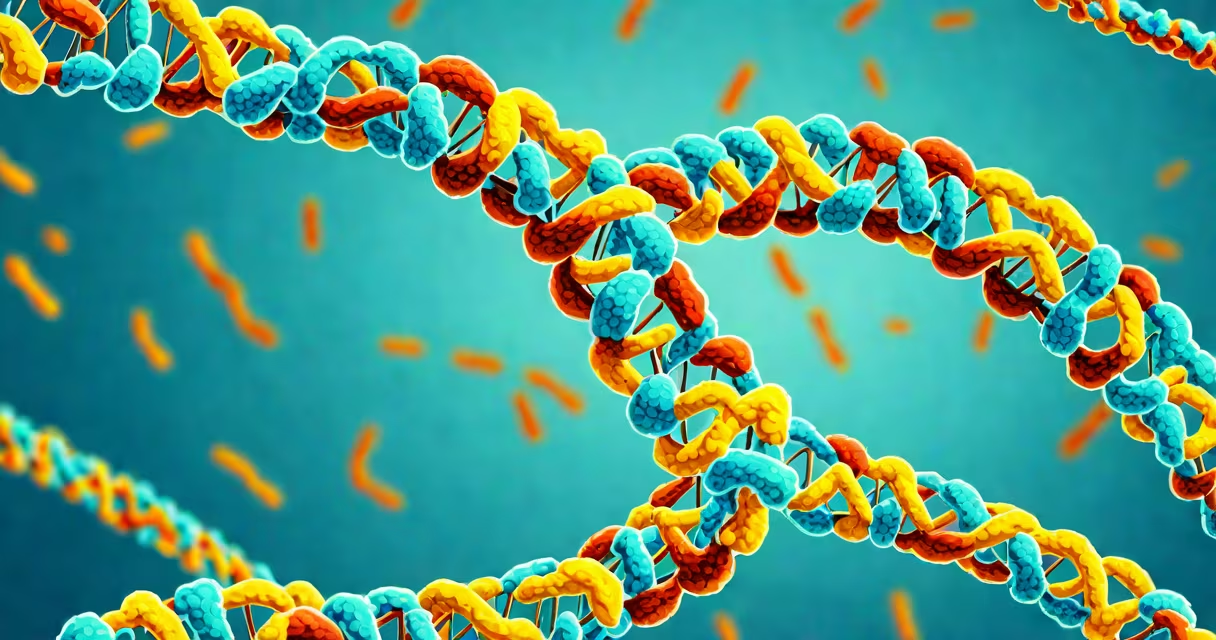
Chromosomes consist primarily of double-stranded DNA molecules tightly wound around structural proteins known as histones. This DNA-protein complex, called chromatin, condenses into visible thread-like structures during cell division. The DNA encodes all inherited traits, while histones organize and protect it.
Each human chromosome contains one long DNA molecule wrapped around hundreds of histone proteins. These proteins form octamer complexes-eight in total-that serve as spools for the DNA strand. The resulting structure resembles beads on a string, with each bead being a nucleosome. Nucleosomes then fold into higher-order structures, forming the compact, visible chromosomes seen under a microscope during mitosis.
Chromosomal DNA includes both coding regions (genes) and non-coding sequences. Genes provide instructions for making proteins, while regulatory elements control when and where those proteins are produced. Non-coding DNA includes repetitive sequences, centromeres, and telomeres-structures essential for chromosome stability and proper segregation during cell division.
Chromosomes are composed of two main components: DNA and associated proteins. DNA stores genetic information in the sequence of four nitrogenous bases-adenine (A), thymine (T), cytosine (C), and guanine (G). These sequences determine the amino acid sequence of proteins through transcription and translation.
Proteins in chromosomes include histones and non-histone proteins. Histones (H2A, H2B, H3, H4) form the core of nucleosomes. Linker histone H1 binds to the DNA between nucleosomes, stabilizing the structure. Non-histone proteins regulate gene expression, repair damaged DNA, and assist in chromosome condensation during cell division.
| Component | Function | Example |
|---|---|---|
| DNA | Encodes genetic instructions | Gene for hemoglobin (HBB) |
| Core histones | Form nucleosome spools | H2A, H2B, H3, H4 |
| Linker histone | Stabilizes DNA between nucleosomes | H1 |
| Non-histone proteins | Regulate transcription and repair | Topoisomerase II, cohesin |
During interphase, chromatin exists in a relaxed state, allowing access to transcription machinery. As the cell prepares to divide, chromatin condenses into tightly packed chromosomes. This compaction prevents DNA damage and ensures accurate distribution of genetic material to daughter cells.
While all eukaryotic cells contain chromosomes made of DNA and histones, their number and structure vary widely. Humans have 46 chromosomes arranged in 23 pairs-22 autosomal pairs and one pair of sex chromosomes (XX or XY).
In contrast, fruit flies (Drosophila melanogaster) have only eight chromosomes, and some ferns possess over 1,000. Despite differences in count, all chromosomes follow the same basic principle: DNA wrapped around histones to form chromatin.
Bacteria and archaea lack histones entirely. Their DNA is organized by different proteins, such as HU in bacteria. This reflects a fundamental evolutionary divergence: eukaryotes evolved histone-based packaging to manage large genomes efficiently, while prokaryotes maintain simpler, less condensed structures.
Many assume chromosomes are solely made of DNA. In reality, proteins constitute nearly half the mass of a chromosome. A 2019 study published in *Nature Structural & Molecular Biology* confirmed that histone levels correlate strongly with chromatin compaction and gene silencing.
Another misconception is that all DNA in chromosomes codes for proteins. Only about 1.5% of human DNA codes for proteins. The rest includes regulatory sequences, introns, pseudogenes, and repetitive elements like Alu sequences and satellite DNA. These non-coding regions play important roles in genome stability and evolution.
For example, telomeres-the protective caps at chromosome ends-shorten with each cell division. When they become too short, the cell enters senescence or apoptosis. This process contributes to aging and cancer development. Telomere length is therefore a key biomarker in longevity research.
Consider a human somatic cell undergoing mitosis. Before division, the cell's nucleus contains 46 chromosomes, each consisting of two identical sister chromatids joined at the centromere. Each chromatid is a single DNA molecule wrapped around histones.
During S phase of the cell cycle, DNA replication duplicates each chromosome. The result is 92 chromatids, still attached at the centromere. As the cell enters metaphase, microtubules from the spindle apparatus attach to kinetochore proteins at the centromere. These proteins bind to the DNA and help movement along the spindle fibers.
When the cell divides, each daughter cell receives 46 chromosomes, each composed of one DNA strand and associated histones. This ensures genetic continuity across generations of cells. Errors in this process-such as nondisjunction-can lead to aneuploidy, including conditions like Down syndrome (trisomy 21).
During my undergraduate genetics lab, I observed fluorescently labeled chromosomes in metaphase spreads from cultured human fibroblasts. Using immunofluorescence staining for histone H3 phosphorylation-a marker of active chromosome condensation-I confirmed that chromosomal packaging was complete. This hands-on experience reinforced how tightly regulated the assembly of DNA and proteins must be for proper cell function.
Chromosomes differ from genes and alleles. A gene is a segment of DNA that codes for a specific protein or RNA. An allele is a variant form of a gene. Multiple alleles exist for many genes, but only two copies of each gene are present per diploid cell-one on each homologous chromosome.
Chromosomes also differ from chromatin. Chromatin is the changing, unpackaged form of DNA and protein that exists throughout most of the cell cycle. Chromosomes are the highly condensed, visible form that appears only during mitosis or meiosis.
Understanding what genetic material makes up chromosomes clarifies inheritance patterns, disease mechanisms, and evolutionary processes. For instance, mutations in histone genes have been linked to developmental disorders such as Coffin-Siris syndrome, which results from abnormal chromatin remodeling.
Chromosomes are not static objects. They change shape, density, and accessibility based on cellular activity. Their composition-DNA and histones-defines how genetic information is stored, accessed, and passed on. This molecular architecture underpins life as we know it.