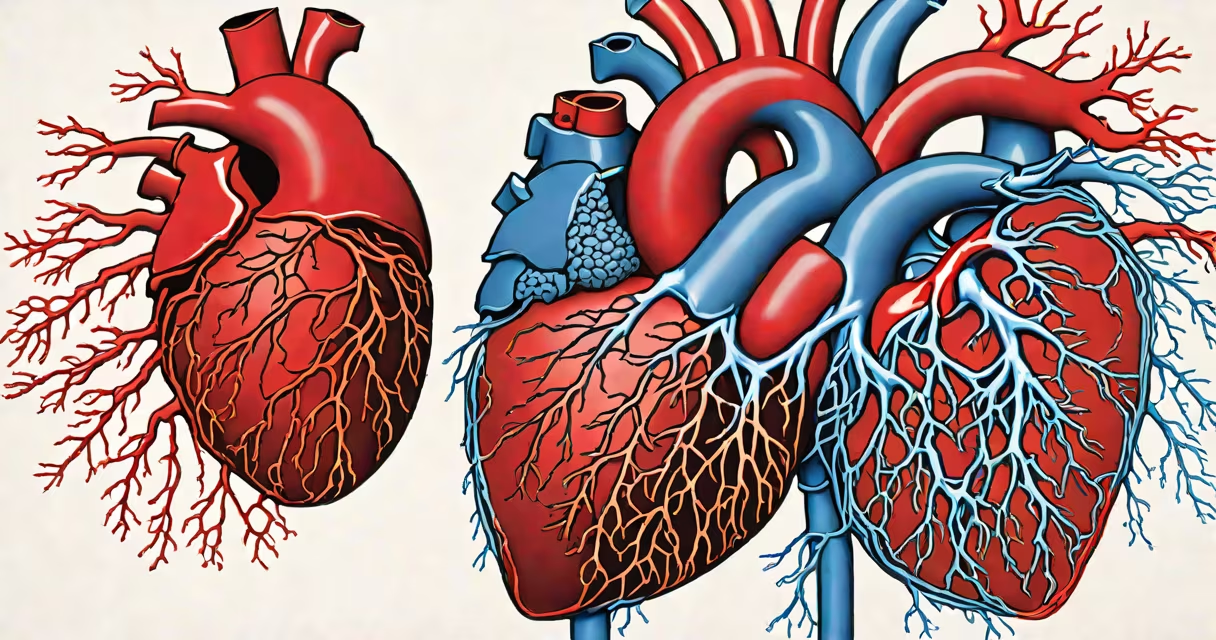
The cardiovascular system pumps oxygenated blood from the heart to tissues and returns deoxygenated blood to the lungs for re-oxygenation. It maintains internal balance by transporting nutrients, hormones, and waste products throughout the body.
This system consists of the heart, blood vessels, and blood. The heart acts as a dual pump: the right side sends blood to the lungs, the left side sends blood to the rest of the body. Blood vessels include arteries, veins, and capillaries. Arteries carry blood away from the heart under high pressure; veins return blood to the heart under low pressure; capillaries enable exchange between blood and cells.
According to the American Heart Association, the average adult heart beats about 100,000 times per day, moving roughly 7,500 liters of blood daily. This constant motion ensures every cell receives oxygen and nutrients while removing carbon dioxide and metabolic waste.
Oxygen-poor blood enters the right atrium through the superior and inferior vena cavae. It flows into the right ventricle, which contracts to push blood into the pulmonary artery. This vessel delivers blood to the lungs, where gas exchange occurs in alveoli. Carbon dioxide exits the blood, and oxygen binds to hemoglobin in red blood cells.
Oxygen-rich blood returns via the pulmonary veins to the left atrium. It passes into the left ventricle, which contracts forcefully to eject blood into the aorta. From there, blood travels through systemic arteries to supply organs and muscles. Capillaries allow diffusion of oxygen and glucose into tissue cells. Waste products like lactic acid and CO₂ enter the bloodstream and are carried back to the heart.
At rest, blood completes one full circuit through the body in about 60 seconds. During exercise, the heart rate increases to deliver more oxygen to working muscles. For example, during a 5K run, cardiac output can rise from 5 liters per minute at rest to over 20 liters per minute.
The cardiovascular system relies on three core elements:
A 2021 study published in Circulation Research found that endothelial cells lining blood vessels regulate vascular tone and prevent clot formation through nitric oxide release. Dysfunction in this process contributes to hypertension and atherosclerosis.
Many people confuse the cardiovascular system with the respiratory system. While both support oxygen delivery, they are distinct. The respiratory system handles air intake and gas exchange in the lungs. The cardiovascular system transports gases and nutrients via blood. You can have healthy lungs but a failing heart-this leads to pulmonary edema, where fluid accumulates in lung tissue due to poor blood return.
Another misconception is that blood is "clean" when it leaves the heart. In reality, arterial blood contains urea, glucose, and hormones. Blood composition changes continuously based on organ activity. For example, after eating, blood glucose rises sharply in mesenteric arteries, triggering insulin release from the pancreas.
Some assume veins are passive tubes. But venous return depends on muscle contractions (the skeletal muscle pump) and negative pressure in the chest during inhalation. Standing still for long periods causes blood pooling in legs-this is why astronauts wear compression suits to maintain venous return.
Consider a 35-year-old runner completing a 10-mile training run. At rest, their heart rate is 60 beats per minute. After 20 minutes of running, it increases to 150 bpm. Stroke volume (blood pumped per beat) rises from 70 mL to 120 mL. Cardiac output increases from 4.2 L/min to 18 L/min.
Arterioles in leg muscles dilate due to local metabolites like adenosine and potassium. This reduces resistance and increases blood flow by up to 20-fold. Oxygen extraction from blood reaches 70% in active muscles-far higher than the 25% seen at rest.
After finishing, the runner's heart rate drops gradually over 10 minutes as sympathetic nervous system activity decreases. This illustrates autonomic regulation: the system constantly adjusts to demand.
Cardiovascular failure manifests in conditions like heart attack (myocardial infarction), stroke, and heart failure. A heart attack occurs when coronary arteries become blocked, depriving heart muscle of oxygen. Within 20 minutes, irreversible damage begins. According to the CDC, someone in the U.S. has a heart attack every 21 seconds.
Chronic hypertension damages small vessels over time. The kidneys respond by retaining sodium and water, increasing blood volume and further raising pressure-a feedback loop that accelerates kidney disease. By age 65, nearly half of Americans have diagnosed hypertension.
When the system fails, treatment focuses on restoring perfusion. For example, in acute ischemic stroke, intravenous alteplase must be administered within 4.5 hours of symptom onset to dissolve clots and restore blood flow to brain tissue.
The cardiovascular system differs from the nervous system in signal transmission. Nerves use electrical impulses along axons. The cardiovascular system uses chemical signals (hormones) carried in blood. Adrenaline released during stress travels through the bloodstream to increase heart rate and dilate airways-effects that take seconds to minutes, unlike neural responses measured in milliseconds.
Compared to the skeletal system, which provides structure and protection, the cardiovascular system enables changing transport. Bones store calcium and produce blood cells in marrow. But they don't move substances across distances. The cardiovascular system performs this role efficiently across 100,000 kilometers of blood vessels in an average adult.
| System | Primary Function | Transport Medium | Speed of Action |
|---|---|---|---|
| Cardiovascular | Move oxygen, nutrients, waste | Blood | Seconds to minutes |
| Nervous | Transmit signals | Electrical impulses | Milliseconds |
| Skeletal | Support and protect | None (structural) | Static |
I once observed a patient with severe aortic stenosis during a medical rotation. His heart couldn't eject blood effectively. Over weeks, his left ventricle thickened (hypertrophy) to compensate. Eventually, he developed fatigue and fainting. After valve replacement surgery, his energy returned within days. That experience confirmed how central the cardiovascular system is to daily function.
Understanding what your cardiovascular system does reveals its role not just in survival, but in performance, health, and longevity. It's not merely a plumbing system-it's a changing network that adapts to every physical and emotional challenge.