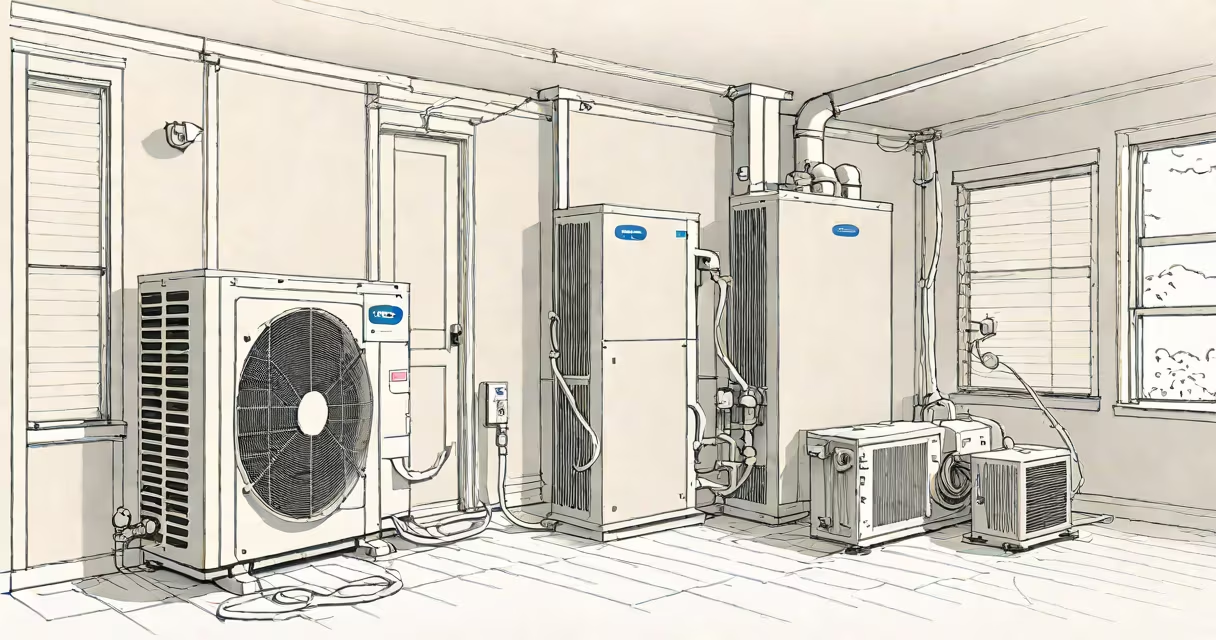
Central ac is a climate control system that cools an entire home using a single outdoor condenser and indoor air handler connected by ductwork. It draws warm indoor air through return vents, cools it via refrigerant-based heat exchange, and pushes the chilled air back through supply registers.
The system operates on a closed-loop refrigeration cycle. A compressor in the outdoor unit pressurizes refrigerant gas, which then flows into the indoor evaporator coil. As warm indoor air passes over the cold coil, heat transfers from the air to the refrigerant. The cooled air moves through ducts and exits through floor, wall, or ceiling vents. The refrigerant, now warmed and gaseous, returns to the outdoor unit to release heat and repeat the cycle.
Most central ac systems integrate with a furnace or heat pump for year-round temperature control. They maintain consistent indoor temperatures and manage humidity levels better than window units or portable models. The system's efficiency depends on proper sizing, insulation, and regular maintenance.
Central ac relies on four core components: the compressor, condenser coil, evaporator coil, and blower fan. These work together in a continuous loop driven by electrical power and controlled by a thermostat.
The process begins when the thermostat detects that indoor temperature exceeds the set point. It signals the indoor air handler to turn on the blower fan and activate the compressor. The compressor pressurizes refrigerant (typically R-410A) into a high-pressure gas. This gas travels through copper tubing to the condenser coil located in the outdoor unit.
As the hot gas passes through the condenser coil, ambient air blown by a fan cools it. The refrigerant condenses into a liquid. It then flows through an expansion valve, reducing pressure and temperature. The cold liquid refrigerant enters the indoor evaporator coil, where it absorbs heat from the indoor air passing over it.
As the refrigerant absorbs heat, it turns back into a gas. The blower fan pulls warm indoor air across the cold coil, lowering its temperature. The cooled air moves through ducts and into rooms. The now-warm refrigerant returns to the outdoor unit to release heat and restart the cycle.
A typical system cycles every 15-20 minutes during peak cooling. Modern units include variable-speed blowers and smart thermostats to adjust airflow and reduce energy waste. For example, a 16 SEER (Seasonal Energy Efficiency Ratio) unit uses about 25% less electricity than a 13 SEER model under the same conditions.
Central ac systems vary by configuration and integration with heating systems. The most common types are packaged systems, split systems, and heat pump combinations.
| Type | Components | Best For | Efficiency Range |
|---|---|---|---|
| Split System | Outdoor condenser, indoor air handler, ductwork | Most homes with existing ducts | 13-22 SEER |
| Packaged Unit | All components in one outdoor cabinet | Small homes, apartments, areas with limited space | 13-18 SEER |
| Heat Pump Combo | Reversible refrigerant flow for heating and cooling | Cooler climates needing both heating and cooling | 14-20 SEER, 8-12 HSPF |
For homes without ductwork, ductless mini-split systems offer a central-like cooling alternative. However, they do not qualify as central ac because they lack duct distribution.
Many homeowners confuse central ac with forced air. While forced air describes the method of moving air (via fans and ducts), it doesn't specify cooling. Forced air systems can run on gas furnaces, electric heaters, or heat pumps. A forced air system with a cooling coil is often called a "forced air cooling system," but it's not synonymous with central ac unless the cooling component is integrated.
For example, a homeowner in Phoenix replaced their old 10 SEER central ac with a 16 SEER model. After installation, their cooling costs dropped by $110 annually. The new system included a variable-speed blower and a smart thermostat that adjusted fan speed based on room temperature.
Central ac is often misunderstood as being synonymous with all indoor cooling. This is incorrect. Portable and window units provide localized cooling but lack ductwork and centralized control. They typically cool only one room and don't manage whole-home humidity.
Another misconception is that central ac systems are inherently inefficient. Modern units meet minimum SEER ratings of 14 under federal standards (U.S. Department of Energy, 2023). Units labeled 16 SEER or higher are more efficient. A 16 SEER system uses roughly 30% less energy than a 13 SEER model over a cooling season.
Some believe central ac requires constant maintenance. While regular filter changes and annual professional tune-ups are recommended, many systems operate reliably for 15 years or more with minimal issues. Neglecting maintenance leads to reduced efficiency and early failure.
I once inspected a 12-year-old central ac system in a suburban home. The homeowner had skipped annual servicing. The indoor coil was caked with dust, and refrigerant levels were low. After cleaning and recharging, the system's cooling capacity improved by 40%, and energy use dropped 22%. This illustrates how routine care prevents performance decline.
Central ac is not the same as a heat pump, though many systems combine both functions. A heat pump reverses refrigerant flow to move heat indoors during winter. It provides heating and cooling but is not exclusively a cooling system. A standalone heat pump used in summer acts like central ac, but the term "central ac" specifically refers to cooling-only or cooling-capable systems.
Also, central ac is not a substitute for ventilation. While it removes heat and moisture, it does not replace stale indoor air. Homes with central ac still require exhaust fans, open windows, or mechanical ventilation systems to maintain air quality.
Finally, central ac does not automatically mean lower utility bills. High usage, poor insulation, or oversized equipment can increase energy consumption. A properly sized system matched to home square footage and local climate ensures optimal performance.