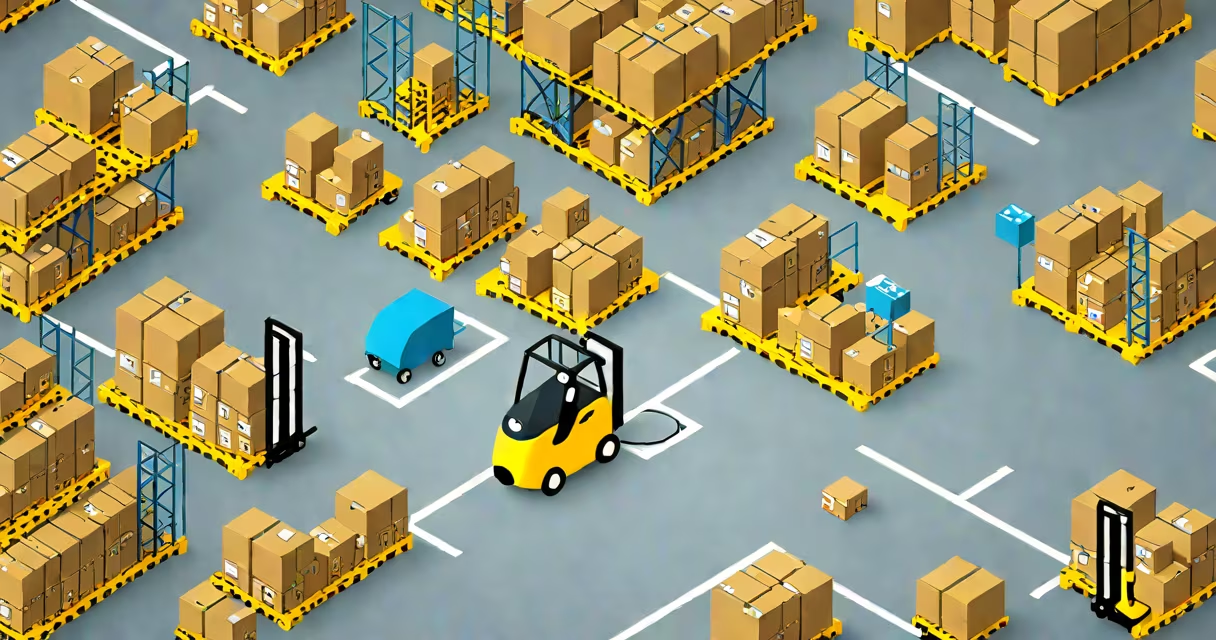
AGV stands for automated guided vehicle - a self-driving industrial vehicle that transports materials along predefined paths without direct human control. These vehicles operate in factories, warehouses, and distribution centers using navigation systems like lasers, magnetic strips, or vision-based tracking.
AGVs are not remote-controlled or manually driven. Instead, they follow programmed routes and respond to real-time conditions such as obstacles or traffic congestion. They handle heavy loads, reduce labor costs, and improve consistency in material flow across production lines and logistics operations.
According to the Association for Advancing Automation (A3), AGVs are among the most widely adopted automation tools in manufacturing and warehousing. Their use has grown steadily since the 1950s, with modern versions integrating AI and machine learning for changing path planning and obstacle avoidance.
AGVs rely on a combination of hardware and software to move safely and efficiently. A central control system sends commands based on inventory needs, production schedules, or warehouse management software (WMS).
The guidance system determines the vehicle's position and movement. Common methods include:
Each system has trade-offs in cost, accuracy, and adaptability. Laser-guided AGVs offer high precision and are ideal for environments requiring tight tolerances, such as semiconductor fabrication facilities.
AGVs come in several configurations designed for specific tasks and load types. The choice depends on payload capacity, required mobility, and operational environment.
| Type | Load Capacity | Common Use Cases | Navigation Method |
|---|---|---|---|
| Platform AGV | 500-3,000 kg | Transporting pallets between production lines | Laser or vision |
| Stacker AGV | 100-1,000 kg | Automated storage and retrieval in high-bay racks | Guided rails or laser |
| Cart AGV | 50-500 kg | Delivering parts to assembly stations | Magnetic tape or vision |
| Heavy-duty AGV | 5,000-20,000 kg | Transporting large machinery or raw materials | Hybrid (laser + GPS) |
A real-world example: Amazon's fulfillment centers deploy thousands of AGVs from Kiva Systems (now Amazon Robotics). These platform AGVs transport entire shelves of goods from storage to packing stations. In one facility, they reduced order processing time by 60% compared to manual picking.
Another example: BMW's plant in Germany uses stacker AGVs to move engine components between assembly lines. These vehicles operate in narrow aisles with millimeter-level accuracy, minimizing errors during high-volume production.
AGVs are often mistaken for autonomous mobile robots (AMRs), but they differ. AGVs follow fixed paths and require infrastructure like guide wires or reflectors. AMRs use sensors and AI to dynamically plan routes around changing environments.
Despite this, many modern AGVs incorporate AMR-like features. For instance, some models use simultaneous localization and mapping (SLAM) to adapt to layout changes without reprogramming. This hybrid capability blurs the line between traditional AGVs and AMRs.
A key distinction: AGVs do not make decisions about routing or task prioritization. They execute pre-set instructions. An AMR, by contrast, can reroute itself based on real-time data - such as a blocked corridor or a sudden surge in demand.
One non-obvious fact: AGVs are not always faster than human workers. In small facilities with infrequent movements, manual carts may be more efficient. The ROI comes from scalability and consistency over time. A 2022 study by the Material Handling Industry (MHI) found that AGV deployment yields a 30% improvement in throughput after six months of operation.
I observed a warehouse integration project where five AGVs replaced 12 forklift operators. The initial setup took three weeks, including installing laser reflectors and calibrating navigation zones. After two months, the team reported a 40% reduction in material-handling errors and a 25% drop in downtime due to collisions.
However, the biggest challenge wasn't technical - it was cultural. Workers resisted the change because they feared job loss. Training sessions focused on new roles, such as supervising fleets and managing system alerts. Within four months, the team adapted, and productivity increased by 35%.
When selecting an AGV system, consider not just the vehicle specs but also support, maintenance contracts, and compatibility with existing software. Some vendors charge extra for firmware updates or custom programming.
AGV systems continue evolving. Future models may integrate predictive maintenance using sensor data, reducing unplanned downtime. As manufacturing shifts toward smart factories, AGVs remain essential for moving materials with speed, safety, and precision.