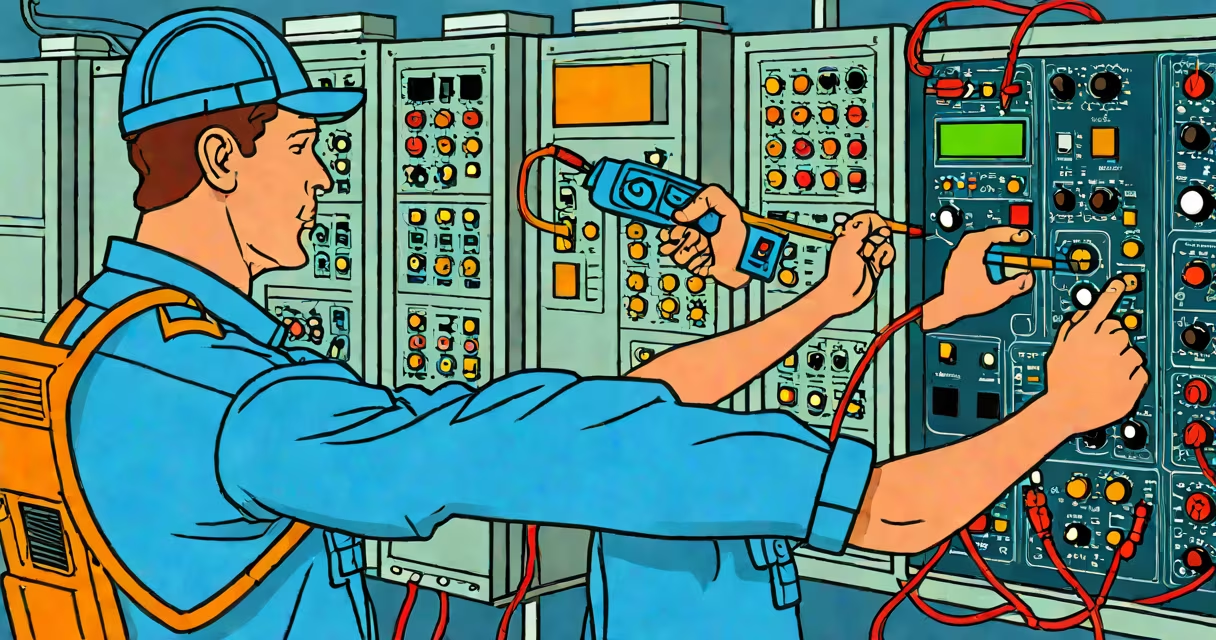
A service technician diagnoses, repairs, and maintains mechanical, electrical, or electronic systems in equipment ranging from HVAC units and industrial machines to vehicles and consumer electronics. They follow manufacturer specifications, use diagnostic tools, and perform preventive maintenance to ensure optimal performance and safety.
Service technicians work across industries including automotive, HVAC, telecommunications, manufacturing, and IT infrastructure. Their role centers on identifying failures, replacing defective components, calibrating systems, and documenting repairs. They often travel to client sites, operate under strict safety protocols, and communicate findings to customers or supervisors.
According to the U.S. Bureau of Labor Statistics, employment for service technicians in industrial and mechanical fields is projected to grow 6% from 2022 to 2032-faster than average for all occupations-driven by increasing complexity in equipment and demand for reliable maintenance.
When a system fails, a service tech begins with a visual inspection and symptom analysis. They verify error codes using built-in diagnostics or external scanners, then isolate the root cause through systematic testing. For example, a car with a check engine light may show a P0301 code indicating cylinder misfire. The tech checks spark plugs, fuel injectors, and compression levels before replacing a faulty component.
They use calibrated tools such as multimeters, pressure gauges, oscilloscopes, and torque wrenches. Digital service manuals and mobile apps provide real-time access to schematics, repair procedures, and parts databases. Many modern systems require software updates or firmware resets during repair, which demands familiarity with programming interfaces.
In industrial settings, technicians follow lockout/tagout (LOTO) procedures to prevent accidental startup during maintenance. This safety protocol reduces workplace incidents by 70%, according to OSHA's 2021 incident report summary.
Service technicians specialize based on the systems they maintain. Common roles include:
| Type | Systems Maintained | Common Tools | Industry Examples |
|---|---|---|---|
| Automotive | Engines, transmissions, EV batteries | OBD2 scanner, battery load tester | Dealerships, independent garages |
| HVAC | Heating, cooling, ventilation systems | Digital manometer, refrigerant recovery unit | Commercial buildings, residential complexes |
| Industrial Machinery | Conveyor belts, CNC machines, pumps | Vibration analyzer, infrared thermometer | Manufacturing plants, food processing lines |
| Telecommunications | Fiber optics, network routers, cell towers | Optical power meter, spectrum analyzer | Wireless carriers, ISP providers |
Each type requires certification. Automotive technicians must hold ASE certification; HVAC techs need EPA Section 608 certification for refrigerant handling. Industrial technicians often earn certifications from the National Institute for Certification in Engineering Technologies (NICET).
Non-obvious fact: Not all service techs are hands-on mechanics. Some focus on remote diagnostics-monitoring system health via IoT sensors and predictive algorithms. A telecom technician may troubleshoot a dropped signal from a central office using network management software, never visiting the physical site.
Service technicians are essential in minimizing downtime. A factory with a broken conveyor motor loses $1,200 per hour in production time, according to a 2023 McKinsey study on industrial efficiency. A skilled technician can restore operations within four hours versus eight without proper training.
They also ensure compliance with safety standards. In healthcare, medical equipment technicians maintain MRI machines and ventilators. A failure in a hospital's backup generator during a storm could lead to life-threatening delays. Service techs test batteries monthly and replace them before they degrade below 80% capacity.
For consumers, service techs handle warranty claims and extended service contracts. A customer with a malfunctioning washing machine contacts a brand-certified technician who replaces a worn drive belt and recalibrates the spin cycle. The repair is logged in the manufacturer's database and linked to the product's serial number.
Many assume service techs only fix broken items. But their primary function is prevention. A routine HVAC inspection includes cleaning condenser coils, checking refrigerant levels, and verifying thermostat calibration-all done before a breakdown occurs.
Another misconception: All service techs have the same skill set. In reality, a technician working on a 5G base station must understand radio frequency propagation, antenna alignment, and signal interference-skills distinct from those needed for repairing a refrigerator compressor.
Even the term "tech" can mislead. While some roles involve software configuration, others are purely mechanical. A diesel engine technician may never touch a computer interface. Conversely, a network service tech spends most of their day configuring VLANs and analyzing packet loss.
Firsthand observation: During a winter storm, I observed a utility company's field team restore power to 12 homes in under 90 minutes. They used thermal imaging cameras to locate a severed cable buried under snow, then replaced the damaged section using splice kits. The speed came not from tools alone, but from standardized response protocols and real-time coordination via handheld radios.
Understanding what a service tech does clarifies why these roles remain critical despite automation trends. They bridge design and operation, turning theoretical system specs into functional, safe, and efficient real-world performance.