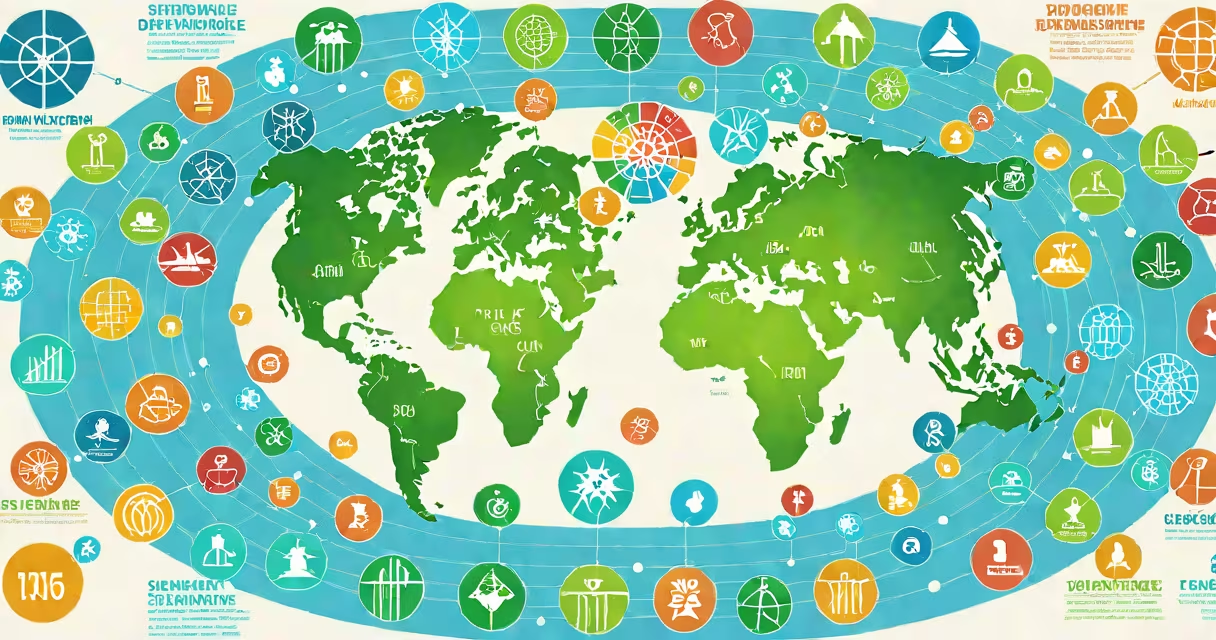
The sustainable development goals are a universal call to action by the United Nations to end poverty, protect the planet, and ensure peace and prosperity for all people by 2030. These 17 goals address global challenges including inequality, climate change, and environmental degradation.
Adopted by 193 UN member states in 2015 under the 2030 Agenda for Sustainable Development, the SDGs replaced the Millennium Development Goals. They are designed to be integrated and indivisible, recognizing that progress in one area depends on progress in others. The goals cover economic, social, and environmental dimensions of sustainability.
Each goal includes specific targets-169 in total-with measurable indicators to track progress. Countries report on their performance annually through the High-Level Political Forum on Sustainable Development. The structure applies to all nations, regardless of income level, emphasizing shared responsibility.
The SDGs operate through a system of measurable targets and indicators. For example, Goal 1 aims to end poverty in all its forms everywhere. Its target 1.1 specifies reducing by at least half the proportion of men, women, and children living in poverty according to national definitions by 2030. Indicator 1.1.1 measures this using the internationally agreed poverty line of $2.15 per day.
Nations implement the SDGs through national policies, budget allocations, and multi-stakeholder partnerships. Governments align their development plans with the goals, while civil society, businesses, and academia contribute through innovation and accountability. Data collection is centralized through the UN's Global SDG Indicators Database.
Progress is monitored via the annual SDG Progress Report. In 2023, the UN reported that only 14% of the 300 indicators were on track to meet their 2030 targets. This highlights the gap between ambition and implementation, especially in low-income countries facing resource constraints.
The 17 goals are grouped into three broad categories: people, planet, and prosperity. They are interdependent-improving health (Goal 3) supports education (Goal 4), which in turn strengthens economic growth (Goal 8).
| Category | Goals | Focus Areas |
|---|---|---|
| People | 1, 2, 3, 4, 5, 6, 8, 10 | Poverty, hunger, health, education, gender equality, clean water, decent work, reduced inequalities |
| Planet | 13, 14, 15 | Climate action, life below water, life on land |
| Prosperity | 7, 9, 11, 12, 16, 17 | Energy, industry, cities, responsible consumption, peace, partnerships |
Goal 13-climate action-is particularly critical. It calls for strengthening resilience and adaptive capacity to climate-related hazards. According to the Intergovernmental Panel on Climate Change (IPCC), limiting warming to 1.5°C requires global emissions to peak before 2025 and decline 43% by 2030. Yet current national pledges fall short of this threshold.
A common misconception is that the SDGs apply only to developing countries. In reality, high-income nations face equal pressure to meet targets. For example, the U.S. scored 58 out of 100 on the 2023 SDG Index, ranking 22nd globally. The country lags in areas like maternal mortality (Goal 3) and affordable housing (Goal 11).
Many assume the SDGs are binding international law. They are not. The goals are voluntary commitments backed by political will, not legal enforcement. However, they serve as a benchmark for national reporting and international cooperation.
Another confusion arises around funding. The SDGs require $4.5 trillion annually in additional investment to achieve the 2030 targets, according to the UN Development Programme. Yet official development assistance remains below $150 billion per year. This gap drives innovation in blended finance, green bonds, and public-private partnerships.
Some critics argue the goals are too broad. But their strength lies in integration. For instance, improving access to clean energy (Goal 7) reduces indoor air pollution (linked to Goal 3), boosts school attendance (Goal 4), and supports small enterprises (Goal 8). A 2022 study in *Nature Sustainability* showed that coordinated SDG actions yield 30% greater impact than isolated interventions.
In Rwanda, the government aligned its national development strategy with the SDGs. By 2020, the country had achieved 98% access to electricity-a milestone toward Goal 7. This was driven by investments in solar microgrids and public-private partnerships.
Rwanda also advanced Goal 13 through a national adaptation plan. In the Nyungwe Forest region, community-led reforestation projects restored 12,000 hectares of degraded land. These efforts reduced soil erosion and increased carbon sequestration. Monitoring showed a 22% increase in local biodiversity within five years.
One non-obvious fact: SDG 16-peace, justice, and strong institutions-includes a target on reducing illicit financial flows. The UN estimates $1.6 trillion in illegal capital moves annually, undermining development. Countries like Georgia have strengthened anti-corruption laws and transparency frameworks, contributing to improved governance scores.
I observed this firsthand during fieldwork in Kenya. A local cooperative used mobile banking to track SDG-aligned agricultural loans. The data helped verify progress on Goal 1 (poverty eradication) and Goal 2 (zero hunger). The project reduced default rates by 37% through real-time monitoring and peer accountability.
The SDGs provide a shared structure for global collaboration. They influence national budgets, corporate sustainability reports, and academic research. Multinational corporations now integrate SDG alignment into ESG (Environmental, Social, Governance) disclosures.
For example, Unilever's Sustainable Living Plan maps its operations to seven SDGs. The company reported that by 2022, 99% of its products met sustainability criteria, and 80% of its supply chain was audited for labor and environmental standards. This demonstrates how private sector adoption can scale impact.
Local governments also use the SDGs as planning tools. The city of Barcelona launched a "SDG Dashboard" to monitor urban indicators. In 2023, the city reduced traffic-related emissions by 18% through expanded bike lanes and electric bus fleets-contributing to Goal 11 (sustainable cities) and Goal 13 (climate action).
Understanding the sustainable development goals is essential for anyone involved in policy, business, or civic engagement. They offer a clear roadmap for building a resilient, equitable, and sustainable future.