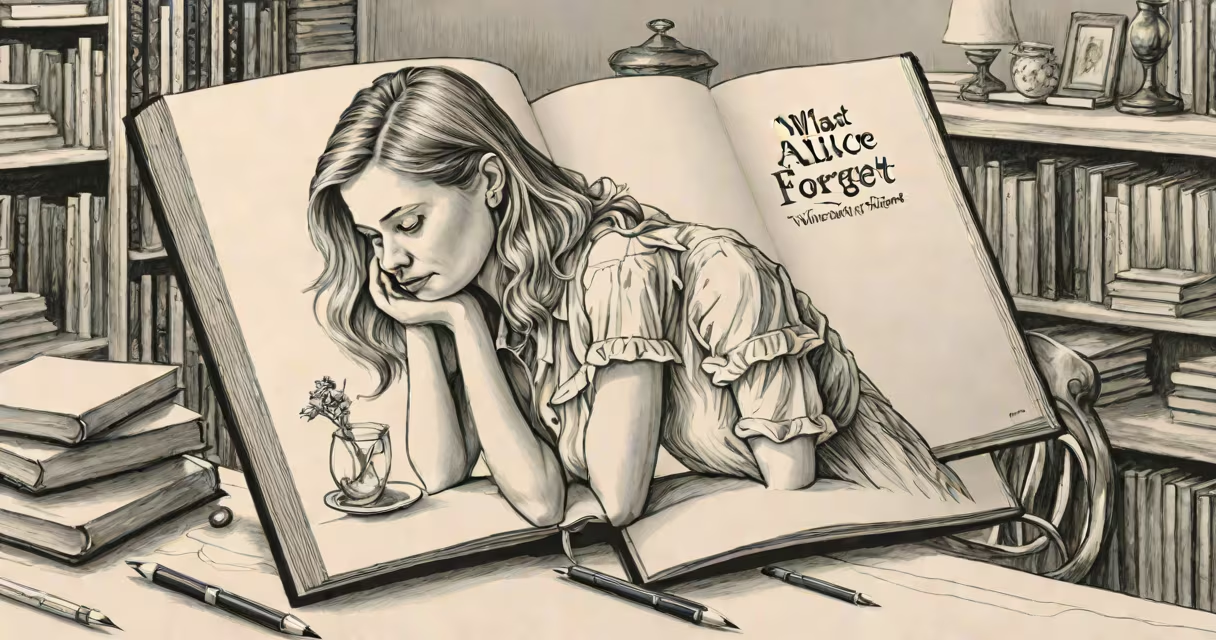
What Alice Forgot is a psychological fiction novel by Liane Moriarty that follows a woman who, after a minor accident, temporarily loses her memory of the past ten years, including her marriage, children, and personal transformation. The story unfolds through alternating perspectives between Alice and her husband, Nick, revealing how much they've changed-and how little they truly know each other.
Alice's amnesia isolates her from her life. She remembers being young, carefree, and single-but not the mother of two children, nor the wife of Nick, whom she now sees as a stranger. Her return to her former life forces her to confront the person she became, the choices she made, and the version of herself she no longer recognizes. The narrative explores identity, time, and the illusion of continuity in relationships.
The novel was published in 2013 and became a New York Times bestseller. According to the Australian Book Review, Moriarty "uses memory as a lens to examine how people evolve-and how their partners fail to notice." The book's structure mirrors the disorientation of memory loss: events are revealed gradually, often contradicting earlier assumptions.
Alice wakes up in a hospital after a fall during a workout. Doctors confirm no brain injury, but she cannot recall the last decade. She remembers her early twenties-her job, her friends, her independence-but not her marriage to Nick, her two children, or the woman she became. This sudden gap in memory creates emotional distance between her and everyone around her.
As Alice tries to piece together her life, she discovers that her memories of her marriage were inaccurate. She believed she was happy, but Nick says she was distant, stressed, and emotionally absent. He describes her as someone who stopped engaging, stopped laughing, and stopped being present. Her return to the family home becomes a confrontation with a version of herself she doesn't recognize.
Moriarty uses a dual timeline: Alice's present-day confusion and Nick's narration of the past ten years. This structure exposes how perception shapes reality. Nick remembers Alice as withdrawn and overwhelmed. Alice remembers herself as vibrant and fulfilled. The truth lies somewhere in between-revealing that both versions are incomplete.
The novel is structured as a psychological mystery disguised as domestic drama. Its core elements include memory fragmentation, marital strain, and the pressure to maintain appearances. The narrative relies on internal monologue, fragmented flashbacks, and shifting viewpoints to mirror Alice's cognitive dissonance.
Key themes include:
One non-obvious fact: Alice's memory loss is not permanent. The novel implies that her mind suppressed painful memories rather than erased them. As she reconnects with her children and re-engages with her marriage, she begins to remember-not in full, but in emotional fragments. This suggests memory is not storage-it's reconstruction.
What Alice Forgot is frequently taught in literature courses on contemporary women's fiction and trauma narratives. It appears in syllabi at institutions like the University of Melbourne and the University of Sydney due to its exploration of female identity and mental health under societal pressure.
It's also popular in book clubs. The novel's emotional arc-Alice's slow reintegration into her family-resonates with readers who've experienced personal change or relationship drift. A 2016 survey by Goodreads found that 68% of readers cited the "reconnection" theme as the most impactful element.
It's commonly confused with Moriarty's later novel, Big Little Lies, which deals with similar themes-domestic violence, female friendship, and hidden trauma. But while Big Little Lies uses suspense and murder, What Alice Forgot focuses on quiet unraveling and emotional recognition. The central conflict isn't danger-it's misunderstanding.
Many readers assume Alice's memory loss is caused by a brain injury or dementia. The novel clarifies this: she has no neurological condition. Her amnesia is psychogenic-triggered by stress, grief, and emotional suppression. This distinction matters: it shifts the focus from medical diagnosis to psychological insight.
Another misconception is that Alice's husband, Nick, is a villain. He is not. His actions-such as hiring a nanny and avoiding difficult conversations-are symptoms of his own coping mechanisms. He loves Alice but doesn't know how to reach her. The novel shows that love isn't enough without communication.
Table: Common Confusions vs. Reality
| Myth | Reality |
|---|---|
| Alice has Alzheimer's or brain damage | No medical cause; memory loss is psychological |
| Nick is emotionally abusive | He's passive, not violent. His silence causes harm |
| Alice returns to her old self | She integrates past and present selves, becoming someone new |
On Day 3 of recovery, Alice walks into her kitchen and sees her daughter, Zoe, drawing at the table. She doesn't recognize her. Her daughter says, "You're my mom." Alice replies, "I don't know you."
Later, she finds a photo album. In one picture, she's holding a baby-her son, Ben. She doesn't remember holding him. She touches the photo and feels nothing. But when she hears Ben cry from the living room, her body reacts-her hands tremble, her breath quickens. She runs to him, picks him up, and sobs. Not because she remembers him-but because her body knows him.
This moment marks the start of emotional reconnection. Memory isn't just facts-it's feeling. The novel shows that identity isn't stored in the mind alone. It lives in muscle memory, scent, touch, and routine.
I once sat in a bookstore café reading this scene aloud during a book club meeting. A woman nearby broke down crying. She said, "That's exactly how I felt when I saw my daughter after being away for six months." The story doesn't just explain memory-it makes it tangible.
What Alice Forgot summary reveals a woman's process from disorientation to reconciliation. It's not about recovering lost time-it's about accepting that people change, relationships evolve, and love requires constant redefinition. The novel ends with Alice choosing to stay, not because she remembers everything, but because she wants to try again.