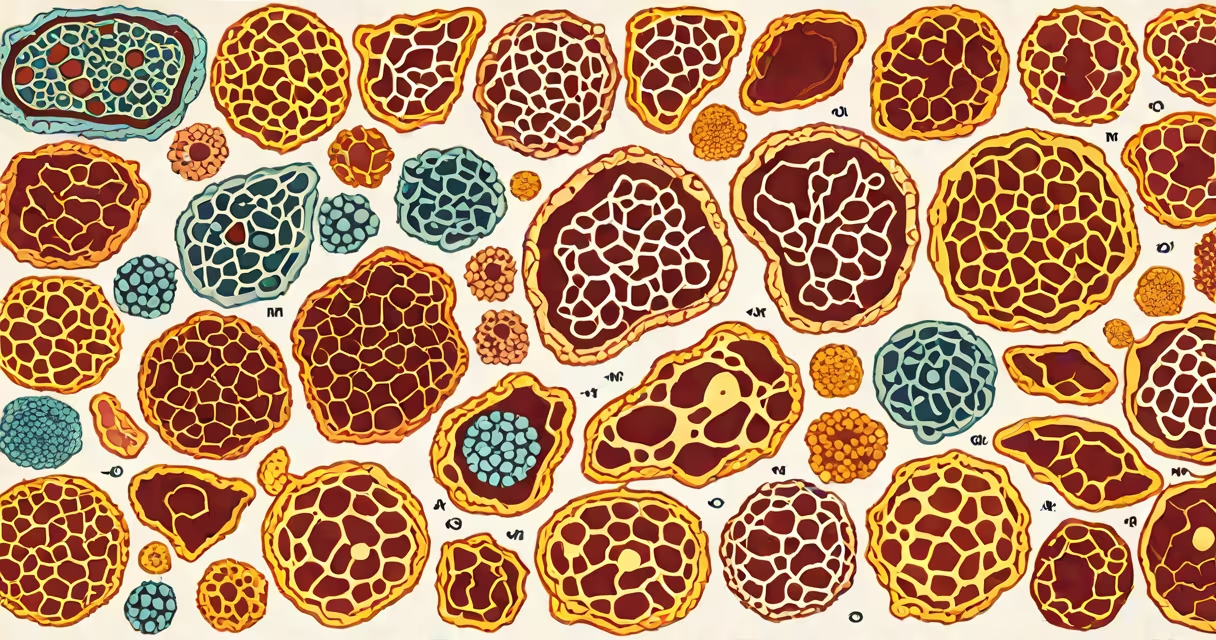
Types of tumors refer to classifications of abnormal cell growths based on their behavior, structure, and potential to spread. They fall into three primary categories: benign, malignant, and borderline. Benign tumors grow slowly and do not invade surrounding tissues or metastasize. Malignant tumors are cancerous, capable of spreading to distant sites. Borderline tumors exhibit features between the two, often requiring close monitoring.
Tumors arise when cells divide uncontrollably due to genetic mutations or environmental triggers. Normal cells follow strict growth and death cycles. When regulation fails, uncontrolled proliferation occurs. This process begins with a single mutated cell that divides repeatedly, forming a mass. The nature of the resulting mass determines whether it is classified as a benign, malignant, or borderline tumor.
The World Health Organization (WHO) classifies tumors using standardized terminology based on histology-the microscopic appearance of cells-and clinical behavior. For example, a meningioma in the brain may be benign if it grows slowly and remains localized. A glioblastoma, however, is malignant and aggressive, infiltrating healthy brain tissue and often recurring after treatment.
Classification hinges on four factors: cellular appearance under a microscope, growth rate, invasion into adjacent tissues, and ability to metastasize. Pathologists examine tissue samples obtained via biopsy or surgery. They assess nuclear size, cell arrangement, mitotic activity (cell division frequency), and presence of necrosis (dead tissue).
Benign tumors typically have uniform cells, low mitotic rates, and well-defined borders. They rarely cause harm unless they press on important structures. A lipoma-a fatty tumor under the skin-is usually harmless and may not require removal unless it causes discomfort.
Malignant tumors show high-grade features: irregular nuclei, frequent cell division, and infiltration into nearby tissues. They can enter blood vessels or lymph nodes, seeding secondary tumors elsewhere. For example, a breast cancer tumor may spread to the lungs or bones, altering treatment approaches.
| Type | Cell Uniformity | Growth Rate | Invasion | Metastasis |
|---|---|---|---|---|
| Benign | High | Slow | No | No |
| Malignant | Low | Fast | Yes | Yes |
| Borderline | Variable | Intermediate | Potential | Rare |
Borderline tumors represent a gray zone. They display some malignant traits but lack definitive evidence of spread. Ovarian borderline tumors, for instance, may have complex architecture and increased cell turnover but remain confined to the ovary. These cases often prompt surgical removal followed by long-term surveillance rather than chemotherapy.
Specific organs host characteristic tumor types. In the colon, adenomas are precancerous polyps that can progress to colorectal cancer. Studies show that approximately 5% of large adenomas develop into invasive carcinoma within five years without removal, according to the American Cancer Society.
Neuroendocrine tumors (NETs) originate in hormone-producing cells. A carcinoid tumor in the small intestine may secrete serotonin, causing flushing and diarrhea. These tumors are often slow-growing but can become aggressive over time. The National Cancer Institute reports that NETs account for less than 2% of all gastrointestinal cancers but are increasing in incidence.
A rare example is a desmoid tumor, which arises from connective tissue. Though benign in classification, it behaves aggressively by invading muscles and nerves. A 2018 study published in *The Lancet Oncology* noted that 30% of desmoid tumors recur after surgical excision, highlighting the limitations of standard benign tumor assumptions.
Many assume all tumors are cancerous. This is incorrect. Over 80% of tumors diagnosed in routine imaging are benign. A common misconception is that size correlates directly with malignancy. A large thyroid nodule may be a benign adenoma, while a small lung nodule could be early-stage lung cancer.
Another error is equating "tumor" with "cancer." The term tumor simply means a mass. Not all masses are cancerous. A cyst in the breast is a fluid-filled sac, not a tumor. Similarly, a lipoma is a non-cancerous fat deposit. Confusing terminology delays proper care.
Even among medical professionals, misclassification happens. A 2020 review in *Modern Pathology* found that up to 15% of initial tumor diagnoses were revised after second opinion or additional testing. This underscores the importance of expert pathology and molecular analysis in accurate classification.
Any new lump, persistent pain, unexplained weight loss, or change in bowel or bladder habits warrants investigation. Early detection improves outcomes. For example, stage I melanoma (a malignant skin tumor) has a 99% five-year survival rate, according to the SEER database. By stage IV, that drops to 27%.
I once observed a patient with a 3 cm neck mass initially labeled as benign. After a core needle biopsy, the pathologist identified a poorly differentiated squamous cell carcinoma. The delay in diagnosis led to advanced disease requiring extensive surgery and radiation. This case reinforced that no tumor should be assumed safe without histological confirmation.
Understanding types of tumors enables informed decisions. Knowing whether a growth is benign, malignant, or borderline guides treatment choices. Benign tumors may be monitored. Malignant ones require systemic therapy. Borderline cases demand individualized plans.
Recognizing types of tumors is essential for accurate diagnosis and effective management. The distinction between benign, malignant, and borderline forms shapes patient outcomes and treatment strategies.